Operation 3am
Journeys on planes are only as good as the seat you get.
My first leg – a Turkish Airlines flight from Madrid to Istanbul – was an exercise in endurance not seen since Shackleton attempted to cross Antarctica.
I checked-in online for my 11:55 flight, and was rewarded with a random seat at the back of the plane, a position incompatible with needing to cross the world’s third largest airport terminal building in record time to make my very tight connection, essential if I wanted to get to bed by 3am.
I explained this to the check-in agent at Madrid – we’d arrive in Istanbul at 18:15 local time, and my connecting flight to Tashkent left at 19:15, and so he, with a friendly smile, offered me the front row against the bulkhead, “it has extra legroom,” he said, “but it’s a middle seat” … and I smiled and thanked him: front row, extra legroom … it felt like things were going my way …
Things were not going my way.
The seat was as narrow as all airline seats are, and whatever advantages there are for men in this world in terms of the patriarchy and whatnot, it is cancelled out as soon as they get on a plane because airline seats are not designed for anyone bigger than the slenderest of waifs.
I am not a slender waif.
I’m in decent shape for a man in his fifties, but I am a man in his fifties and I have surprisingly broad shoulders that I wish women would notice more because they’re a good feature – except when you get on a plane in Economy class, and especially not when seated between two other men. My clothing size is XL (because of those shoulders we were discussing, I’m not fat), the man on my left was probably of similar build (a bit narrower in the shoulder, so let’s say an L), but the man to my right would need to add a few Xs to his clothing order – and not because of his shoulders.
That’s an uncomfortable premise to start with, but manageable with skill and cooperation. Unfortunately however, my neighbours – who may have been nice men in real life – were less nice when it came to elbow control, and the frequency by which their wayward extremities would cross the seat border into my territory was astonishing. I kept having to strategically knock them accidentally-on-purpose and then apologise as if it were my mistake.
Then my TV didn’t work.
It took me a while to work out how to release the damned thing from its position under the seat. Front row seats don’t just get a screen in the back of the seat in front, they are on the end of an arm that flips down beneath the seat, and by the time I’d worked out how to release it, applying super-human strength in the process, the cabin crew were already well into the meal service and so couldn’t help me when I explained that the screen kept drifting limply back down under the seat.
So I read my book, On the Beach by Nevil Shute. I had wanted something a bit romantic, but from the male perspective, but there’s not a lot of that about, male literature seems to focus mostly on killing and helicopters and stuff, and whatever male protagonists there are, they tend to be brooding with inner pain and super macho, and I identify more as a misunderstood bookish introverted socially-awkward nerd – this trope features less in romance literature than you might think .
I’d enjoyed Nevil Shute’s A Town Like Alice many years ago, and so was disappointed to find myself a bit bored with On the Beach’s plodding pace and domestic focus, despite the post-apocalyptic setting after a nuclear war that had left a deadly radioactive cloud slowly drifting down from the northern hemisphere, giving the people in our story only months to live.
This should have made any book exciting, yet it felt like reading the most mundane of soap opera scripts. I found out later it had been written as a series to be released in four parts, and this episodic approach shows as the story meanders and the up-and-down pace makes it hard to engage with.
Not that I’m one to talk.
I once wrote a novel about an impeached President in an imaginary UK that had become a republic. He accidentally starts five separate wars whilst getting re-elected and dealing with the collapse of his marriage and it still read like nothing was going on – I might re-write it one day, because I still think it has promise.
The problem is that it’s not easy to write compelling fiction.
Any writer with a decent bit of craft can write a blog post about a flight to Tashkent, it takes the rare skill of an artist to make you care about characters and a story they just made up – and that’s where I just don’t have the chops. I can write a sentence, I just can’t make you care about what happens next.
I tried the TV again, but no luck. I maneuvered it into its erect position, but it soon drooped back down again and I gave up. I didn’t really want to watch anything anyway, so I got up and paced the galley area, and got chatting to the lovely cabin crew woman whose charismatic expressive face was enchanting. I am accustomed to cabin crew being tired and busy, and treating passengers with courtesy rather than friendliness, and so it was a little intoxicating to find my cautious chitchat received with interest and warmth. I took advantage and explained about my tight Tashkent connection – just an hour between landing and take-off – and the importance of making it if I stood any chance at all of getting to bed by 3am that night.
She raised her lovely eyebrows and said brightly that she was also going to Tashkent the following day, “maybe we’ll see each other!” she said, and leaned in close as we discussed which hotel the cabin crew used.
“I have an instinct we will meet again,” she said smiling.
I smiled back, and because she had seemed so enthusiastic, and because I am a ridiculous man, I started to wonder if was she coming on to me.
On paper that looked very unlikely. She was a young attractive woman in a job that would naturally attract all sorts of male attention. Me, well, let’s just focus on the positive and say I look quite good for my age (in my opinion) but I am still my age, and a passenger on a plane talking to a member of staff decades younger … and I’m in Economy, so I’m obviously neither rich enough, nor important enough, to get Business Class travel … perhaps these broad shoulders were having the desired effect after all?
“Maybe I’ll see you at the hotel breakfast on Tuesday!” she said.
“That would be nice!” I said, wanting to come across as friendly but not at all creepy.
To avoid me making a complete fool of myself, I went back to my seat and got my book out again, hoping she was attracted to middle-aged misunderstood bookish introverted socially-awkward nerdy types.
We landed in Istanbul, and I gently eased my way to the galley area where us Economy passengers were being held back while our Business Class fellow travellers slowly disembarked. I didn’t see the lovely cabin crew woman from earlier, so asked the other – the one holding us back – if I might be allowed to get off anyway, explaining the importance of my rapid egress given my very short connection time and my 3am bedtime target, and she smiled and continued to block my path, utterly disinterested in my plight.
We had landed on time, but the airport is huge, and taxiing to the gate takes an age, but the connection remained possible. I only had hand luggage because I wanted to avoid the time-consuming problems associated with checked baggage, especially given the short connection time. Even if I made it, my suitcase probably wouldn’t, so I’d be in Tashkent airport filling out forms at 3am instead of tucked up in bed in my pyjamas – pyjamas that would, in that scenario, still be sitting in Istanbul.
I needed to get to Gate E3, and from what I could tell through the misty plane window from my middle seat, we had docked at B-something, one of the lengthy piers at the opposite end of the terminal to the E gates … this was going to be tight … very tight.
I was eventually released and set off with a quick pace, following signs to “International Connections”, dodging and weaving between passengers, marching purposefully down travelators, huffing and puffing up escalators, jogging inelegantly through the busy terminal, keeping eyes fixed on the signs for the E gates to ensure no wrong turns … that 3am bedtime depended on it … avoiding distractions … except hang on … there’s a bookshop … no, come on … E gates … where are they?
I checked the screens and my flight was “boarding” … at least it wasn’t “last call” … so I pushed on, my left leg now hurting as I continued my wobbly progress through the crowds of extras wandering slowly across my path.
I arrived just in time, conscious I was sweating and probably looked like Worzel Gummidge having a bad hair day. I showed my passport and boarding card, and – reluctantly handing over my hand luggage to be checked in on this busy flight (a potential banana skin for that 3am target) – I got on.
I had made it! Luggage collection permitting, the 3am bedtime was still viable. If I could make that (11pm for me), then get up around 9am local time (which would feel like 5am to me, after 6 hours in bed), I had a fair chance of getting the jet lag more or less sorted, and getting myself in good shape for three long days of work.
My life used to be centered on creating opportunities to party, or to maximize my food and beer consumption; these days my entire life is structured around getting a good night’s sleep.
I had a window seat, and the other two seats were occupied, so it was a bit of a squash but at least I could lean to my left and look out the window. It was getting dark already, and we were flying toward the oncoming evening, but we would be passing over central Asia, not just a bunch of sea, so there might be something to look at.
My second Turkish Airlines flight of the day backed away from the gate on time, and sat for a few minutes on the tarmac before taxiing to the runway and taking off.
The girl next to me was French, she introduced herself as Amelie. She worked in Tashkent, something to do with water purification projects, and after admitting I was a little nervous having never been to anywhere in Central Asia before (and having fumbled a little ineptly with the inflight entertainment) she adopted me as a surrogate father figure. She knew the city well having worked there for a couple of years, and had also used Tashkent as a base to explore a fair bit of central Asia, including the beautiful Issyk Kul and Song-Kul lakes in Kyrgyzstan.
“You’d like it,” she explained, “I took my parents and they loved it.”
This was when I realized I had been put in the “parent” category.
The northern side of Issyk Kul, she explained, moving the route map with her index finger and zooming in, was over-developed in ugly Soviet-era style, but the southern shore was wild and much nicer. It is odd how we humans develop beautiful places in ugly ways that no-one actually likes. Most parts of most cities in most of the world are mostly not very nice – they might not be horrible exactly, but they are constructed around the needs of the developer to turn bricks and mortar into dollars and cents, rather than the needs of the human beings who will live and work there – I understand economics, but it still seems like the wrong focus to me.
We descended from humans who were driven to maximize their own short-term wellbeing over all other factors, because when you live in a tribe on the savanna, that’s the best strategy for survival. Problem is, those same short-term survival traits don’t scale up to the size of today’s societies, and what helped us and our tribes survive the scarcity and dangers of the savanna, now lead to selfish short-term decisions that accumulate into dysfunctional societies.
This might mean voting for tax cuts today even though we know this will lead to worse public services tomorrow, services we will depend on, or denying climate change to ensure we can keep pumping oil to maximize our short-term profits … or, on a smaller scale, idiot middle-aged men on business trips risking financial and marital ruin for the sake of a sexual encounter with a stranger …
… hang on, that didn’t happen, it was just an example … an example of how we pursue fleeting short-term satisfaction – be it sex, alcohol, cigarettes, cake or whatever – that have bad long-term consequences … consequences we were fully aware of at the time!
Daniel Kahneman talks about this, and uses the metaphor of us having two selves, the “experiencing self” and the “remembering self” (from his book Thinking Fast and Slow).
The “experiencing self” lives in the present, responds to stimuli and wants its short-term itches scratched. This is the devil on our shoulder, the one the political populists mostly talk to. It’s this experiencing self that has the extra slice of cake, one more beer, the one who can’t be bothered to go to the gym …
It’s the sensible “remembering self”, who looks back from their vantage point of the future, remembering what we did, joining up these memories to something we call an “identity”.
As Gurwinder Bhogal put it:
Somewhere in the future, your older self is watching you through memories. Whether it’s with regret or nostalgia depends on what you do now
Humans are capable of a lot of very short-sighted silliness that means our future selves often watch us with regret.
Pretty much the entire global economy is based on it.
The premise in my On the Beach book is based on human’s managing to destroy the entire planet because of their ridiculous short-sighted decisions. All-out nuclear war that assures mutual destruction is not great long-term thinking, but with certain death drifting slowly closer to Melbourne (the setting of the novel), humans show their other side, their stoic ability to just get on with things with good humour, despite circumstances way short of ideal.
As we approached Tashkent I looked up from my book about deadly toxic clouds of radiation as Amelie began to tell me about the deadly toxic cloud of pollution in the Uzbek capital, the AQI (Air Quality Index) she explained using the AirVisual app, often soared into the dangerous category …
I could smell it even in the airport terminal.
Tashkent is a big city, well over 3 million people, and it seemed like every one of them was burning a pile of tyres.

I got through immigration (Amelie kindly waited behind in case I had any problems) and waited for the luggage I’d been forced to check in, the clock now ticking dangerously close to 3am. My case arrived quickly and Amelie said I needn’t wait with her and her luggage, so I gave her a hug which appeared to horrify her … I suspect she thought my daft experiencing self was having a go, lunging in – something women need to be constantly on guard for – but I wasn’t. I might be a man with my unhelpful evolutionary drivers still fully functional, but I am a civilized person who tries to treat people with respect and kindness … but I’m also not very socially adept, and sometimes misread situations, and maybe my desire to show more warmth and appreciation for her kindness than a handshake or a tip of the hat could demonstrate, was a bit over the top, and so I thanked her with a little bow and headed for my taxi.
I got to the hotel at 3:05am and stood in the queue to check in.
“Welcome to the hotel …” he said, as I eventually got to the front of the line, “We have breakfast here, restaurant there …” I nodded along, thinking how little I cared at that moment, “a gym over there, a shop …” I was practically jiggling on the spot with impatience … “and would you like to join our rewards club thingy?” (I paraphrase) and I said, “not right now, it’s 3:15am, I just want to go to bed”
I got my key, went up to my room and flopped into bed. It was 3:20.
Operation 20,000 steps
I was going to have to be tired if I wanted to get to sleep at 7pm that night – it would be 11pm in Tashkent but my body clock wouldn’t know that.
I needed to do some exercise.
I headed out my hotel. working from memory because I had no data on my phone and never thought of getting a paper map. I walked to Amir Temur Square to see the monument and the old Hotel Uzbekistan. I got slightly lost on the way, misunderstanding the grid of streets, thinking I was facing south when I was facing west.
That is the problem when you get cocky with your sense of direction skills.
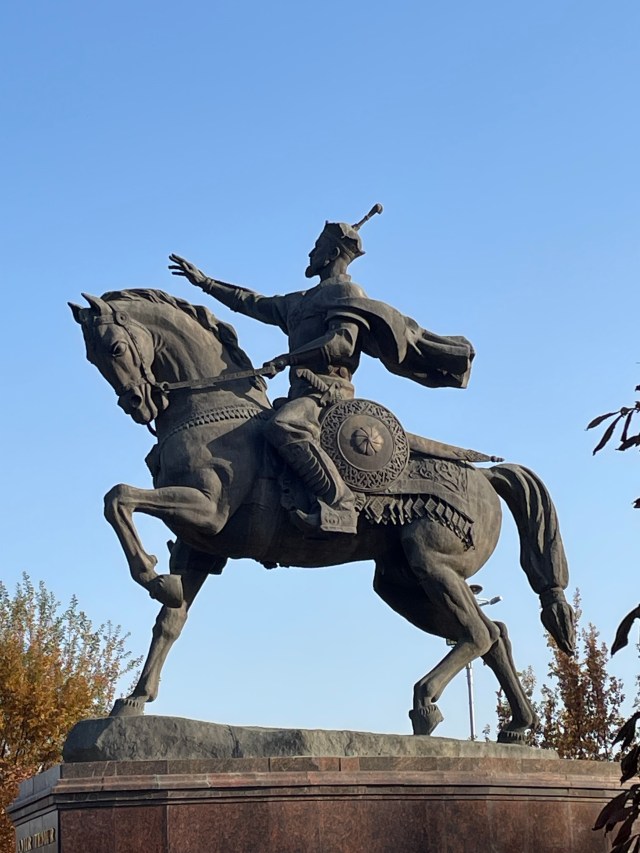
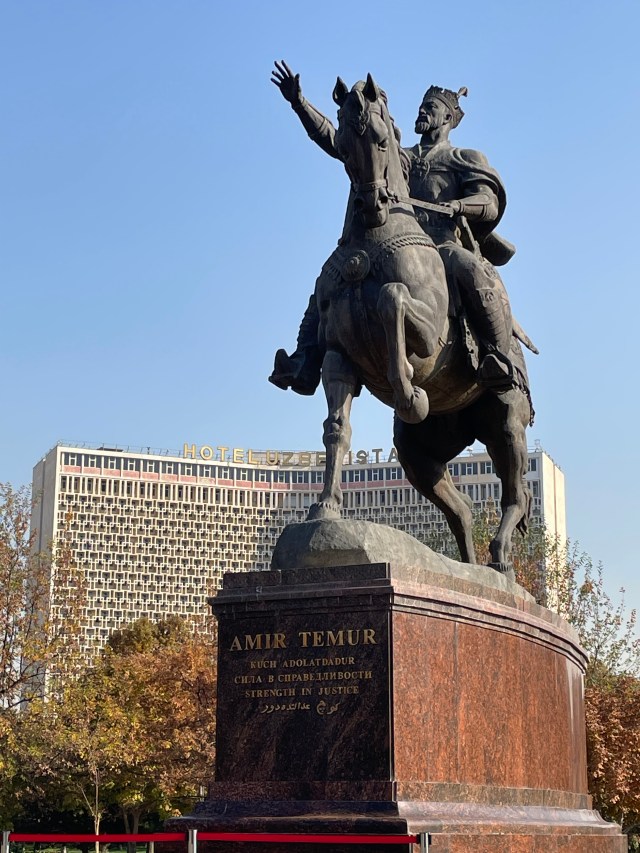
Amir Temur was a Turco-Mongol warlord who founded the Timurid Empire that covered large sections of Persia, Central Asia and the Caucasus back in the middle ages, but as it was centred on the Uzbek city of Samarkand, Temur is regarded as a founding father of the Uzbek nation. He shared ancestry with Genghis Khan, and by all accounts was similarly successful and similarly cruel.
I don’t know much about him, but from what I can tell he seemed typical of warlords of that era in that his life was not focussed on getting a good night’s sleep in the way mine is, it was more about amassing the largest possible amount of power and treasure – not so dissimilar from many of today’s billionaires, although his methods differed.
Tashkent was badly damaged in an earthquake in 1966 with much of its old town destroyed. The new Tashkent was designed as a model city, and as I walked up to the main road near the top of the square, I could see how they’d created wide streets and open squares, tree-lined roads and large spaces and parks in an attempt to create a city suited to human habitation.
The thing is, the beauty of the built environment is not in its sensible conformity or its spacious consistency, it’s in its quirks and complications. The beauty is in the unexpected shady little square, the crooked alley and the sheer variety, even in a single street. Very few cities designed from the top-down are beautiful, even if they are practical and livable, because beautiful cities grow from the ground up.
I headed toward Chorsu Bazaar, about an hour’s walk away.
I went back to the hotel first. I had dressed for freezing temperatures, thinking late November on the Asian steppe, deep in the middle of the Silk Road, would be something like Siberia. It wasn’t. Tashkent was warm and humid, at least in the sun, and I was dripping with sweat.
I got changed and set off again.
I didn’t have many ideas for novels to buy, the most obvious Uzbek writer Hamid Ismailov was unwelcome in his home nation these days and I doubted I’d be able to find his books. I thought I’d find a bookshop and have a look and then decide, on my travels I rarely found the exact books I wanted and often had to improvise. It’s surprising how few countries promote their native authors in English (they’re available on Amazon, so the translations do exist).
As far as my music exploration went, I had found a local band I liked (Крылья Оригами – or Origami Wings), and in a new idea, I had decided to sometimes pick a football team where it felt right to do so, and in this case had made the decision to support Lokomotiv Tashkent.
I don’t always pick a football team, it depends on what clicks emotionally – deciding on a team is not an intellectual process, it’s like a relationship, it’s instinctive – there’s chemistry or there isn’t, the relationship with the club goes beyond the sport or the players, it becomes – like any other emotional attachment – something deeper. This means it’s not easy to just decide, willy-nilly, to become a fan of a club in another country.
Anyway … I crossed the fast-moving River Chirchiq, flowing south toward its confluence with the Syr Darya (Asia’s 23rd longest river at 2,212 kms), a river that only briefly cuts across Uzbekistan on its way north to what remains of the Aral Sea – no rivers in double-landlocked Uzbekistan make it to the sea proper, they are mostly just soaked up by irrigation these days.
I once knew someone who thought all rivers flowed south.
I was probably a little too sarcastic in my scornful response, and have since learnt not to be so unkind to other people’s stupidity – we all have our areas of stupidity, my own is a constant source of amusement, but I thought the idea of all rivers flowing south was particularly daft – he was, after all, a grown adult, with – I assume, but have no evidence of – an education.
Anyway, I never found the bookshop I was looking for, but did find two others, although neither stocked novels by Uzbek authors in English. I also never found anywhere to buy music, but I did find the sports shops, although neither sold merch from their local teams, so no Lokomitiv t-shirt for me.
I also didn’t find Chorsu Bazaar.
I got as far as the circus and sat down for a rest. The pollution was getting to me and my eyes were stinging and I was starting to wonder if I had passed it – it wasn’t exactly on this main road, but set back from it, and perhaps I had missed it. I sat and watched a few large crows peck at the ground, looking for insects, and thought how much of their life was just about getting enough food so they could lay enough eggs to have enough chicks so those chicks could go through the same cycle.
If crows evolved sufficient intelligence to escape that routine, as our ancestors did on our behalf, what would their lives be like?
The fact that they pair up, rather than exist in gregarious tribes that depend on communication, means their society would be quite different from ours – no throwing up ugly crappy buildings on beautiful lake shores in Crow world, no climate change denial to maximize oil industry profits, they’d likely be sorting the world out in sensible monogamous relationships, and criticizing each other’s nests.
Although perhaps there would be no evolutionary drive to favour intelligence in the first place given their lifestyle doesn’t demand complex social interaction and communication.
Sorry crows, looks like you’re stuck scratching for grubs in our polluted cities.
Perhaps the very drivers of evolution, something that rewards intelligence in individuals living in groups, simply cannot scale up without the negative consequences – the only animals capable of evolving are therefore necessarily unsuited to do so.
That’s a depressing paradox, I thought, and decided to head back to my hotel, my need to crawl back into the comfort of my own nest was now greater than my need for adventure and souvenirs. The lengthy flights, short night’s sleep and long walk in the heavy air was all getting to me and I turned back.
By the time I got to bed at 11pm (7pm for me), I’d done 18,780 steps – just short of my 20,000 target – with the help of a cup of sleepy tea, a paracetamol and a melatonin gummy thing, I slept quite well.

Operation Actually Do Something
That hotel room was just too comfortable.
It’s been a long and difficult year, with restructures at work and bereavement at home, both, in different ways, leading to increases in stress and workload. The couple of weeks of rest I have planned for December are approaching as slowly and as inevitably as the radioactive cloud in the tiresome noveI I am plodding through. I tend to take my mental health for granted and assume I’m fine, but I have noticed some fraying at the edges more recently, and so at the end of each long and intense day at work, I unplugged from the world, ordered room service and hibernated.
This meant I barely saw the city until my last evening.
According to the map I had only been one block short of Chorsu Bazaar the other day, and so with little time to spare before the markets closed, I jumped in a taxi.
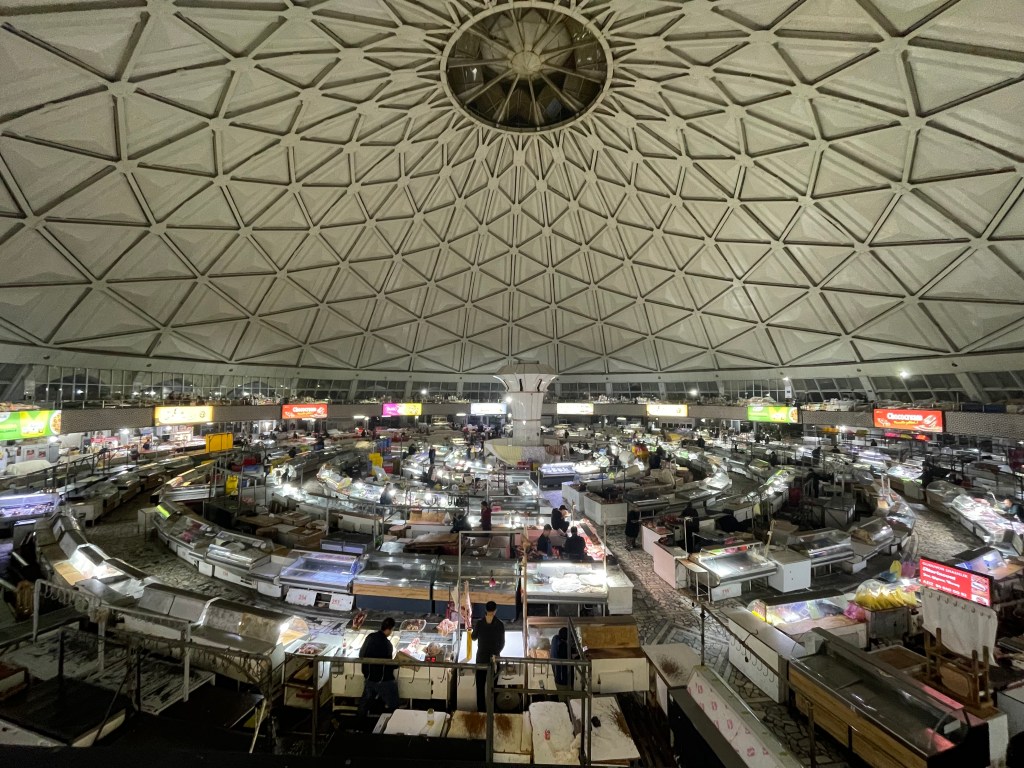
I am not an intrepid traveller any more, and sometimes I feel overwhelmed and full of doubt, and then I dither about, not sure what to do with myself. I felt like this as I first entered the bazaar area and wandered the stalls surrounding the main domed building. It was already dark and many were closing, and I indecisively pawed through some scarves – some silk, some a mix of cotton and silk – before moving on to see what other stalls offered, but I couldn’t find what I wanted and the original place where I’d dithered indecisively had lowered its shutters. I wandered to a place selling ceramics and bought a beautiful hand-painted plate and a fridge magnet. I regretted only having brought hand luggage because the ceramics and embroidered hangings were gorgeous … oh well, a plate and a magnet would have to do, and I headed up to the main market hall.
It was not what I expected.
The lower floor sold meat, the upper floors sold nuts, dried fruits and sweets, and the whole place stank like a butcher’s shop.
I walked around the lower floor, then up the stairs to the balcony, but I didn’t want to buy anything – I am well aware that, whatever my evolutionary urges might say, I do not need more food, and certainly not more sugar.
I left, not really sure what I was doing, and walked around some of the other stalls, many selling food including the national dish of plov. Plov translates as pilaf, as in rice, and the dish is similar to a rich oily meaty paella. Most travel writers would try the national dish, but having travelled for years, eaten countless local delicacies, I have concluded that food is overrated. Most of it is fine, some of it quite nice, but mostly it’s just food – I’d quite happily live off nutritious shakes and pills and the odd chunk of dark chocolate and not bother with food (although the baklava in the hotel was wonderful).
I walked back out into the street and along the road to look for the metro, passing the stunning Hoja Ahror Valiy Mosque. I took a few photos and continued my search for the metro, which turned out to be behind the bazaar. As someone used to London’s warrens of ancient tunnels or Madrid’s clean and functional system, Tashkent’s metro was a wonder, by far the most beautiful I have ever seen.

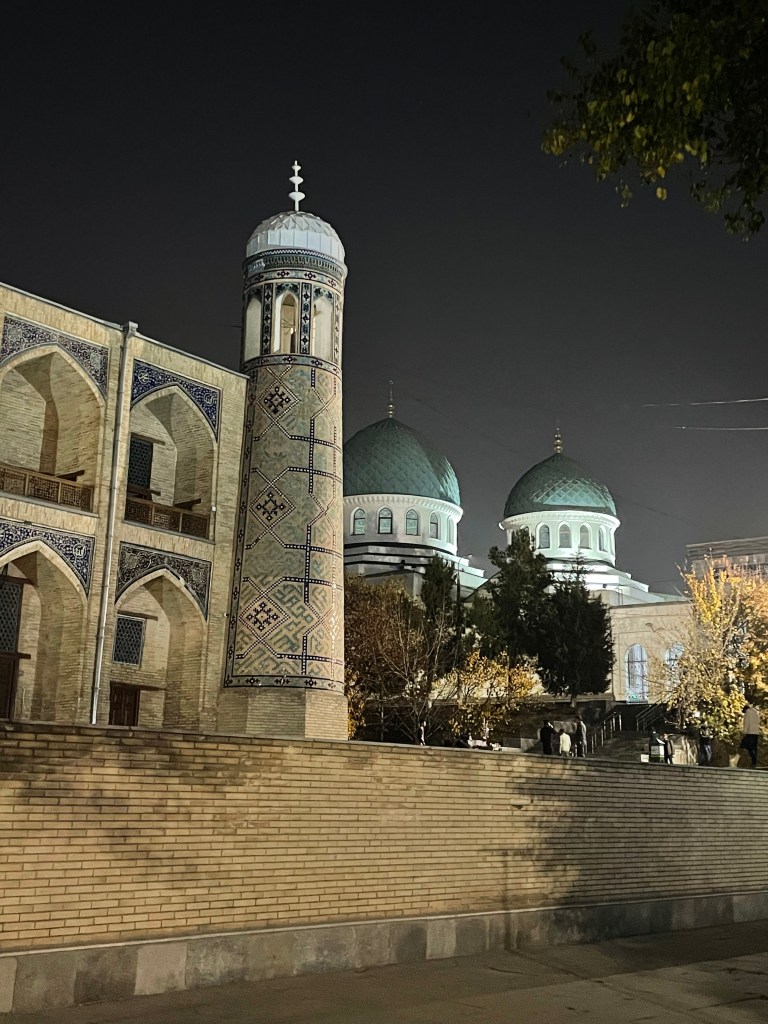

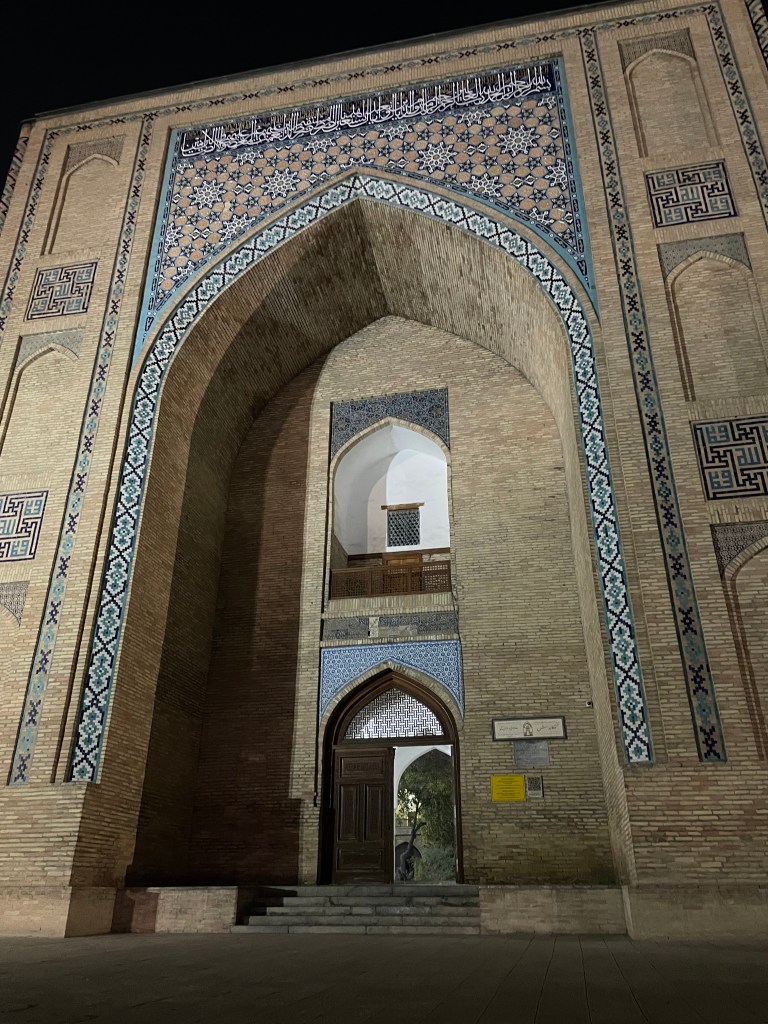
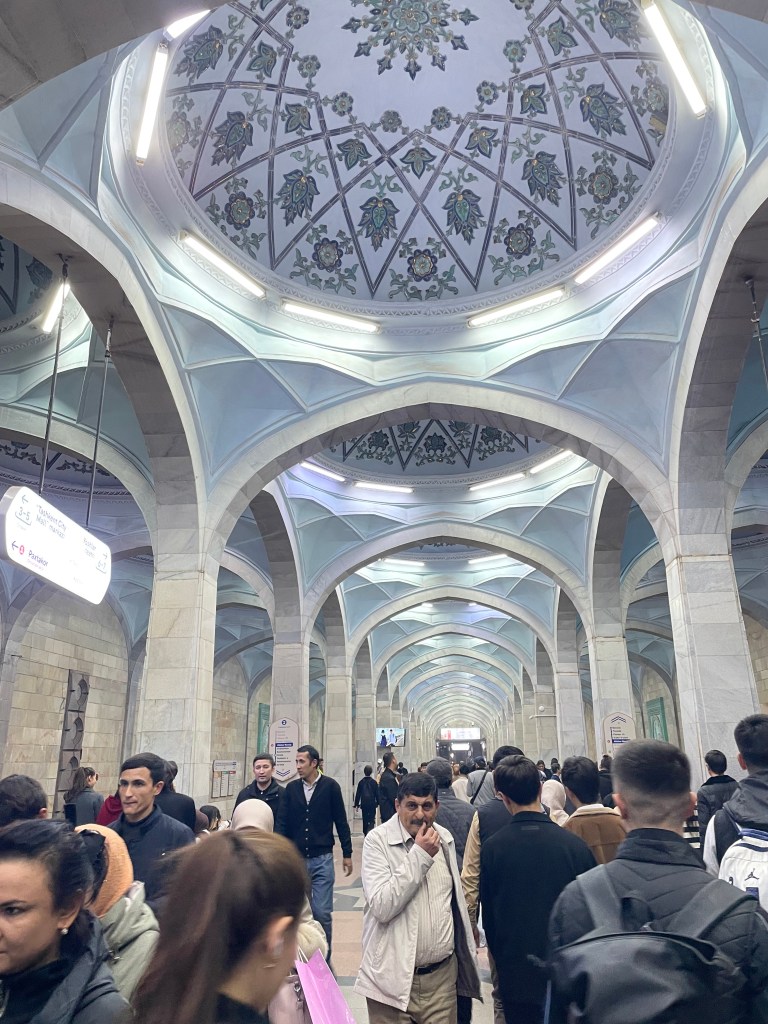
I had started this week a little nervous, unsure I even wanted to travel here, but left with a new fascination for Central Asia, and Uzbekistan in particular, and was keen to return.
It is an odd-shaped country, and borders tell you a lot about the geography of the land – straight lines mean people just had to make a decision about which bit of this flat land with no obvious geographical feature belonged to which country – the western border, a long straight line separating the steppe from Kazakhstan is one such example. The rest of the country is squiggly borders and exclaves, suggesting mountains and valleys, natural barriers that separate people, language and culture. Most of the country is on the same latitude, but running East to West it stretches over 1400kms – if it’s most Western point were Lisbon, it’s most Eastern would be somewhere near Milan.
I regretted having seen so little of the city, never mind the country or the wider region. I chatted a little with the taxi driver on the way to the airport, he asked me where I was from and when I said Leeds, he said “Ah, Leeds United!” then “we are Manchester City fans,” he explained, “because [Tashkent native] Khusanov plays for them” and I shrugged, it was a fair enough reason to support a team in another country. In Uzbekistan he supported Pakhator and I kept quiet that I had been a Lokomotiv fan for at least a fortnight.
The airport was breathtakingly expensive – my small coffee was $7 and duty free prices were like they hadn’t really understood the currency and had just guessed a random price. I read my book, On the Beach had become completely tedious, with lengthy sections on an unnecessary car race that added nothing to the story, and the plodding pace of the unconvincing love-story-that-wasn’t-a-love-story was unbearable – the book only came alive when they were on the submarine doing navy stuff, and I regretted not buying something that at least had a Silk Road theme – the toxic cloud link in this post is at best tenuous, although the noble self-control of Captain Dwight Towers to not succumb to boozy Moira Davidson’s charms because of his loyalty to his wife was nice – unnecessary seeing as the wife was almost certainly dead – but nice all the same.
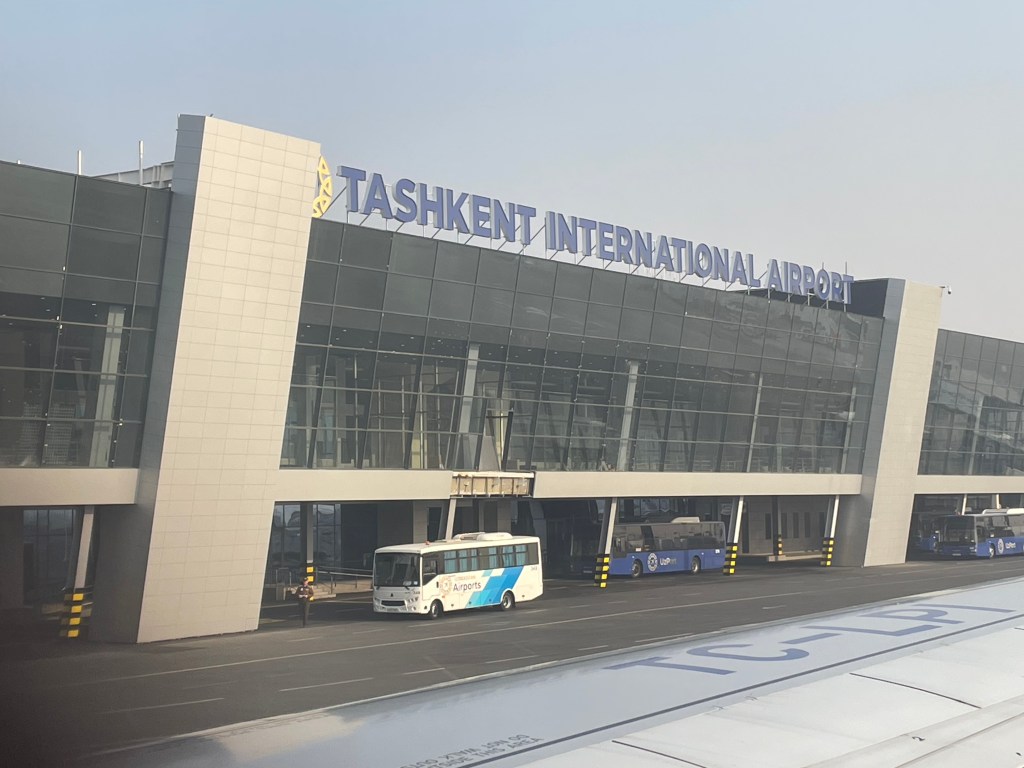
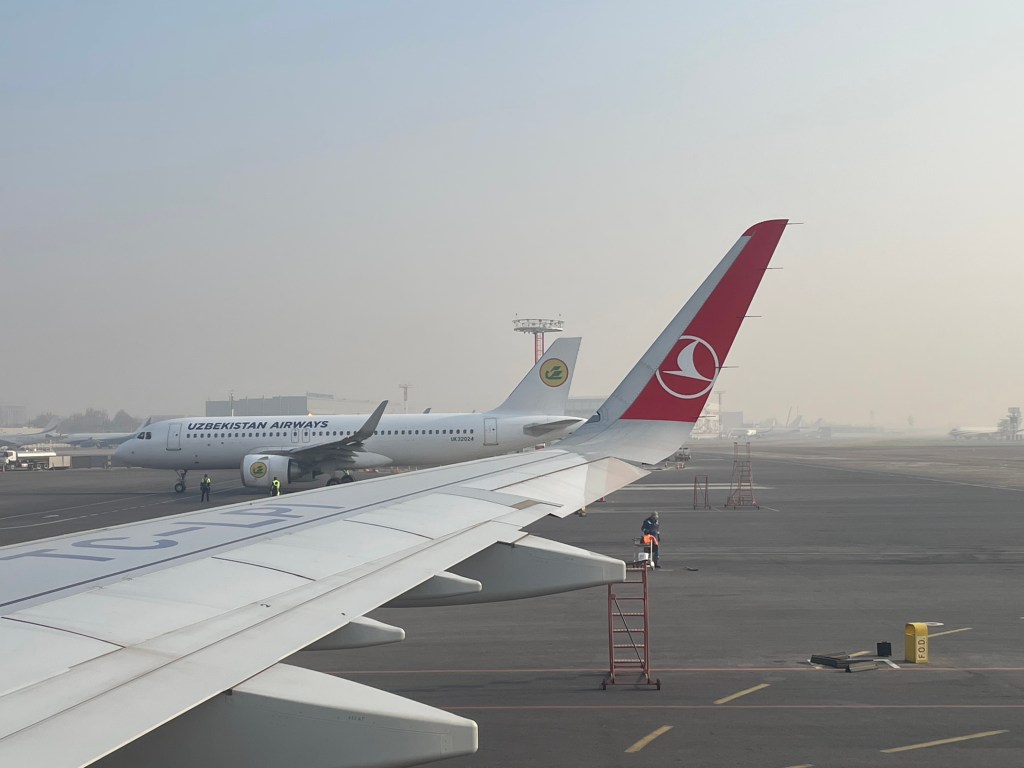
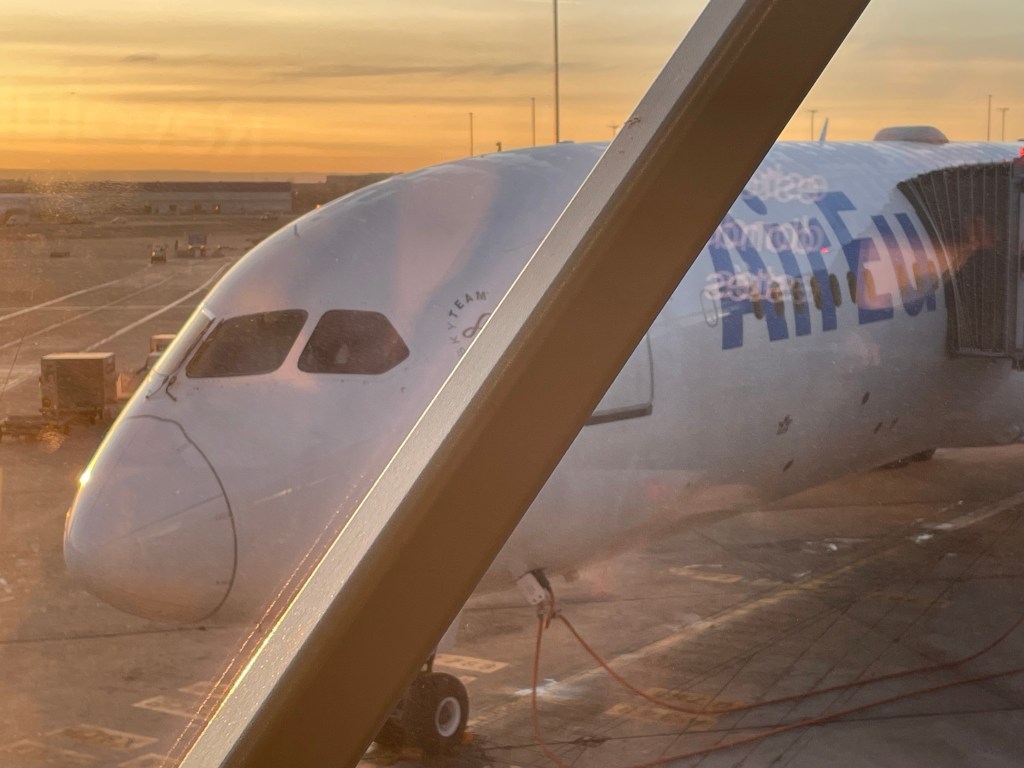
The flight back was longer because we were going west, into the wind, and my stopover in Istanbul was nearly four hours this time, and so, with a four-hour time zone shift to manage, there was plenty of time to finish my book. My hopes for some sort of interesting but satisfying twist at the end were dashed as the inevitable crept up upon them and they each either took a cyanide pill or went down with their ship.
If I were giving stars to novels, it would scrape a two, and that’s for the interesting premise and skillful prose rather than the characters or story. The reviews on Amazon are mostly five stars, so perhaps I missed the point, although there are a few one star reviews that I agree with; the two below were less helpful:

Did not buy this item … helpful stuff Paul R, I wish I could say the same.
I got home and wearily made it to about 10pm before collapsing in bed … ready to turn around and go back to Istanbul a day later … but that’s another story.
 MrJohn