This post is about a trip I took from Madrid to Edinburgh, via Leeds – but having re-read it for the podcast version, it’s a bit boring in places, so sorry about that. Anyway, the podcast version is with my good friend Arnold Agyeman.
The link to the blog post is here for those reading this via the podcast feed, if you’re reading this on the blog, this link won’t make much sense.
The first leg: Madrid to Leeds
Too early for public transport, too early for traffic, and way too early me … a 4am start for a very early flight on Ryanair … don’t let anyone ever tell you travel is glamorous.
It’s now 5am, it’s cold, and I’m tired, and – in a cruel twist of Sod’s Law – it’s already busy when we pull up to Adolfo Suárez Madrid-Barajas Airport.
Yes, I’m a morning person, but this is taking it too far.
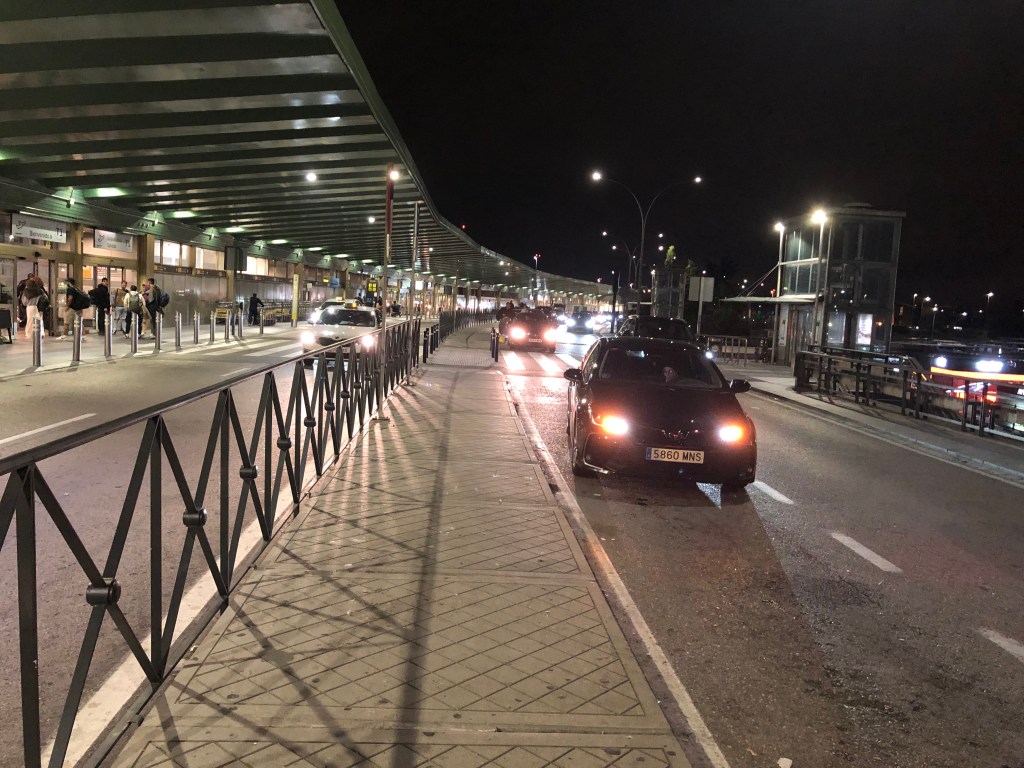
This is Terminal 1.
Despite the number, it was the second terminal constructed at Barajas, being stuck on the side of the older Terminal 2 in the 1970s, and improved when Spain hosted the 1982 World Cup. It’s not brilliant, but it’s not bad either, and given it was designed before airport design was a thing, it stands up pretty well – certainly better than its neighbour T2.
Unusually for me, I’m travelling with hand luggage only, so can stumble wearily straight to security then passport control, both fairly straightforward with queues just long enough to grumble about, but not long enough to impede my lumbering progress to the gate.
I hate having to get up early for flights. I toss and turn all night, worried I’m going to oversleep, then have to rush when I get up. I don’t mind being an early riser, I’m a lark not an owl these days, but give me at least three hours to drink coffee and do the crossword before you make me move!
The flight is already being called, though not boarded, and I wander over, looking for the Priority signs because Ryanair’s ticket policy means people paying to use the overhead lockers get to board first. This is smart, they’re the ones who need the space, and Ryanair cleverly brand this as Priority. I’ve always admired their innovative pushiness, even if I don’t much enjoy the no-holes-barred transactional nature of the experience (“Sell! Sell! Sell!”).
They board us on time, and we walk down the stairs to the bus. No way are Ryanair paying the airport to use an air bridge, so a bus it is – rather diluting any advantage of priority boarding. We get to the plane, and wait an age while they finish getting it ready. No moment is wasted as they line the people up in blocks, ready to release them the moment the plane is shipshape.
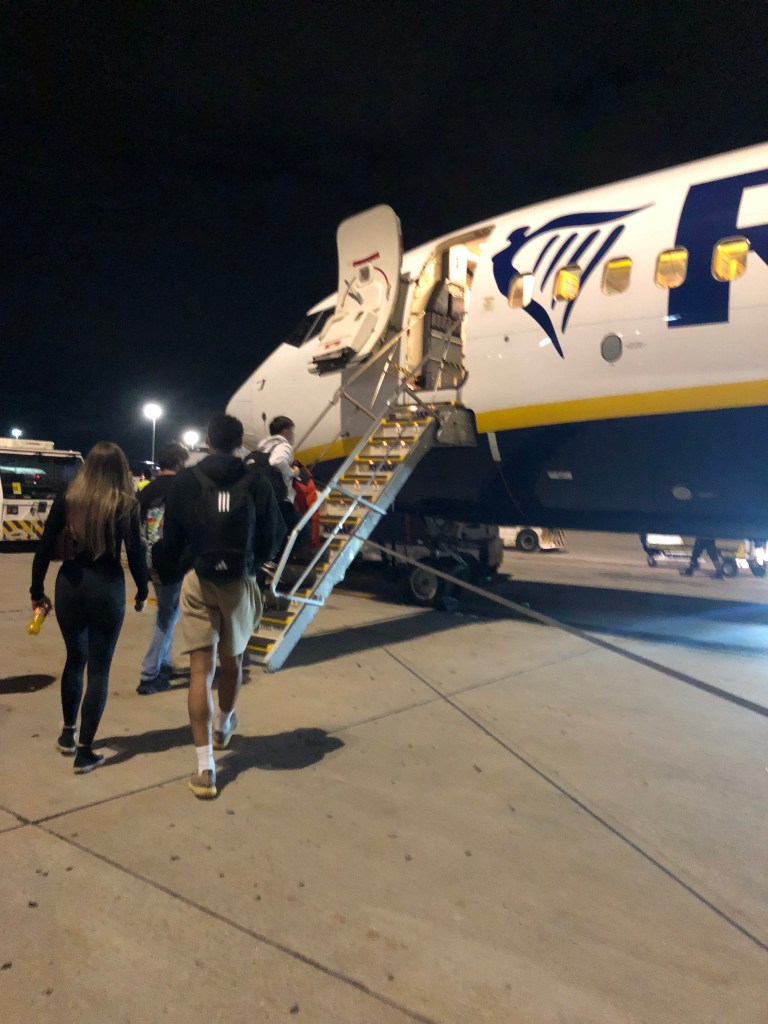
We are freed, and walk up the steps. No way are Ryanair going to pay to use the airport steps and so we clamber up the ones that concertina out of the plane itself.
I’m in 6D, and plonk myself down with Kindle, phone and headphones in hand. If I can keep my eyes open, I’m hoping to finish my book during the next three hours and have a few good podcasts loaded up, just in case. I am soon joined by the two lads sitting in 6E and F, and I squirm a little as they loudly exchange banter with their friends a few rows back. The plane is freezing, there’s no way Ryanair are going to pay to start the engines until they have to.
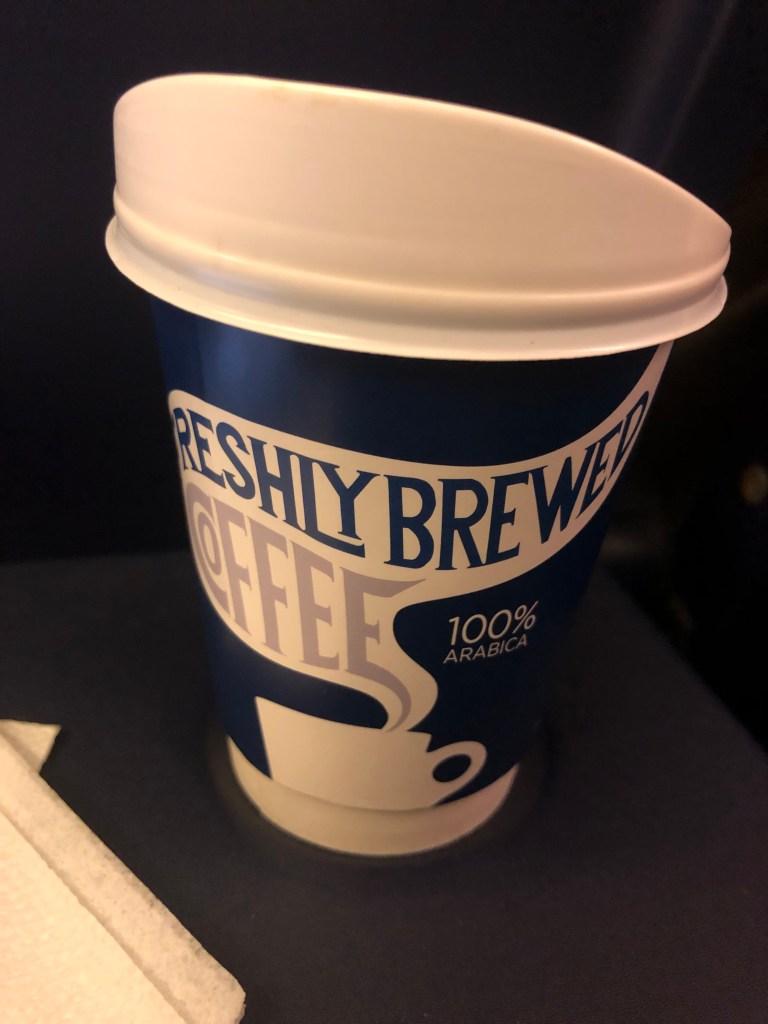
We take off on time and I play about with the in-seat ordering option on the app, a clever idea that connects to the plane via Bluetooth – I couldn’t log in, and didn’t have the patience to run through the forgot-password-rigmarole, so entered as a guest. I didn’t use it this time, I think this is because I wanted my order of a large black coffee to be more anonymous and look less like showy privilege a first-in-the-queue-waiter-service would imply. I’m funny like that: as much as I want to be given special treatment to avoid the masses, I hate being seen to be given special treatment to avoid the masses. That said, I like this innovation, and resolve to get over myself and try it on the way back. The coffee is actually surprisingly good for an airline, and it was even hot!
I admire Ryanair more than I like them. The staff are courteous but not warm, you don’t feel much of a connection beyond that of card to card reader. The first trolley is food, then drinks, then duty free perfumes, then duty free booze, then lottery tickets … it’s not aggressive, but it is incessant.
Once I was trying to fly home to Madrid from my home town of Leeds, no easy task in a country so obsessed by its distant southern capital. It was a snowy day and the three flights leaving that early morning perfectly encapsulated their differing attitudes to their task of linking our remote northern outpost to the rest of the world: the BA flight to London was cancelled, their lack of commitment confirmed when this busy route was discontinued altogether a few months later; KLM – my flight home via Amsterdam – was running about two hours late; and Ryanair, well, there’s no way Ryanair were going to be deterred by a mere blizzard: Ryanair were on time.
We leave Madrid, Europe’s 5th busiest airport on time and arrive at Manchester, Europe’s 19th busiest, a few minutes early. We’re in Terminal 3, and being near the front and with only hand luggage I am free quite quickly. The crew and I thank each other as we depart, the final transaction between customer and supplier successfully completed, and I walk down the plane’s steps and across the apron to the little door marked International Arrivals.
Terminal 3 isn’t great, and the difference between the Spanish capital and England’s third city (or second, depending on how we’re counting) is striking: no millions in infrastructure investment here!
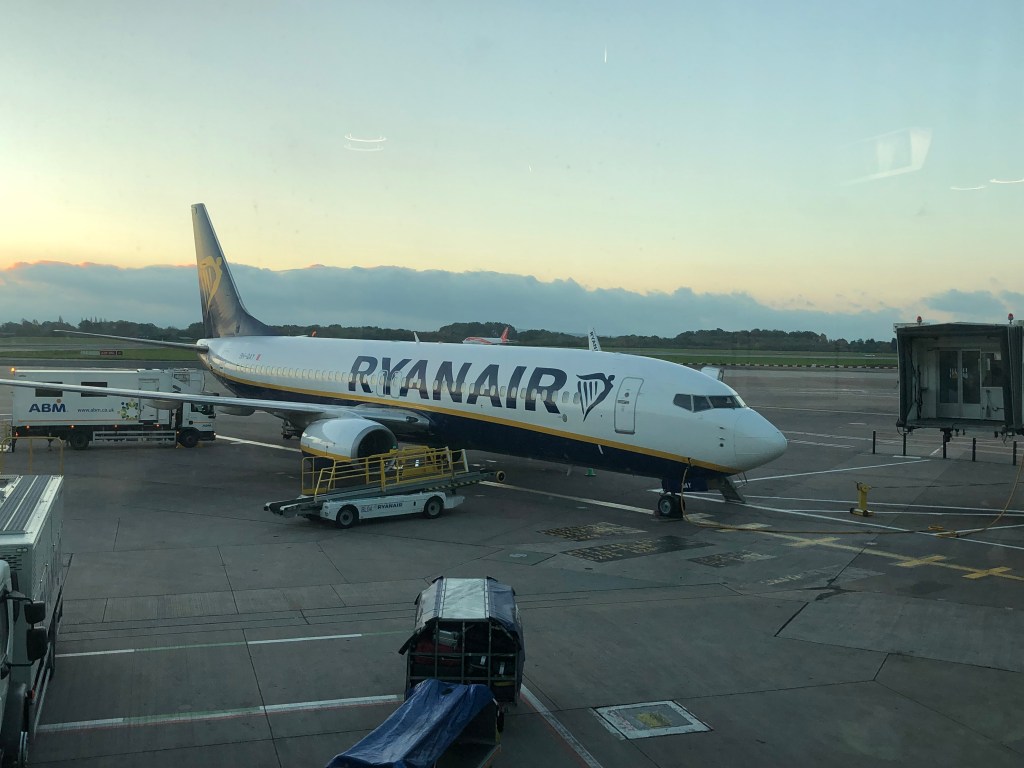
I get through the automated passport gate, a relief given my favourite hat has messed up my greying balding head, leaving me looking like a scarecrow that’s been left outside over the winter months. No baggage to collect, so I march out to find the station … it’s a ten-minute walk through the jumble of buildings, corridors and lifts.
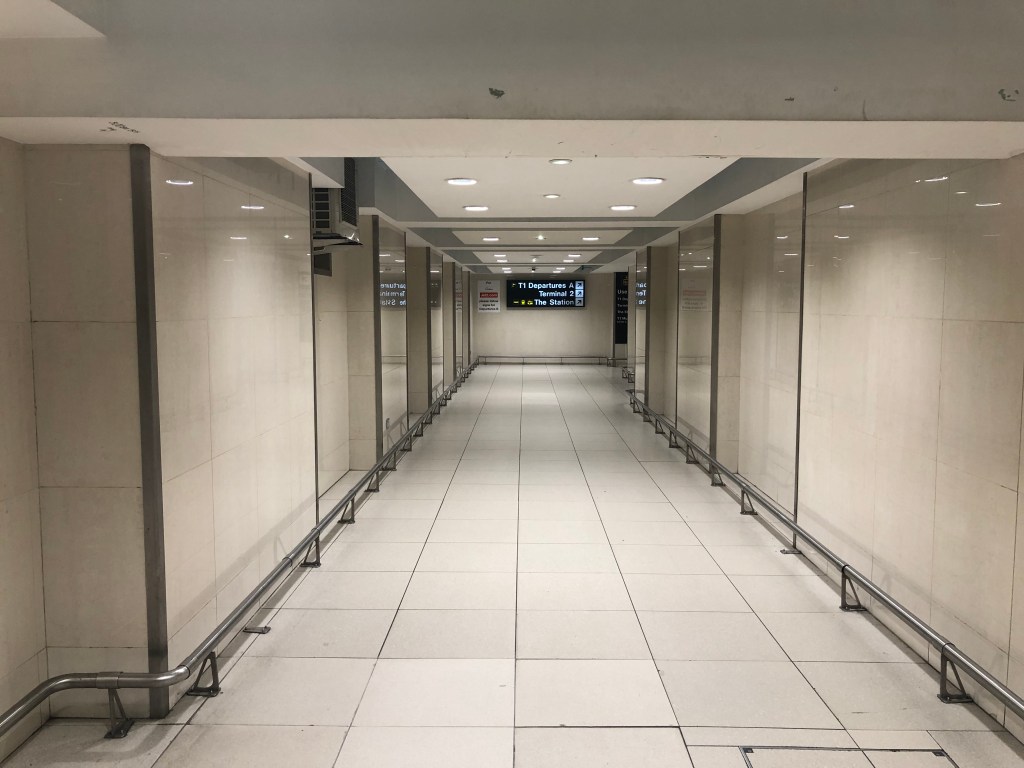
I am now excited. The travel I love is not squashed in on planes, whizzing through the sky being sold stuff whilst chucking kilos of CO2 out the exhaust pipe, it’s on the surface, on boats and trains and buses, even in cars on lengthy road trips. I am looking forward to getting a train back to my old stomping ground and nosing around Leeds Station to see what might have changed before catching the branch line up to my family seat of Horsforth … but then I get told the price for a train ticket … £36!
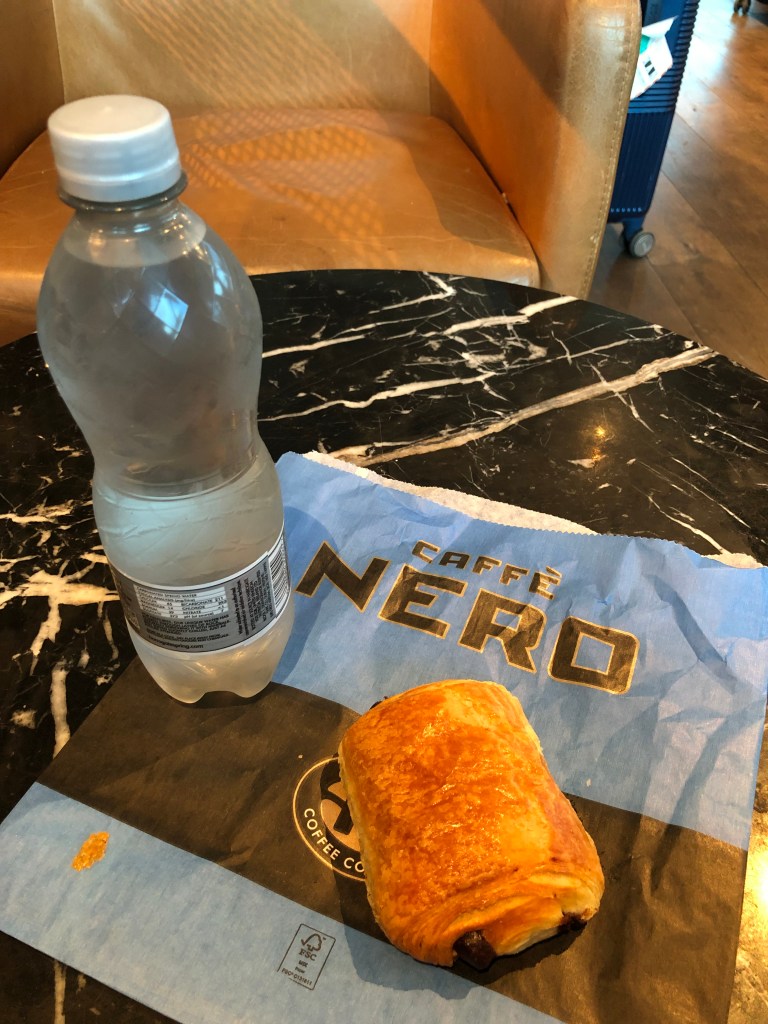
I check online with Trainline and it is cheaper, but still £29, but Trainline also show coach prices, and so my little eye spies that in 45 minutes there is a coach to Leeds for around £10! I like coach travel, although the pleasure is directly proportional to the seat you manage to bag, and so I rush over to the coach station and find no information whatsoever, and certainly nowhere to buy a ticket. Eventually I find a sign saying you have to buy online, so I buy a ticket via the National Express app and head upstairs to Caffè Nero to get some breakfast.
Here’s where things go awry.
Note: the following paragraph has been redacted. The official reason given by authorities was it was “tediously uninteresting”.
I want something small, and don’t want another coffee, so think I’ll get something like a pasty and a bottle of water. They only have sausage rolls of a small-enough size but I dither, I’m not a big fan of the sausage roll, so I grab a water, and check to see what they have on the counter, then under pressure to decide everything immediately by the queue forming behind me, I order a pain au chocolate that, defying the laws of perception, seems to smaller as it gets closer to me. Oh well, a tiny pastry and a bottle of water … but oh, what the fuck have I done, I’ve only been and gone and bought fucking sparkling again … why do I do this?
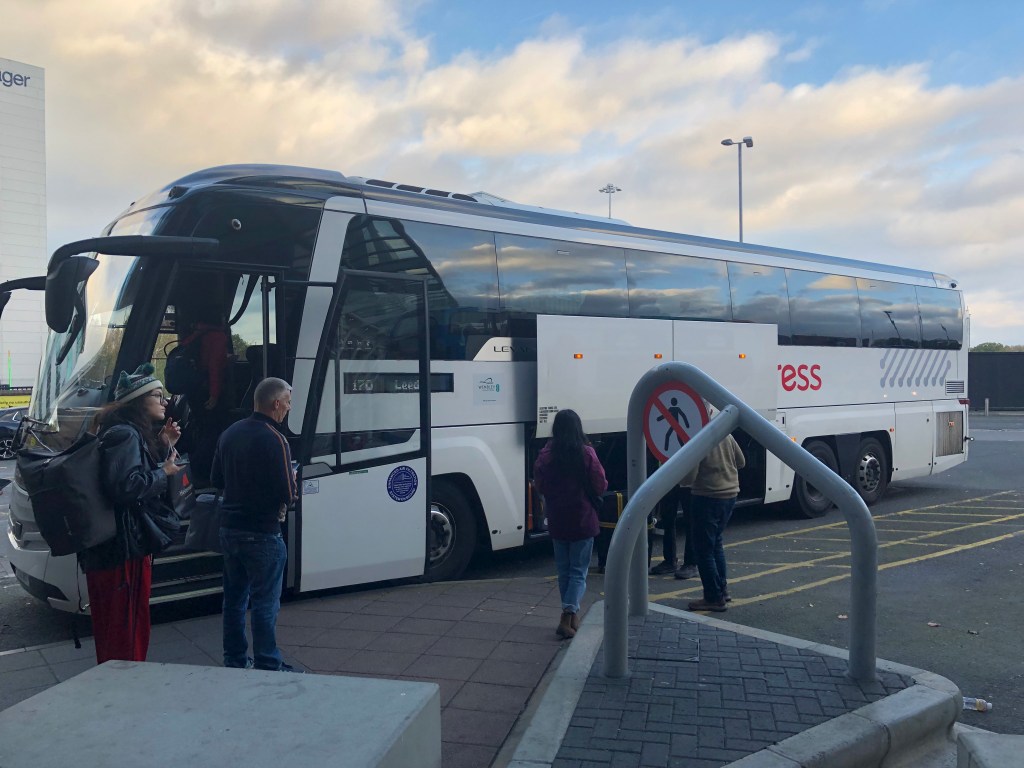
The coach arrives from Liverpool early, and, as expected, the driver is friendly and funny, like most people are in this part of the world. I get on board and sit in 1A, directly behind the driver and settle in. I am looking forward to crossing the Pennines and getting back to my native Yorkshire.
The bus trundles slowly through the Manchester outskirts and into the city centre. I don’t know Manchester’s coach station, and given Manchester tends to have everything bigger and better than Leeds, I am interested to see what its like. It’s grim. We don’t have time to get out and nose around, but I can see from my seat that it’s dark and tatty, like most other coach stations, and I am a little disappointed – perhaps they’ll get a new one soon in recompense for HS2 cancellation1.
We are soon back on the road and heading out of Manchester toward the M62, Britain’s highest motorway, that will take us through the Pennines and on into Yorkshire. These hills aren’t so high or dramatic, but at the start of the industrial revolution they were enough to make one side perfect for cotton, the other for wool. The Lancashire side got most of the rain, the humidity perfect for cotton (plus it would have arrived into the port of Liverpool, I guess); the Yorkshire side – wilder terrain anyway – was in the rain shadow, so making the land much more suited to sheep.
The sun is now shining, despite us still being on the Lancashire side, and the green hills look gorgeous, although the six busy lanes of traffic cutting through the middle take the edge off any romantic ideas you might have of a Heathcliff-type character brooding about stuff on these moors. The Brontës weren’t here anyway, their moors are further north near Haworth, where the landscape is wilder and bleaker than anything we can see from our coach window.
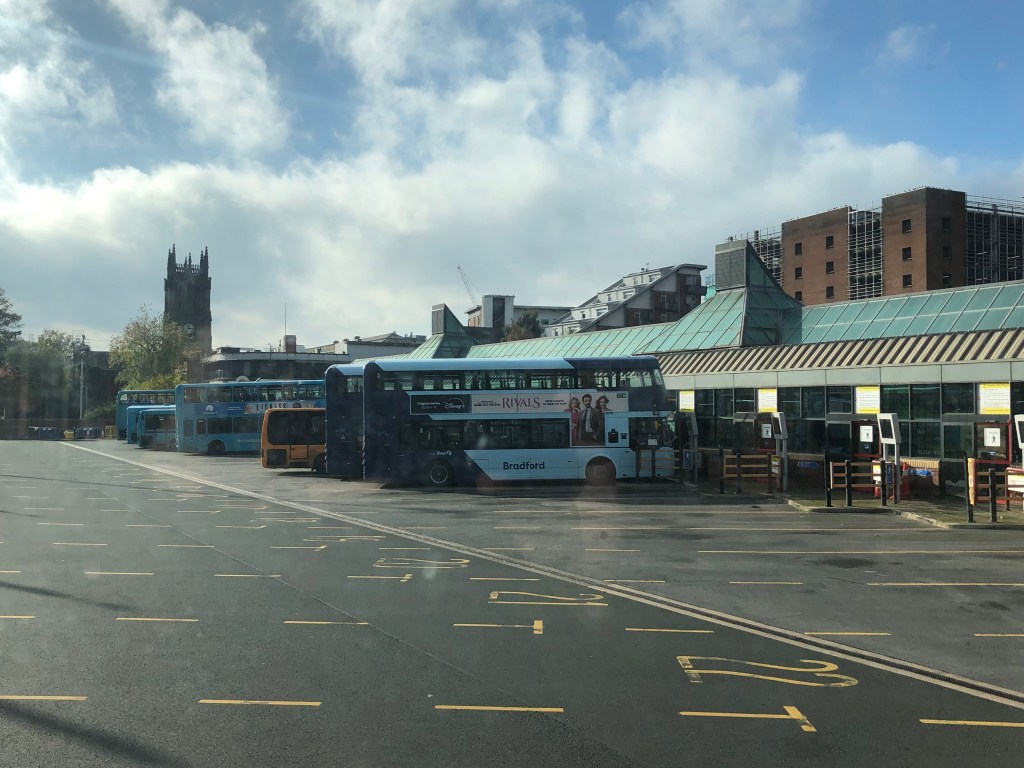
It isn’t long before we’re descending into Yorkshire and passing the edges of Huddersfield and eventually onto the M621 motorway that skirts through the south of Leeds, past the football ground, eventually connecting to the M1, but we’re not going that far. This is my hometown, but I return so infrequently these days that every time I see it with something like fresh eyes. We come off just south of the centre and drive parallel to the river until we cross it at Crown Point and edge through the traffic into Leeds Coach Station.
As always this bit isn’t quite as I remember, and it feels scruffier and busier than last time – the whole of the UK has a more neglected feel, especially up north, but maybe it’s just my weary eyes coupled with the rosy spectacles of nostalgia, maybe it’s always been a bit tired and overcrowded.
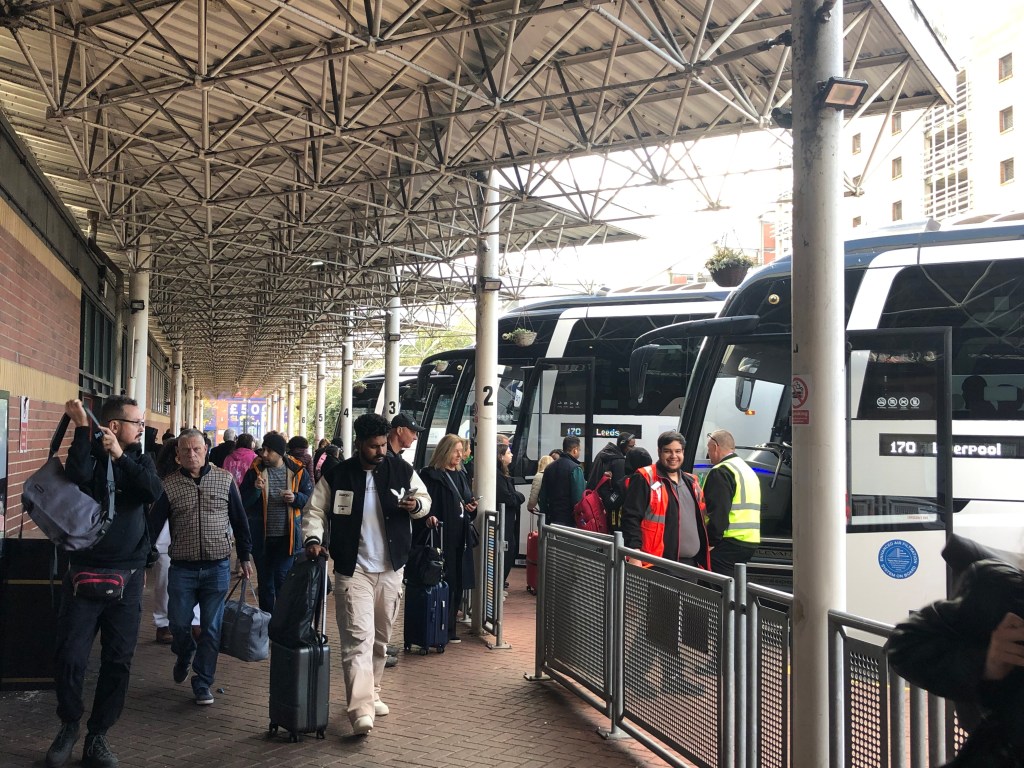
I duck through the door into the bus station and see a number 27 to Horsforth about to leave.
Horsforth was, in the old days, the first proper crossing of the River Aire – hence the name, which seems to mean a ford for horses (i.e. a fairly deep ford). It was an important trade route back in the day when access to the north half of Yorkshire wasn’t as easy as it is now. The East of the county is protected by the Humber, a wide tidal estuary formed by the rivers Trent and Ouse – their confluence was a huge boggy marshland back then (now drained) – meaning the best way to get to York in those days was to sail down the Trent on the ebb tide, and back up the Ouse on the flow. With the Pennine hills to the west, the gap between marshland and upland was the main land route, but that was criss-crossed with rivers: the Calder and the Aire in this part of the world, the Wharfe slightly further north – hence Horsforth playing a key role.
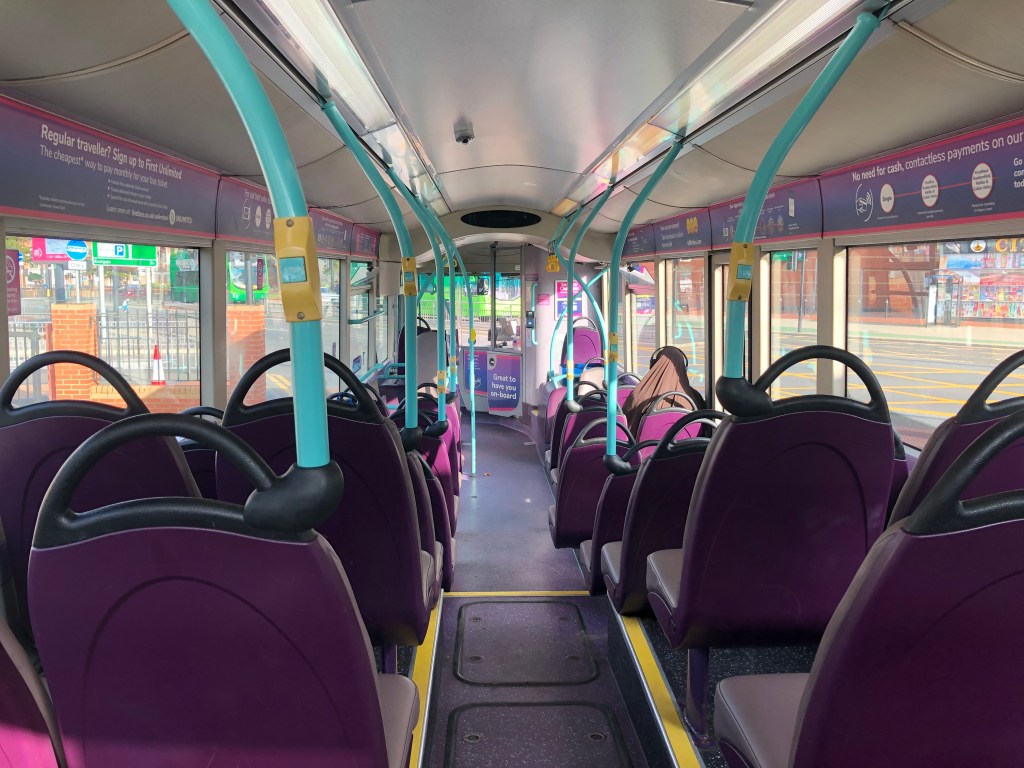
Horsforth wasn’t that much easier to get to when I was a kid, at least not my bit of it high up on the hill. We had the horror tale that was the world’s most unreliable bus: the 655. It’s route between Leeds and Bradford was so long and circuitous that if they do ever find a bus on the dark side of the moon, I bet you it’ll be the 655 that got lost somewhere between Shipley and Guiseley. The less-ambitious route of the 27 makes it much more reliable and I am glad to find it waiting for me. I jump on, tap my card, and take a seat. It’s empty, but fills up as we make our way through the centre and out toward Headingley. I get off in Horsforth, just next to the weather line – a contour above which the weather is always worse than below – the line has moved up the road since they built a row of student flats at the bottom of the University’s fields, their concrete warming the air enough to nudge the bad weather a few metres further up.
I get off and wheel my case down the road, glad to back on my ancestral lands.
The second leg: Leeds to Edinburgh
Needing provisions for my five-hour coach journey, I slip into Greggs. I feel unclean doing so, having no love for chains that churn out mediocrity for the masses. They survive on being ubiquitous, so not only do they passively drive out competition through low-prices for a consistent menu that plays to our decision-fatigue, they build habits in us customers, drawn to the risk-averse knowledge that whatever else, it won’t be terrible, and a tepid chicken bake will at least be cheap and edible.
A woman, eyes down, walks in and takes a box of sausage rolls from a display in the centre of the store, then walks straight back out, disappearing around the corner into the Coach Station. She probably needs them more than Greggs do.
I buy a bottle of still water and a tepid chicken bake. It is cheap and edible.
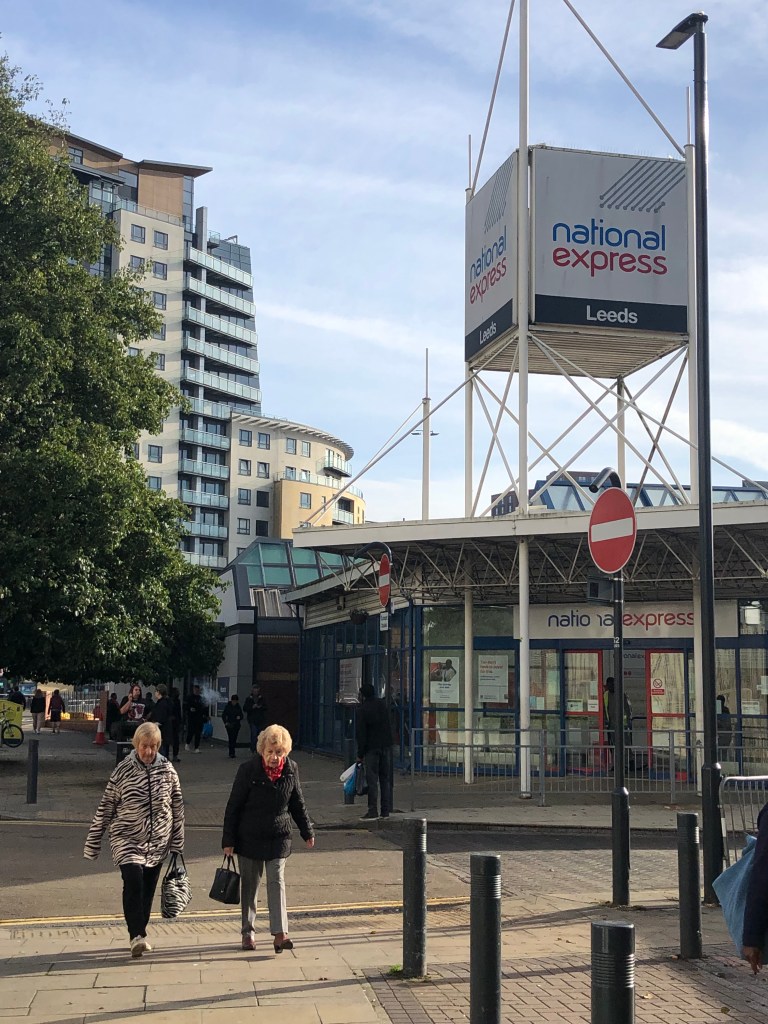
I wait for the coach, and when it’s called (perfectly on time) I am at the back of the queue because the other passengers had already spotted its arrival from Birmingham and were lining up as the driver and passengers took a break. Silly me, amateur move.
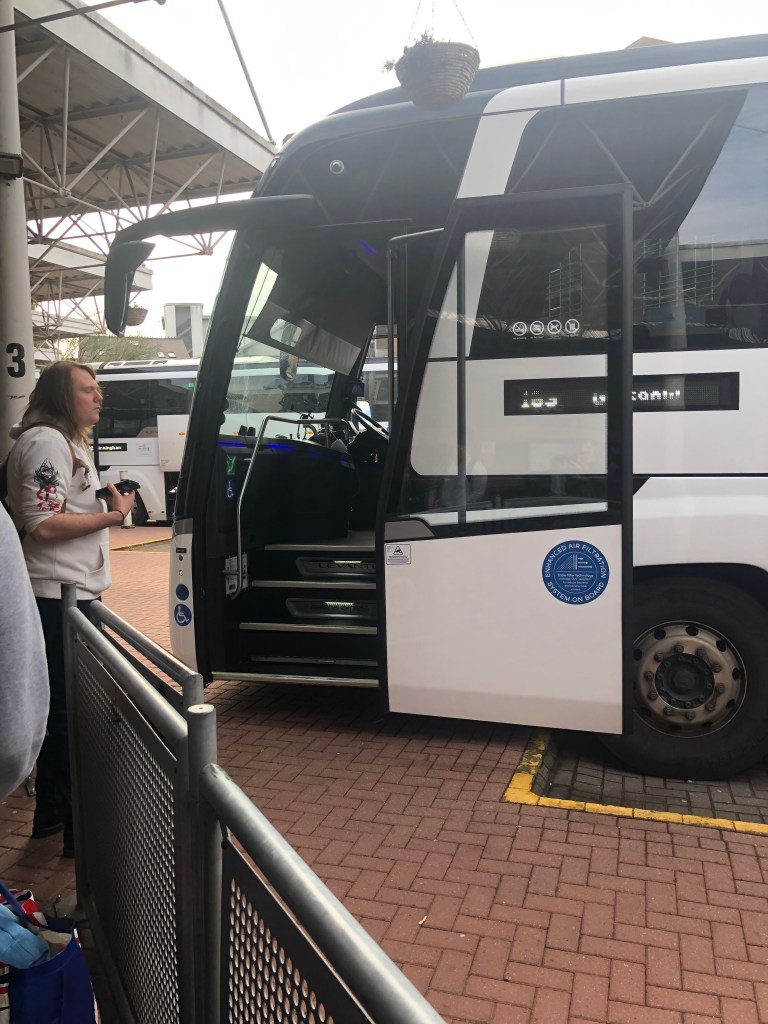
I get on board, and luckily bag the second row behind the driver, the first row being reserved although no one sits there at any point. The seats are very comfortable, and I settle in, looking forward to listening to the Bristol City – Leeds United commentary.
At the last moment, seconds before reversing out of our bay, a woman with a heavy Glaswegian accent gets on, quickly explaining her life story to the driver in the process. Her voice is louder than a foghorn, but the accent sufficiently defends her against any danger of being understood. She sits behind me.
I connect my headphones quickly, but alas, I have no signal, or rather I do, but it doesn’t translate into internet access. I try the coach wifi, but it is similarly jerky and useless for streaming. I restart my phone, it’s a temperamental bastard, and perhaps switching it off and on again will sort it out.
It connects, but then crashes. The screen going black, then slowly an Apple logo appears, then my home screen, then black, then home-screen, then I got access for a few moments before the cycle repeats … and repeats.
Fortunately I have printed backup copies of my travel tickets (because I am over 50 and that’s what we do), but access to my room in Edinburgh depends on a series of codes only released at 3pm via email, and with the footie match now underway, I was also missing the game!
I don’t panic, I focus on what I can control. My best laid plans for listening to the commentary while watching the world go by the window are gone, but I can’t help that. I’m now hunched over my phone, trying to get any information I can from each short window of connection. Can I send a WhatsApp so people know I’m likely to be going off-grid? Can I quickly access my email to get the codes before it crashes again? I try and try, but mostly sit looking out the window, enjoying the scenery as we sweep north along the A1.
Eventually I get the address of my accommodation, scribble it down before it crashes. Then the wifi details so I can, if necessary, log in via my computer from outside in the street. Then I get the code for the main door, then finally the email arrives and between crashes and reboots, and I get the codes for my room.
We pull into Newcastle, a nice city on the Tyne at the southern end of my favourite English county: Northumberland. The bus station is not so nice; Newcastle deserves better. We don’t wait long and are soon off again but during our stop, the loud foghorn woman receives a loud phone call that she loudly takes. I hear everything, as does the whole bus, but understand one word in ten. Her call loudly ends as she loudly lets us know she’s going to the loo before we set off.
I watch her walk down the aisle on the CCTV and eat my cheese sandwiches.
She doesn’t reappear, and I wonder if she is smoking or taking drugs or has taken ill. I hope she hasn’t died because the inevitable delay to our journey would be frustrating. I watch the CCTV, but nothing … I check the seat behind me, but she’s not there. We pass Morpeth, then Alnwick, then I see Holy Island at high tide, entirely cut off, a proper island for a few hours before the causeway opens again, then we cross the Tweed at Berwick – a town currently in England, even though it’s changed hands a dozen times (and its football team plays in the Scottish league) – but still no foghorn woman … I wonder if I should say something. I imagine explaining to the second driver who is resting on the back seat that she’s been in there for over an hour, and us forcing the door to find her, but then I spot a woman who looks a bit like her two rows back, then notice others are getting up and using the loo, so this narrative collapses and I realise nothing remotely unusual has happened and she had just sat back in a different seat.
Oh well, our humble travel blogger needs dramatic stuff to happen to fill these posts, else he’s left talking about his tepid chicken bake and his cheese sandwiches, and so I sigh, and wonder if something else might happen as we continue on north up the A1.
Nothing does happen, and we cross the Scottish border, a seemingly random spot chosen because making it the Tweed river would slice Berwick awkwardly in two. I’d prefer that, I like borders to be based on geography not practicality, although I have a soft spot for those absurdly complicated ones, like that bit between Belgium and The Netherlands.
The Scotland-England border is mostly based on geology. Scotland isn’t just the top third of Great Britain, it’s the bit that came from the North American craton (Laurentia) – the Scottish highlands are an extension of the Appalachians – and the rest of Great Britain came from Avalonia, an entirely different tectonic continent that ended up forming parts of North West Europe and the eastern seaboard of North America – hence the England-Scotland border is a divide of ancient continents. This means Scotland is genuinely different from England, and it’s noticeable: different rocks mean different mountains and different flora, which means different fauna, all meaning different ways humans have to live there to survive, meaning different cultures develop.
It also means different bus station design, because as pull into Edinburgh, a minute or two after our scheduled arrival time, the driver gruffly describes it as “the country’s worst bus station”. I can see what he means, driving a bus in and out of it seems to have been an afterthought, and buses need to do all sorts of fancy twists and turns to pull into their bay.
I spend two days in Edinburgh on family business, my phone slowly settling down and getting itself back to normal. The Scottish capital is a beautiful city, and jam-packed full of tourists, so it is expensive; hence I compromised on a room a bit out of town with a shared bathroom – not something I’ll make a habit of, although it isn’t as bad as I expected. We eat Chinese at the popular and noisy Rendezvous on Saturday night, as we always do now, it’s become our thing, and whilst it’s good, it’s not as good as I remember it being – perhaps we got lucky the first time and that’s anchored our perceptions, destined to be mildly disappointed from now until eternity. We then meet for Sunday lunch at Cold Town House – first on the chilly roof terrace to see the views, then downstairs where my vegan burger is excellent and the staff wonderfully helpful.
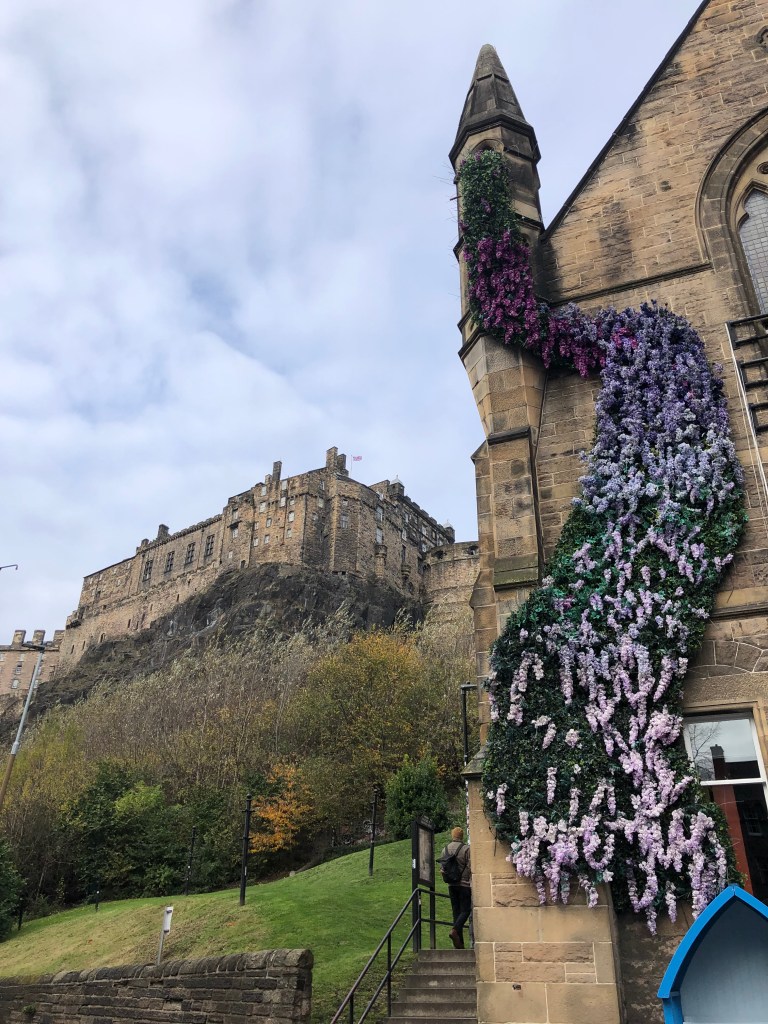
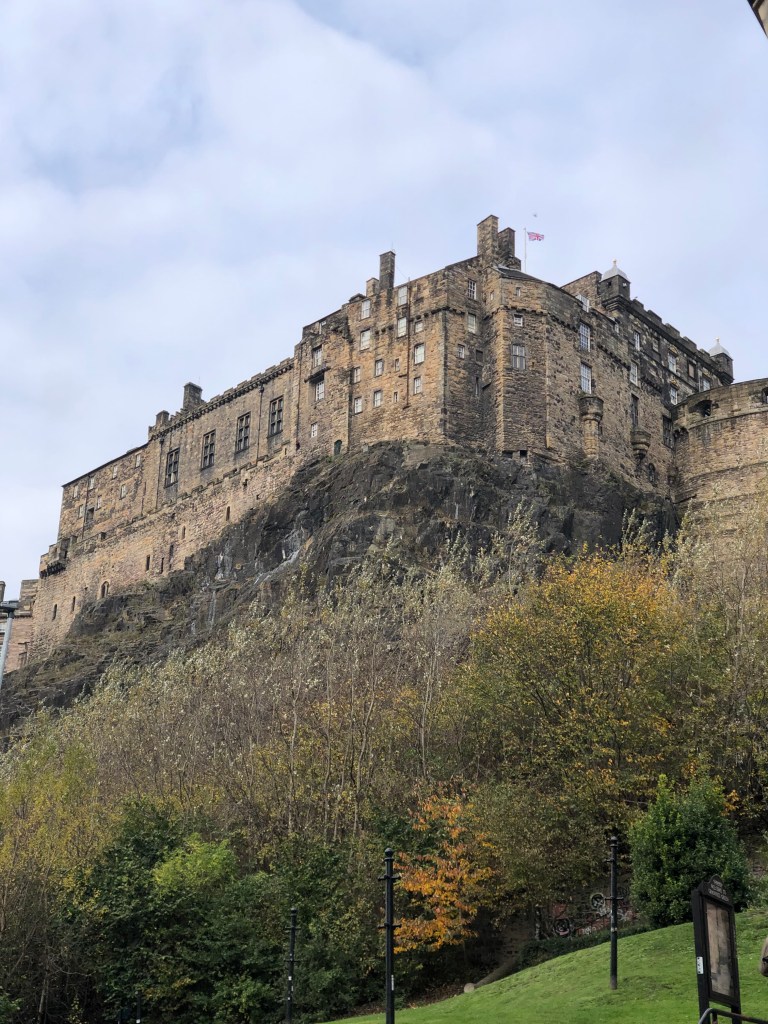
I could go on to fill this post with typical tourist snaps, like this …
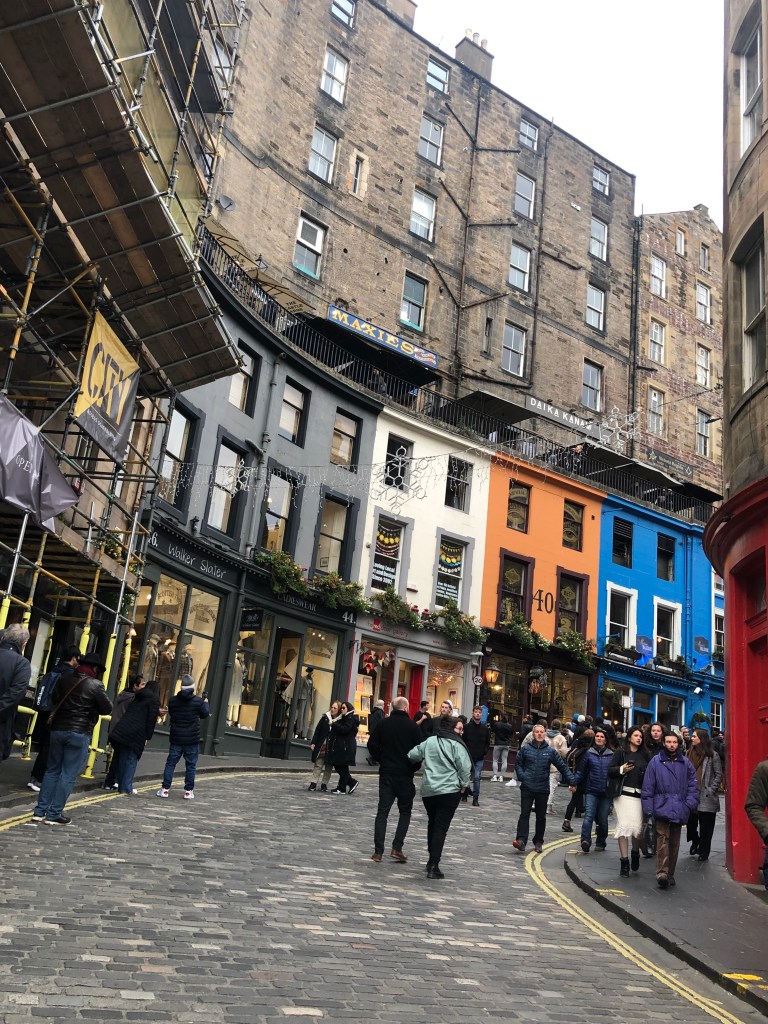
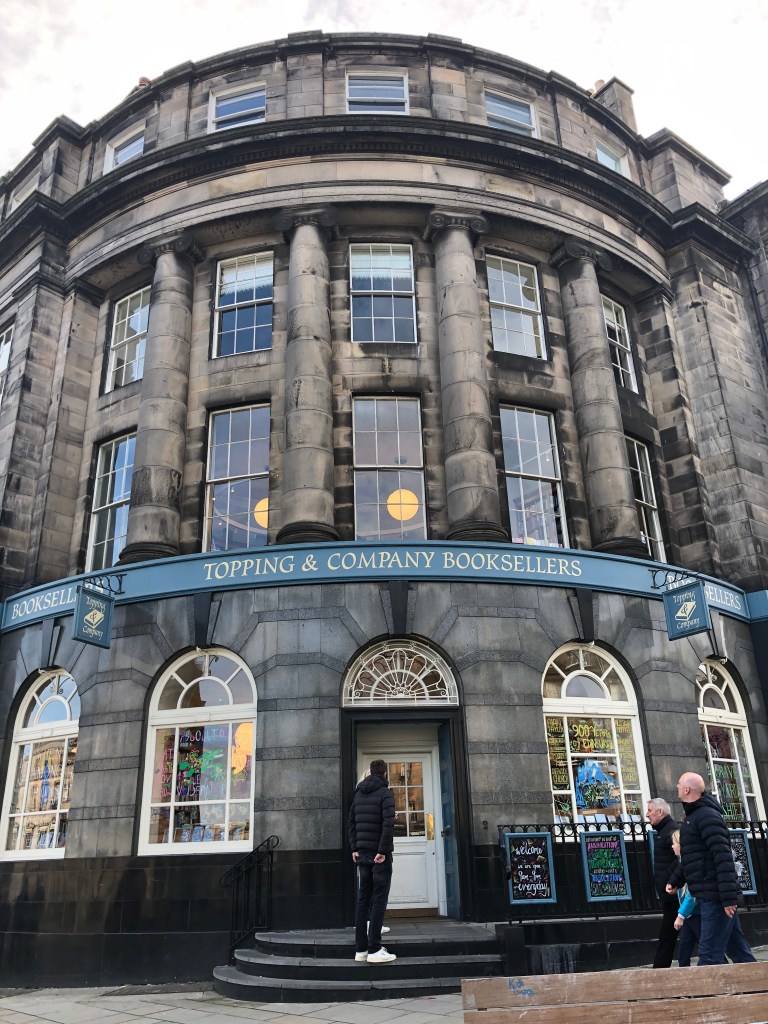
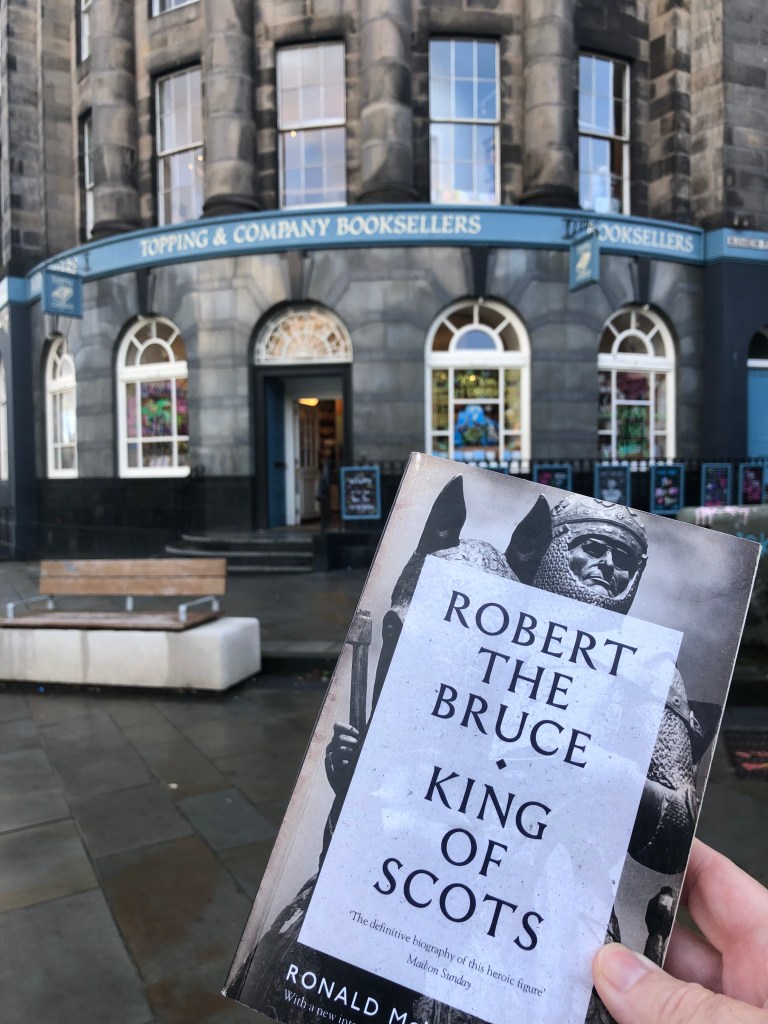
… but I won’t do that. This blog is mainly about journeys not destinations, but as I like to use every journey as a learning experience about the history of where I am – and ideally about the music it has produced – I go into the lovely Topping & Company Booksellers and buy a biography of my ancestor Robert the Bruce by Ronald McNair Scott2.
The third leg: Edinburgh back to Leeds
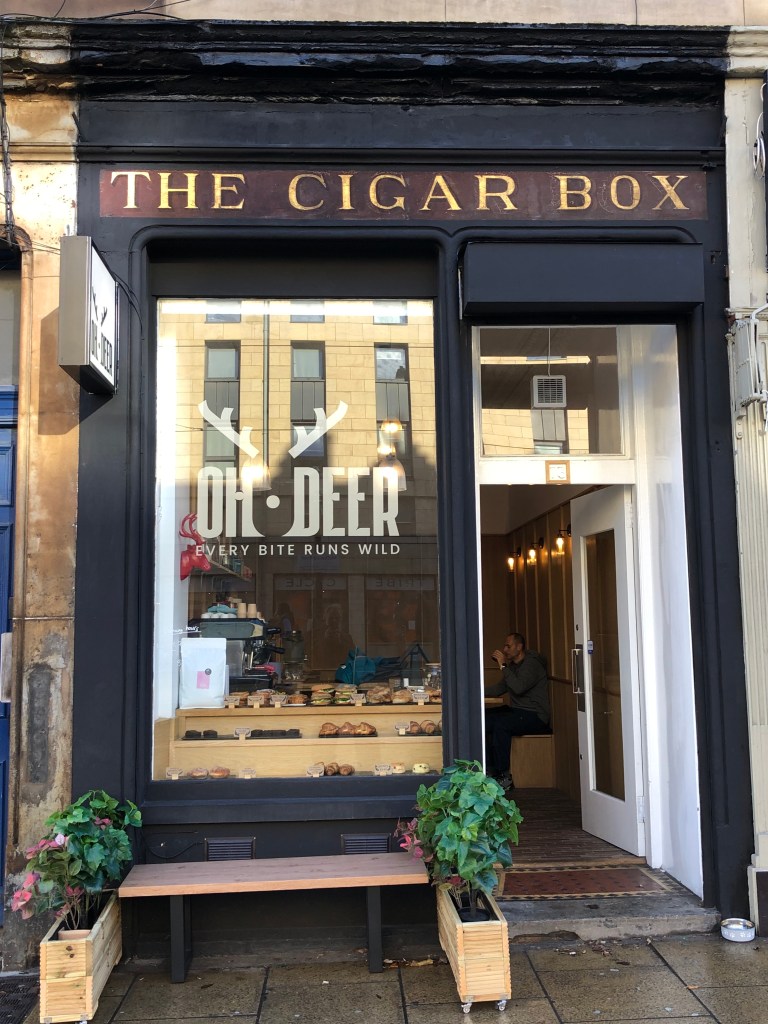
I get up earlier than I intend and am ready too soon for my 10am checkout, so, having slagged off Greggs earlier, and despite the pull of predictable chains with their known offerings like Caffè Nero and Starbucks just yards further up the road, I decide to go to an independent coffee house for breakfast: Oh Deer.
Immediately this is more difficult because I have no idea what’s on offer, and have to make a snap decision, meaning there might have been something better but, because I have now chosen, the probability wave collapses, and all other options are closed off, meaning I am exposed to the risk of not having picked the best thing. Oh well. I go for the pistachio croissant and a flat white coffee, I can’t really lose.
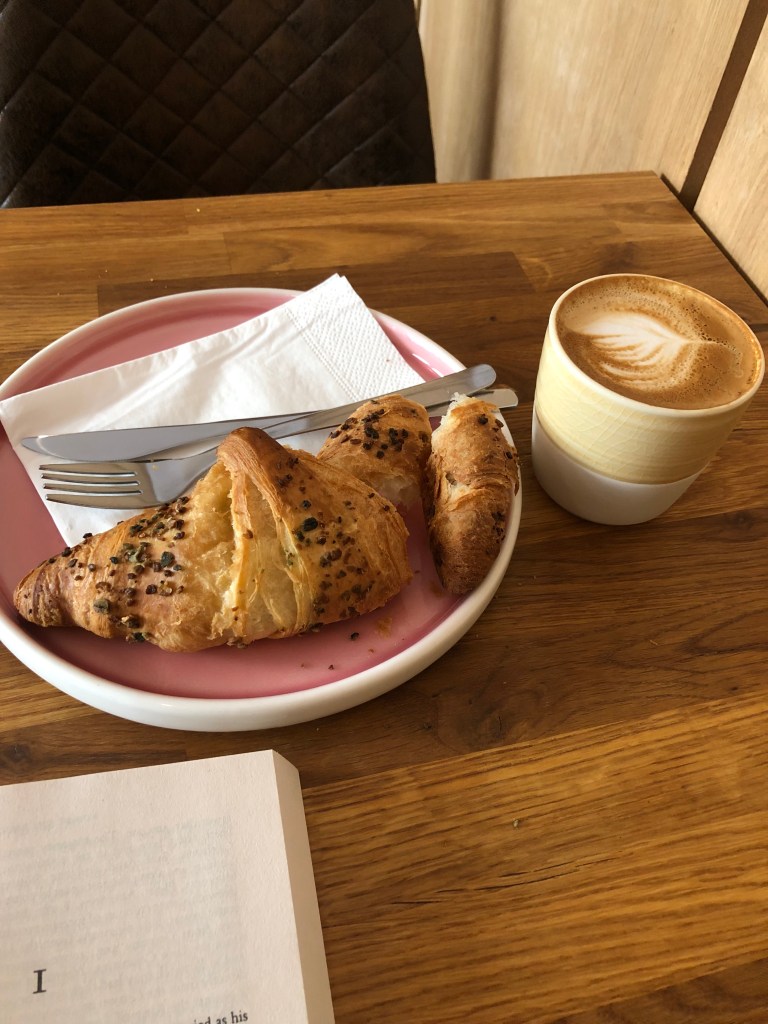
I have oceans of time to kill, so I take it slow, and do Wordle (my phone has started working again) and crack open my Robert the Bruce book, but the music is distracting because it’s really quite good. I listen, but don’t know who it is and when I ask (it’s Orpeth) we have an enjoyable conversation about music, and the magical guitar skills of David Gilmour, and about tattoos about music. This conversation is included in the price, making my £6 breakfast even better value.
I drag my case up the hill, past Vinyl Villains (I resist), back past the bookshop (I resist) and on to Waverley Station to await the train. Thinking ahead, I buy a sandwich in Marks and Spencer which is not like me because I suffer from mild ARFID food phobias and hate the idea of buying a sandwich that someone else has made. I do it anyway, forcing myself to get the most boring option with the least latitude for rogue ingredients sneaking in under the radar.
There’s nowhere to sit, and so I perch in the corner on an uncomfortable metal bar and let my mind wander.
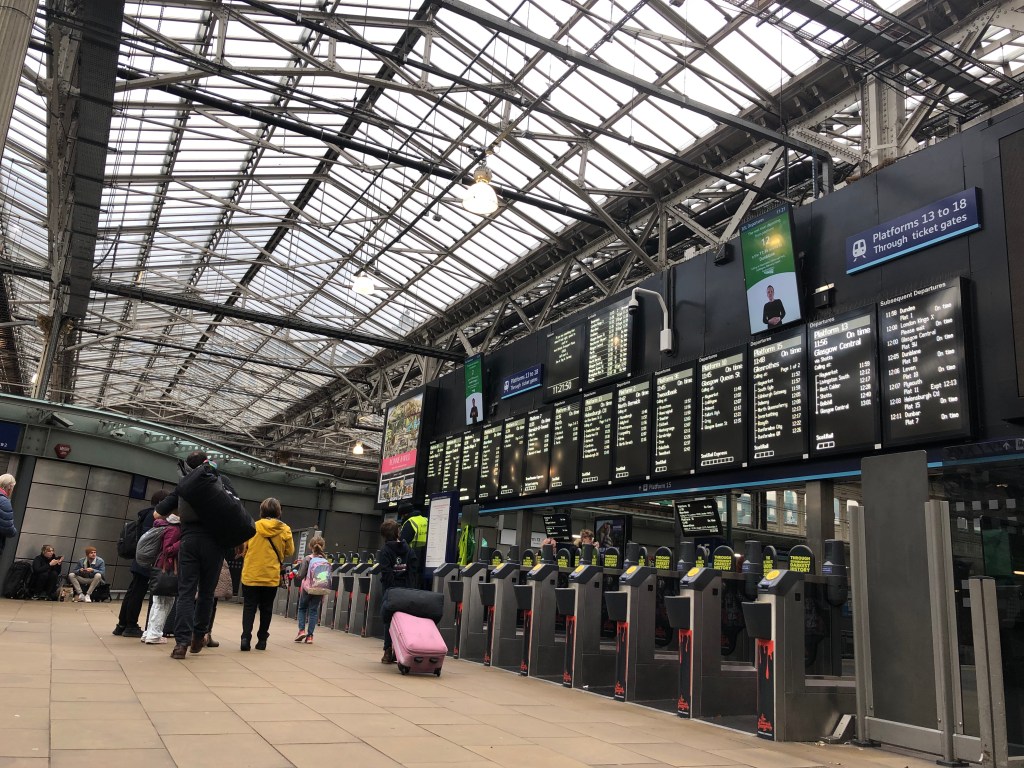
Surprisingly, this is the first train of my journey. Train travel is officially the best mode of transport for the travel enthusiast, but more for what it could be than for what it usually is in reality. LNER’s London service is not bad at all, but it is not much more than an efficient way of pulling lots of people south – there’s no adventurous stuff going on here, no sleeper cabins or viewing decks, no dining car with posh food and waiter service, just carriages with seats, and sometimes a table.
I want to be on the sea side of the coach, so when platform 9 is announced, I head there quickly, not easy in Edinburgh’s labyrinthine station. Eventually, with a bit of trial and error, a couple of dead ends and wrong turns, I find the platform and board the train.
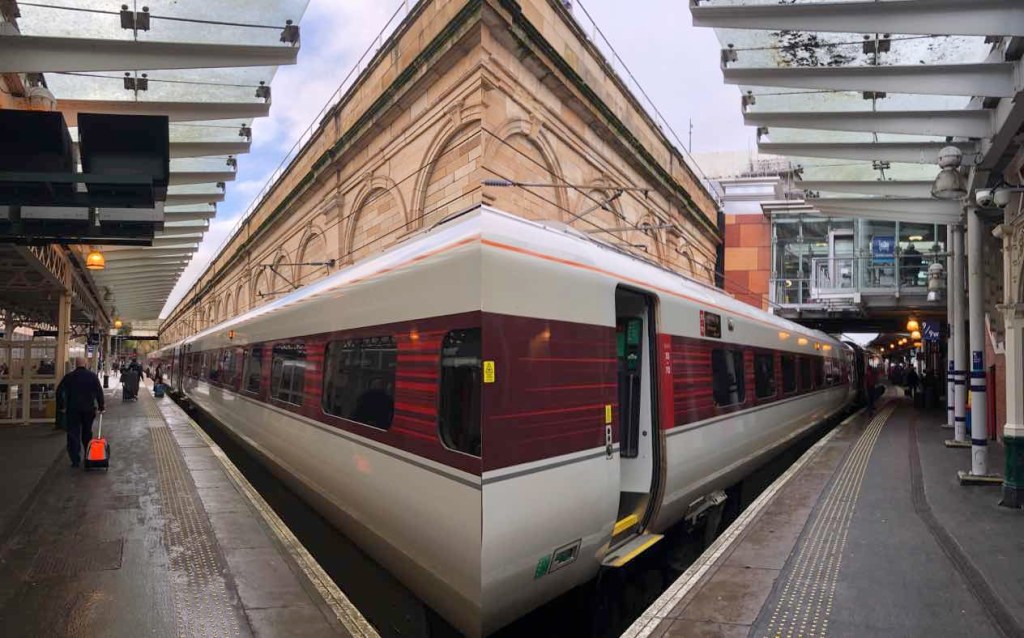
The train isn’t jam-packed and I bag the perfect spot, although a family with two young children sit in the table opposite me, and I inwardly sigh, anticipating noise and rumpus for the next few hours. I needn’t have worried, they are fairly well-behaved and the parents do a decent job of keeping them under something approximating control. As we set off, I stare out the window at the Firth of Forth, then the open coast of Scotland and we are soon crossing the Tweed into England and the beautiful Northumberland coast, the location of so many wonderful childhood holidays.
My Marks and Spencer sandwich is surprisingly good.
We pull into Newcastle and the train fills up a fair bit, and we get a good view of the Tyne and the famous bridge. Surprisingly quickly, we’re in Durham and more people board.
The scenery flattens out as we head south, to Darlington, and across the border into Yorkshire. Here the Vale of York takes over, shoving aside the hills and forests of lands further north, replacing them with the iron-flat fertile country of the Vale. Northallerton is next, and then finally – for me, anyway, the train continues south to London – it’s York where I get off, and dozens more people pile on, some of them as I’m trying to get off.
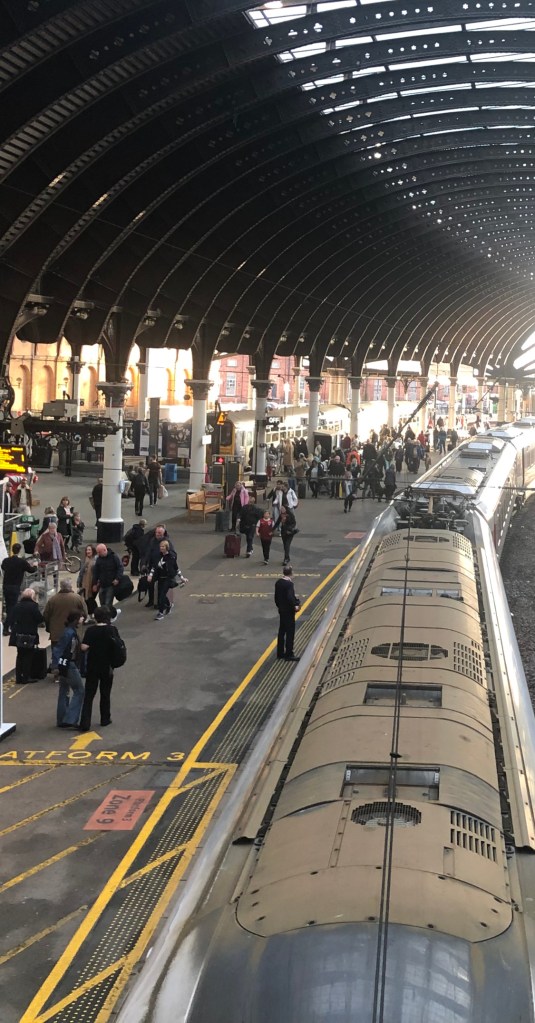
I have an 11-minute connection to get the train that sneaks north out the station before hanging a left to Harrogate and cutting back into Leeds from the north-west. This route is not advertised as Leeds, lest anyone get it by accident, thinking it’s the quick way (the direct route down the mainline is three times quicker), but for those of us wanting to alight in Horsforth, it’s the best way.
The train is full to its seams, there are children everywhere, excitedly returning from a half-term day out in the lovely city of York. The rattly loudspeakers join the cacophony by playing a tinny Halloween jingle at top volume every few miles. My head aches, I am desperate for peace and quite, and because this route is pretty, especially as we approach Knaresborough and then on to Harrogate where we climb out of the Vale and into the foothills of the Dales, I want to appreciate it with calm and tranquillity, but this is hard to do when there’s a whiny kid kicking your seat and screaming for attention.
They get off just after Harrogate, and I sigh with relief and enjoy the last few stops to Horsforth in peace.
The fourth leg: Leeds to Madrid
The plan was to catch my odd route to Manchester Airport, a Northern Rail service officially going to Wigan via Bradford, with a change at Salford Crescent … except I’d got a message the day before saying it had been cancelled.
So I leave Horsforth about an hour early, just to make sure I’ve got plenty of time to get across to Manchester. I figure once there, it’ll be easy to get up to the airport, even if I have to pay again, even if I have to get a bus.
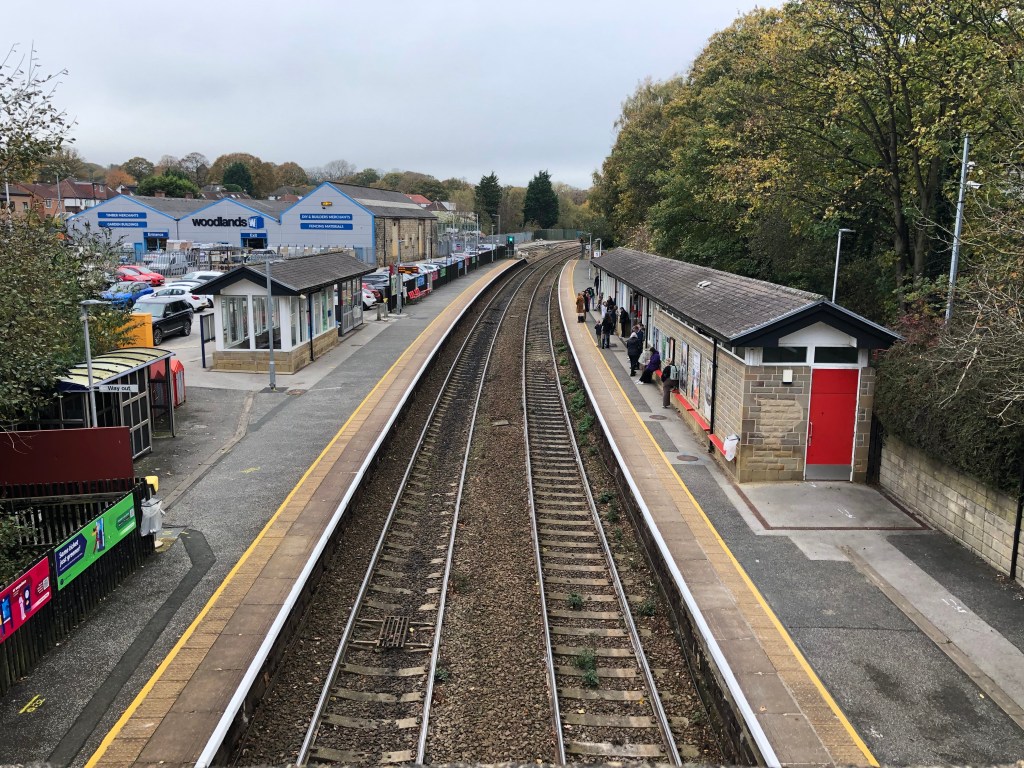
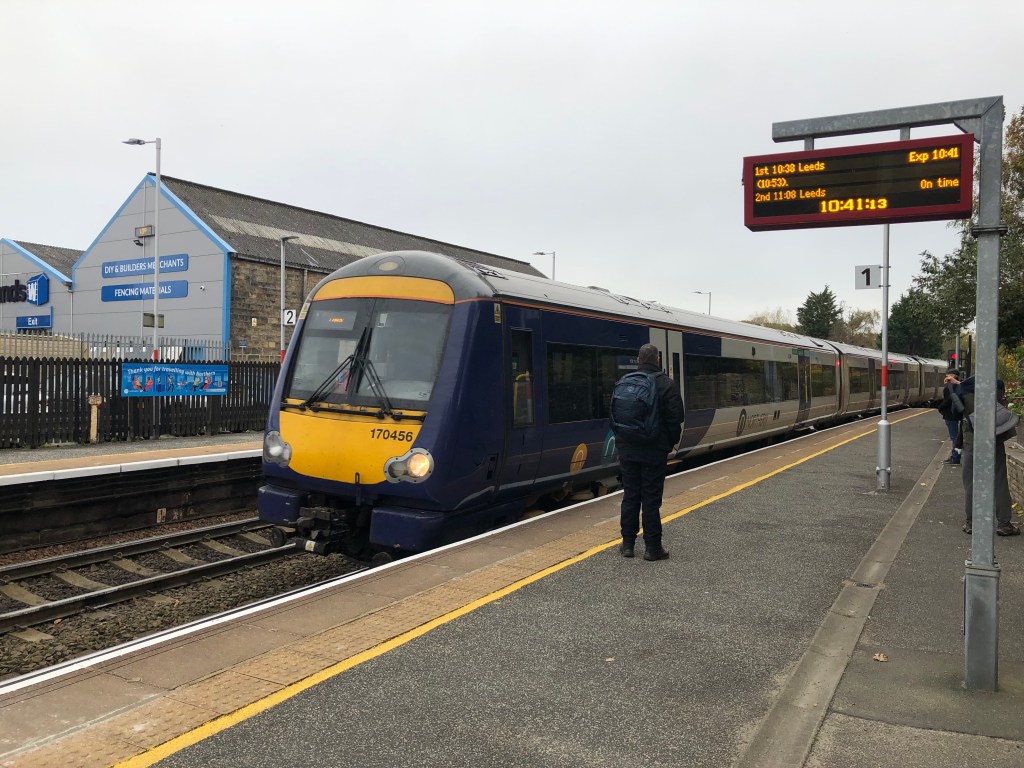
Leeds City Station is a bit of a mess. It’s the second-busiest station in the UK outside London (now that it is slightly busier than Manchester’s Piccadilly, it is second only to Birmingham’s New Street), and the only major station in the UK not to connect to any other transport network, because Leeds remains the largest city in Europe with no mass transit system.
It’s a bit of a mess because it was formed when New Station and Wellington Station were merged back in the 1930s (the access road in still called New Station Street, and its platforms extend parallel(ish) to Wellington Street), and with New Station being a through station rather than a terminus, it was built on large stone arches over the river so trains could get out the other side and on to York and Hull. This makes it difficult to extend or do much with, it’s boxed in by City Square to the north and the river to the south. It also never got a fancy old railway edifice – no grand concourses or arched roofs straddling dozens of gleaming platforms here – and so has always felt like a cramped functional shed rather than the busy impressive gateway it could be.
I like that they’re pushing the Leeds City name again though, that seemed to get forgotten once the other station (Leeds Central) was closed back in 1967.
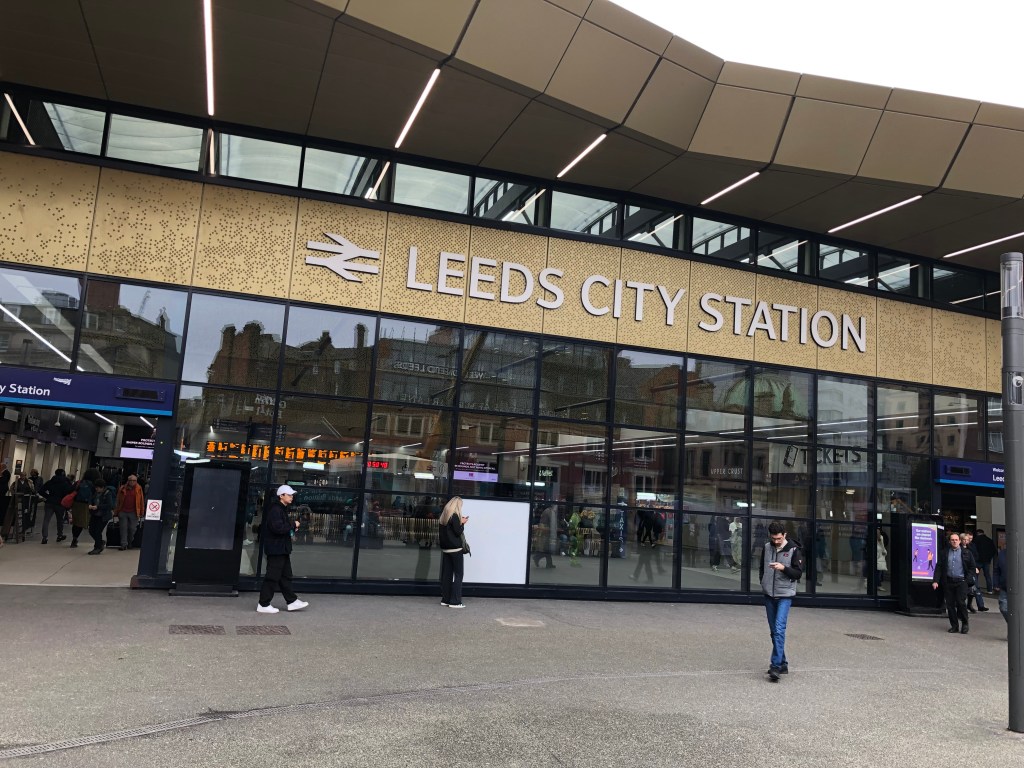
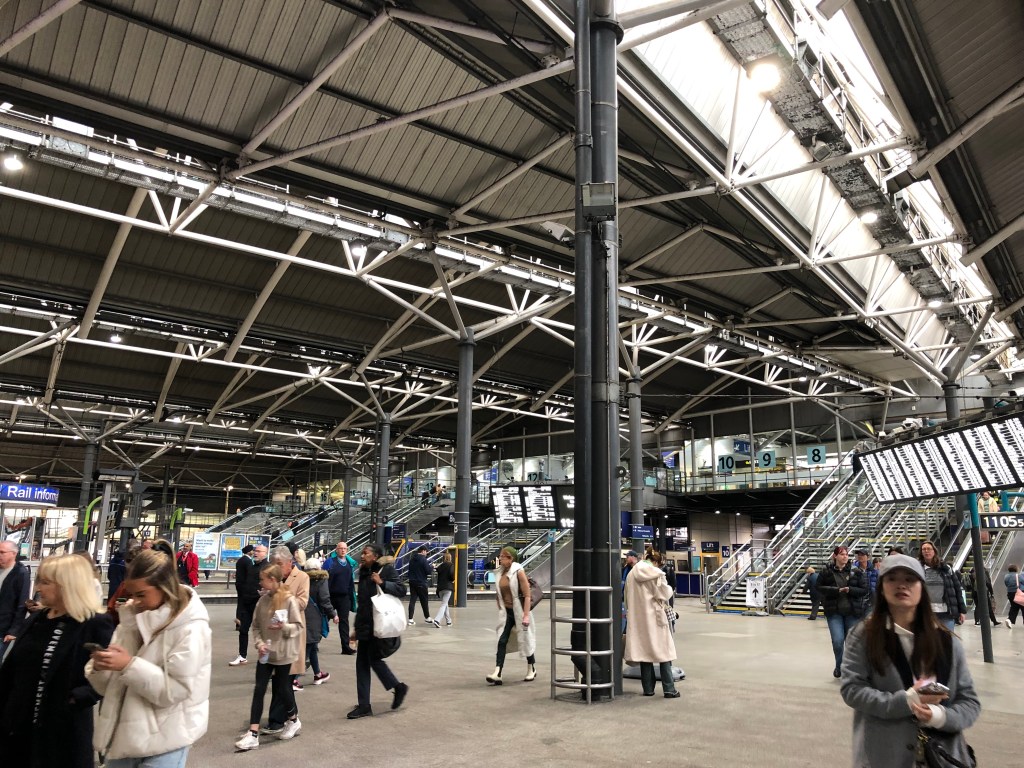
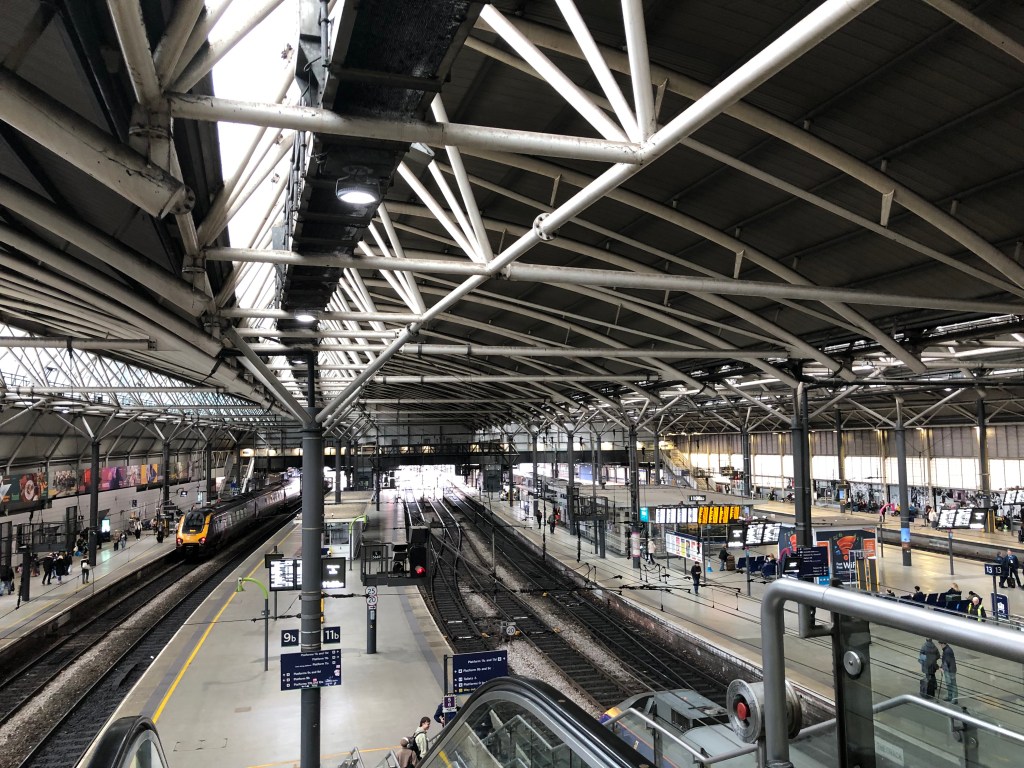
The train I’m supposed to be on is the 12:17, but I am over an hour early so decide to catch the 11:17, reasoning that it’ll get me there an hour early, but at least I’ll be there. The helpful Northern Rail ticket lady in Horsforth had told me to get to Manchester Victoria and walk across to Piccadilly if the Salford Crescent connection wasn’t available, so I felt comfortable that one way or another, I was going to make it – so much for building tension and jeopardy into these journeys to make the blog post more interesting! Sorry about that.
I do buy a chicken and mushroom pasty, but apart from regretting it’s stodgy blandness, there’s not much else to add. I really need to get over myself and start to eat salad.
My train is on time, I get a perfect seat, facing forwards because I know we’ll reverse direction at Bradford Interchange, and I prefer to sit facing backwards because the scenery is so much easier to take in when it slowly recedes from view rather than hurtles toward you.
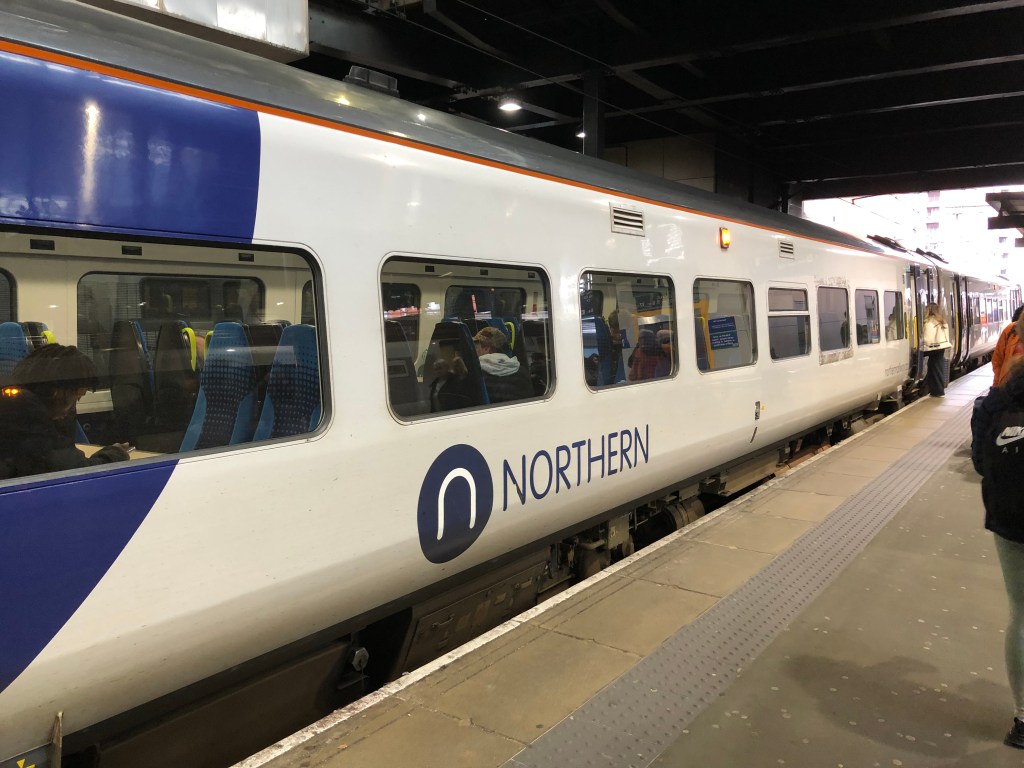
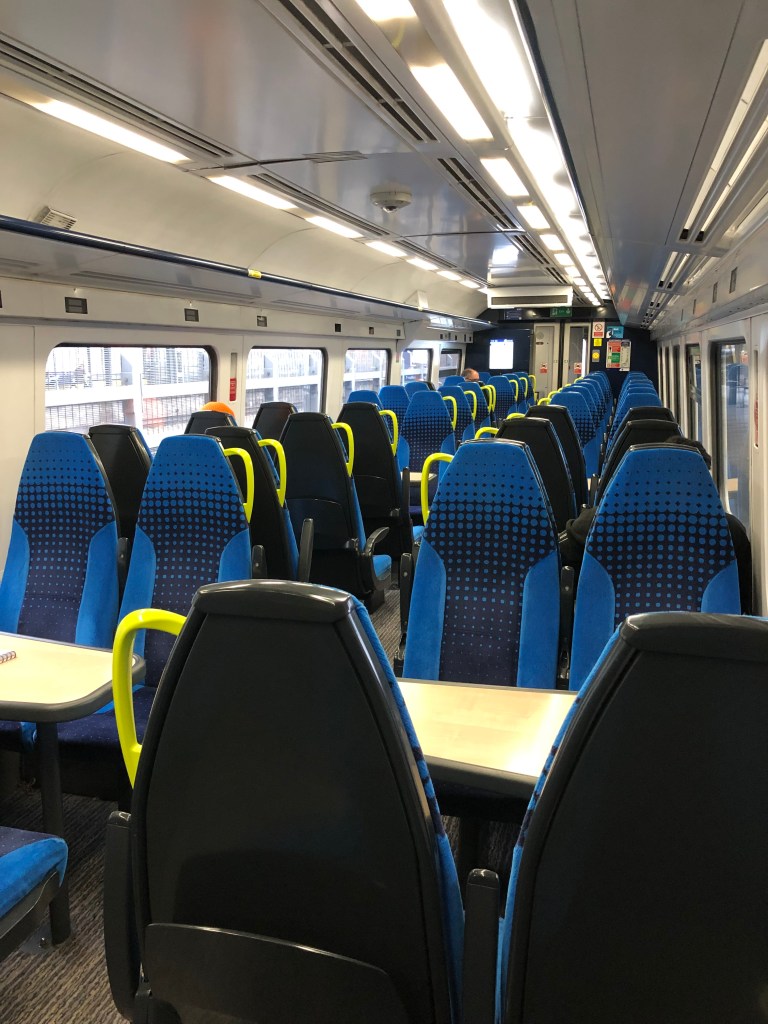
I moan about Leeds not getting transport infrastructure investment, but crikey, poor old Bradford really does get the poor end of that equation. The city centre has two disconnected terminus stations – one in the north (Forster Square) and one in the south (Interchange, although I prefer its old name of “Exchange”) – and plans to connect them never seem to get anywhere. We wait at a red light for a while before we can pull into one of Interchange’s three platforms, leave a few people, and pick up many more. Then, with a loud rumble of diesel engines beneath our feet, we slowly edge away, build momentum as we trundle south out of the station, and are soon back moving westward on the main Calder Valley Line. It’s a pretty route up past Halifax, Sowerby Bridge and Hebden Bridge into the Pennines, then through tunnels to emerge at the border town of Todmorden (good second-hand bookshop here, especially decent section of music books!) and on into Lancashire.
As we get to Rochdale, the tone of the train changes. No longer is this a little rural branch-line serving the towns and villages above Bradford, it’s an urban workhorse taking people into the sprawling Manchester conurbation. It’s busier and noisier now, onboard data usage must have sky-rocketed as everyone hunches over their phones and we plough south into the Manchester suburbs.
Manchester, unlike the conurbations surrounding Birmingham and Leeds, is centred on one main city – yes, there’s Salford and the surrounding towns like Stockport and Oldham, each with their own character and sense of identity, but no-one questions who’s top dog in this region … unlike Leeds which has to accept its urban neighbours Bradford and Wakefield as partners, not subservient areas to be swallowed up and turned into extra bits of Leeds. Perhaps the geography doesn’t help, Leeds – like Birmingham – is to one side of its conurbation rather than physically central. This all makes it easier to develop Manchester’s infrastructure in a more coherent way, and we see the difference as we pull into Victoria.
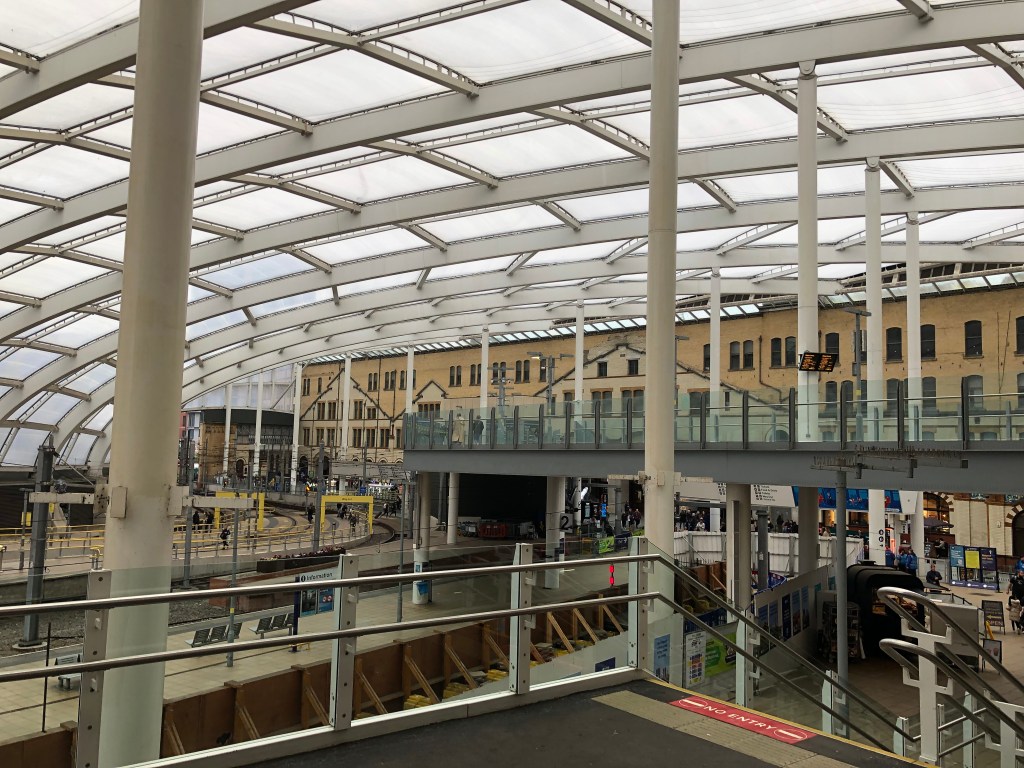
I decide to walk across the city centre rather than change at Salford Crescent. I have plenty of time and it seems like it has more potential for something interesting to happen, this is contrary to the advice of the lovely lady at the ticket barrier at Victoria who suggests I get the tram to save my legs.
My legs need the exercise far more than they need saving, and so I head out into the drizzle and walk through the city centre to the main station: Piccadilly.
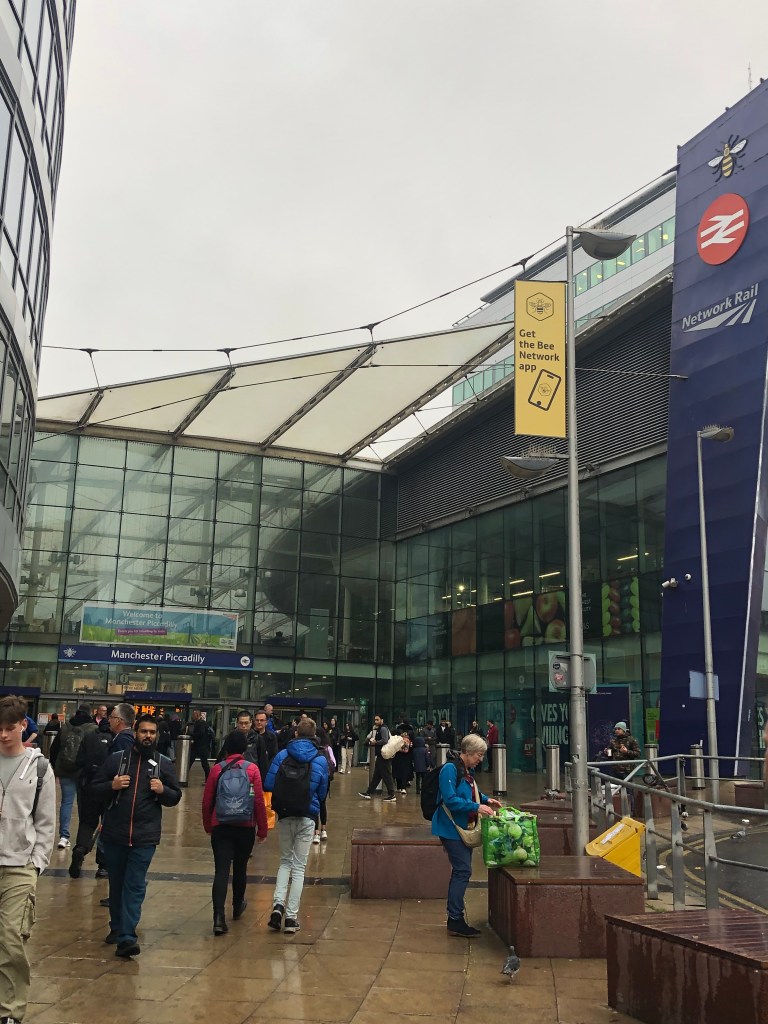
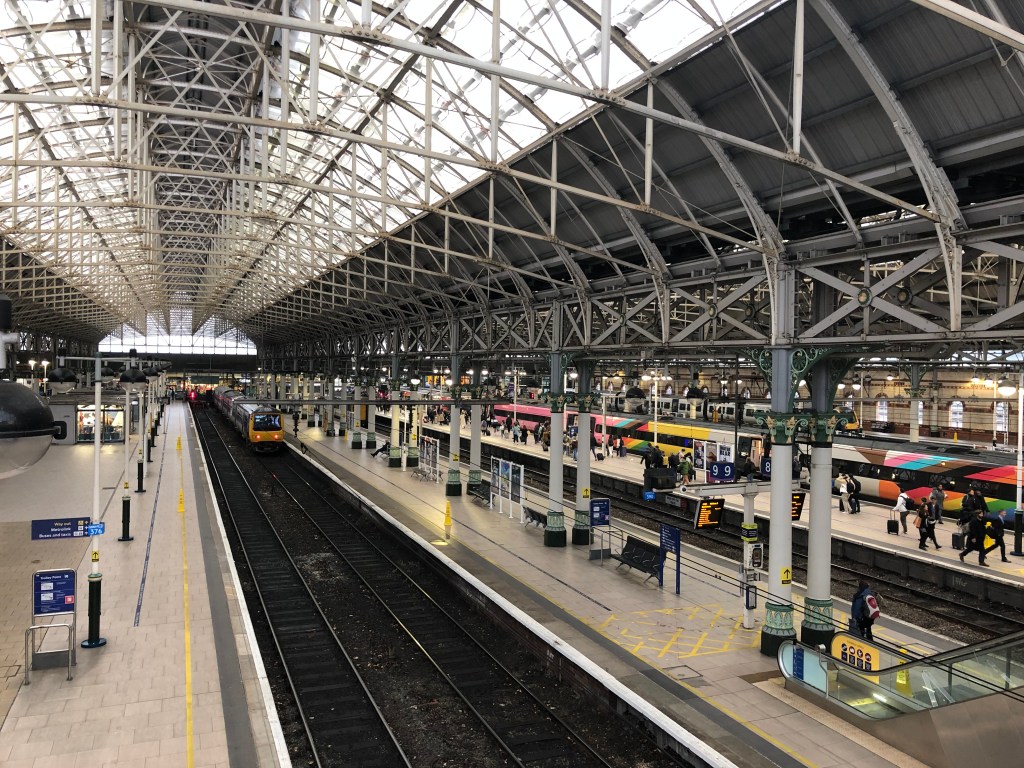
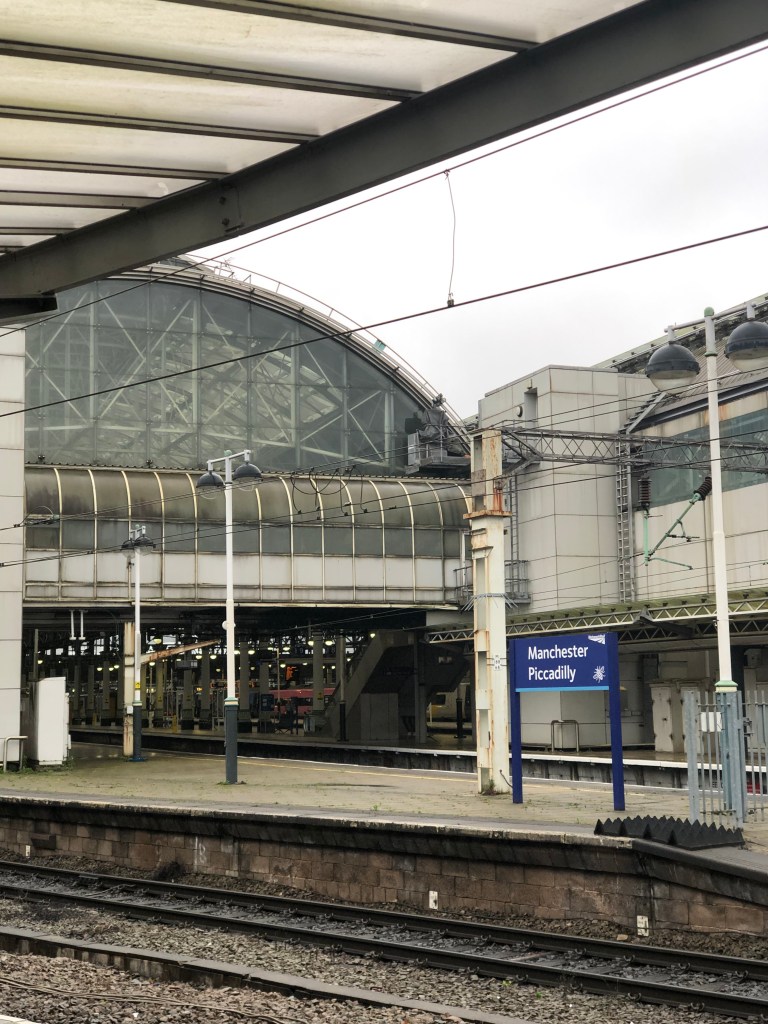
This is an impressive station once you get on to the platforms, a task hindered by the manual ticket check. I show my QR code to a distracted man who scans it and turns away without a word. This is out of character for this part of the world, Manchester is – in my experience – a friendly and funny place, so I make a point of waiting until he acknowledges my existence as one of the humans, then wander to find Platform 13. This isn’t hard, but as it’s a through platform, it’s miles off to the side rather than in a neat row like the rest. I like things to be tidy, but I get they don’t have much choice other than to stick it on the end, so I put up with this clunky asymmetry.
The train is on time, it’s come from Salford Crescent, so it’s probably the one I’d have caught had I kept on my Calder Valley train instead of crossing the centre on foot. It’s busy and functional, like a bus, but it’s efficient, and it’s not long before we’re slowing into the airport’s decent little station. I give a little nod of approval as I get off and look around. I like this station, and appreciate it as a nice bit of joined-up transport infrastructure.
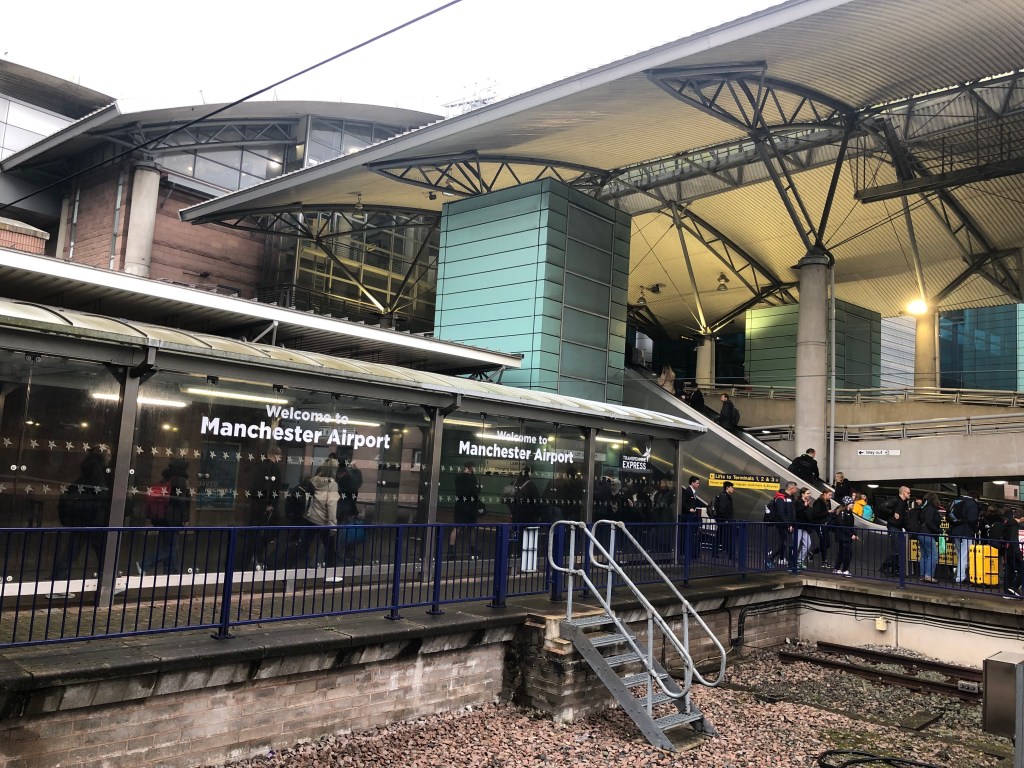
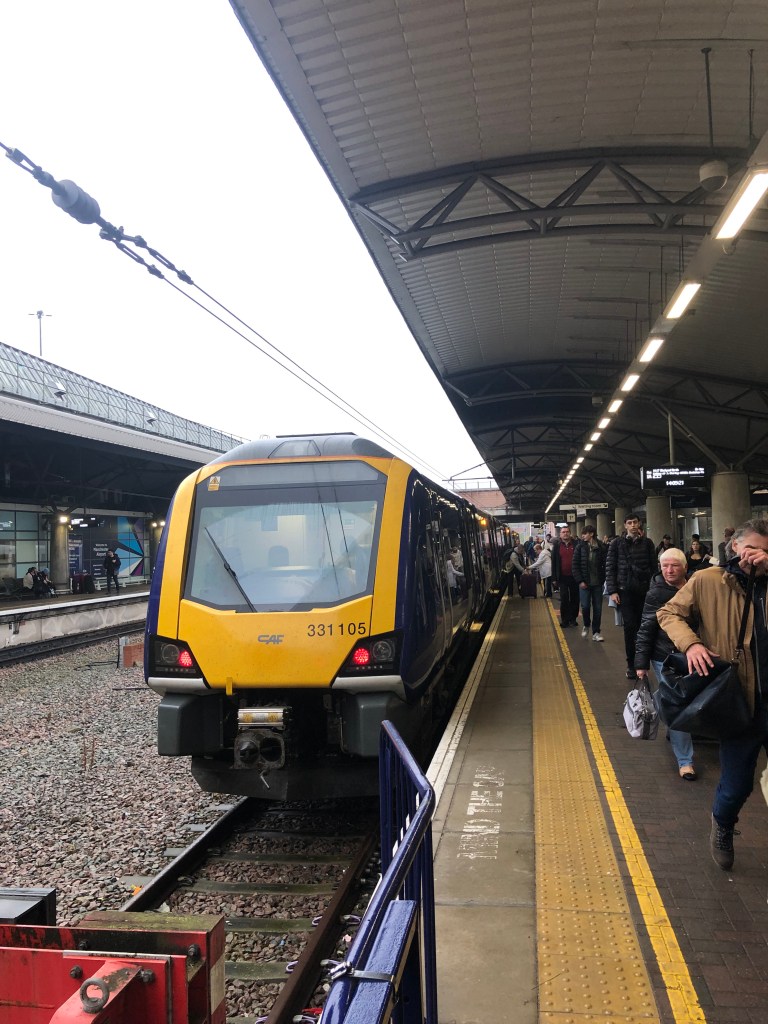
Also redacted for boringness …
I think about going to our old friend Caffè Nero for a coffee and make up for last week’s rubbish breakfast, but I don’t see it when I reach the top of the escalator. I must have come up a different way, or failed to sufficiently crane my neck. I retrace my steps from last week and get to Terminal 3.
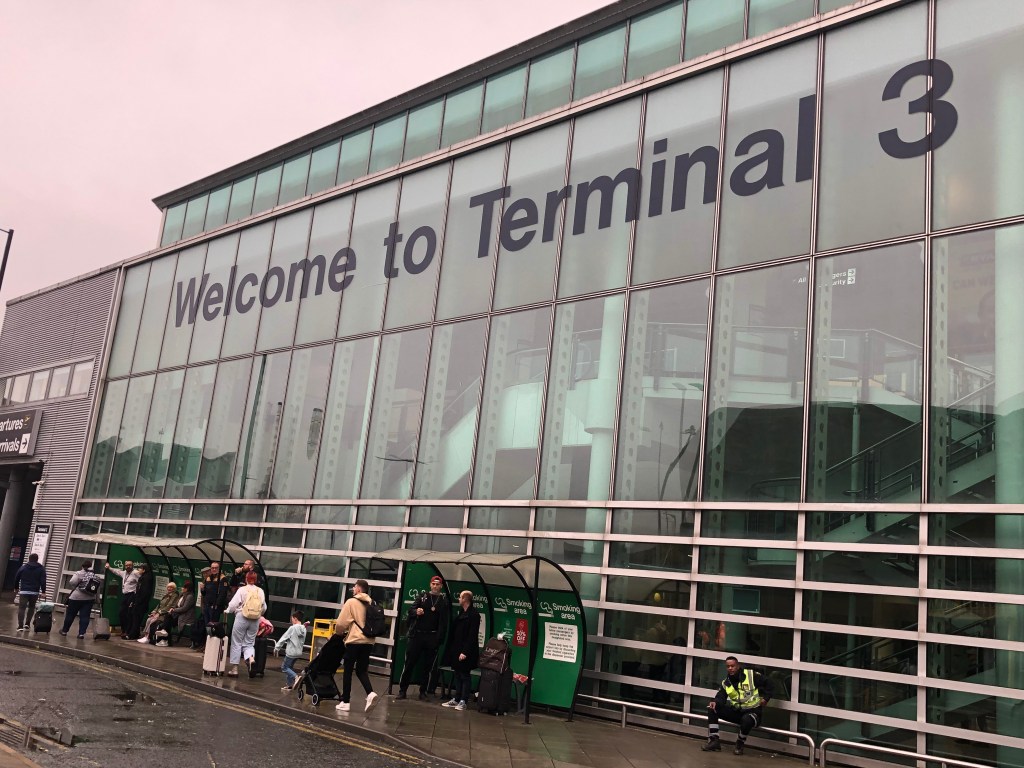
I am enjoying not having to check in, and head straight for coffee at a different Caffè Nero conveniently located near the security gates. I impulsively add some stem ginger biscuits and I’m glad I do because they are excellent. Ginger is almost always a good thing. I find a seat in the corner so I have no-one behind me and I can see what’s going on, and take my sweet time, reading my Robert the Bruce book, and mucking about with my phone which crashes again and repeats the frustrating cycle of crashes and reboots. I sigh and put it away, getting back to my book.
I am surprised to learn the powerful Bruce family were originally Norman-English (de Brus) given English estates by Henry III. Like many Scottish nobles, they had sided with England’s Edward I for most of his early interference in the Scottish succession crisis, triggered when Alexander III died unexpectedly, leaving only an infant Norwegian princess as his heir. Originally Edward had tried to marry his own infant son (the future Edward II) to Scotland’s Margaret, but when the poor girl died soon after arriving in her new kingdom, Edward sided with the Balliol claim over the Bruce’s, mainly because John Balliol was – correctly – seen as more malleable, plus Balliol’s senior line reinforced the idea of primogeniture which still wasn’t completely established in those days. Even then the Bruce clan, feeling culturally more English in those days, didn’t seem to kick up too much of a fuss about it all, although they didn’t recognize Balliol as king. It took Robert’s grandson – also called Robert (our future King Robert) – who had been born and raised Scottish (to a Scottish mother), to side with William Wallace and others a decade or so later when they challenged Edward’s bloody attempts to dominate the country.
That’s as far as I got when I decided to get through security and find the gate.
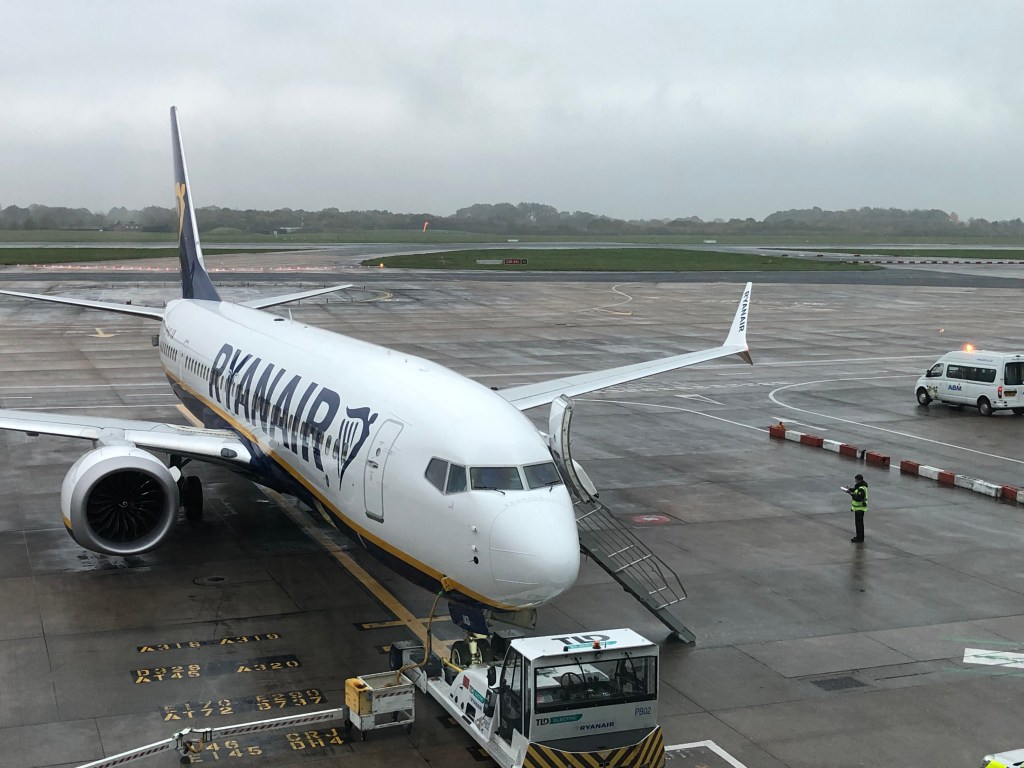
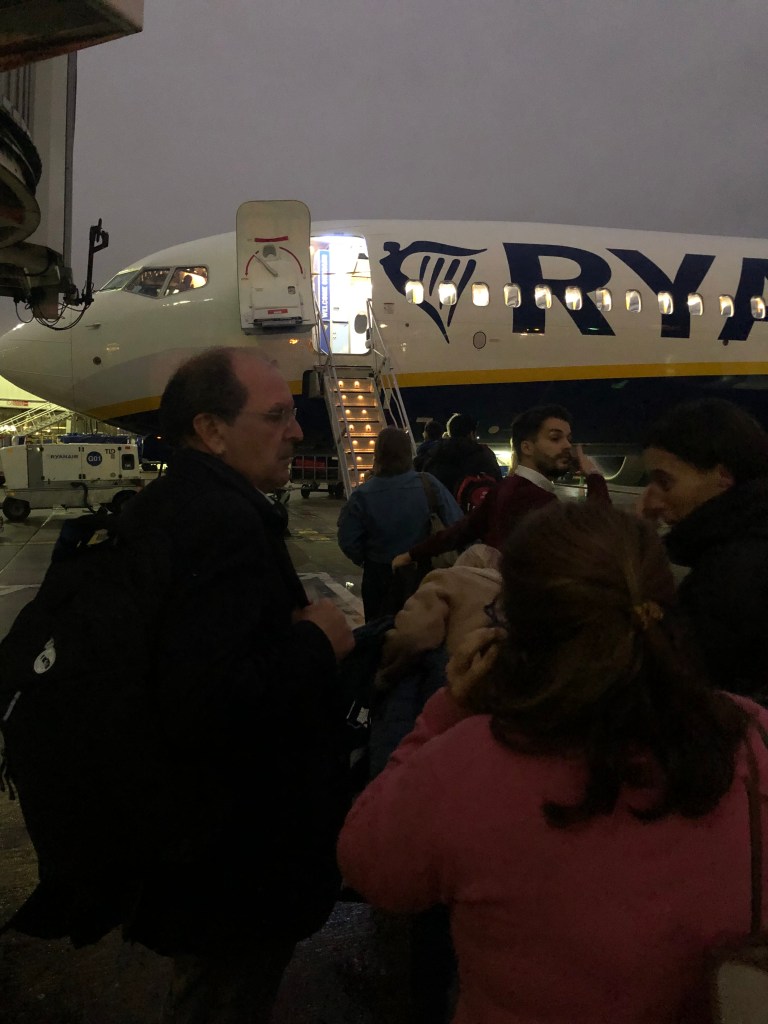
I board the flight, the Cabin Crew are busy doing something else so I don’t even get a hello, but they prove to be perfectly nice and friendly later in our voyage. By luck, I get a row to myself, at least I do once a man wearing a Manchester United woolly hat relocates to a row nearer the front to sit with a friend.
I continue with my book, but soon my eyes are dry and glazing over and I feel the need to sleep overwhelming me. I doze, but not really, and miss not being able to plug into a podcast or some music. Stupid phone.
My journey isn’t over when we land, although my photography is … we get a bus to the terminal, then suffer a long slow passport queue, followed by a walk to T2 to get the metro to Nuevos Ministerios in the city centre, then a local train up to my house … I get home about 11 and fall into bed.
Footnotes
- This is the process the UK follows for investing in the north: (1) major announcement of flashy infrastructure scheme; (2) scaling back to something smaller to be delivered later; (3) cancellation of the northern end of the project; (4) new lick of paint applied to existing bus station. ↩︎
- This claim is based on some dodgy genealogy I found on the internet when researching my family history. Going up my surname line, it’s fairly reliable until the late 1700s, whereby my ancestors – rural working-class stock from northern England – worked as bakers, then drapers, then architects, meaning I am from a line of people who have avoided heavy lifting for over two centuries. Further back it gets murky, but there’s one female line that suggests my family is (illegitimately) descended from the house of Bruce via the Stuarts. This is almost certainly untrue, but until proven otherwise, I’m going with it.
↩︎
 MrJohn