This is just about a short flight to Lisbon, and then a short flight back to Madrid, and being on the train after – not much happens really, but it’s only 33 minutes long, so you should be fine. The podcast version is with my friend Sarah Owen.
Link to the blog post and photos here for those reading via the podcast feed.
You’d expect it’d be easy to get from Madrid to Lisbon by train, but it really isn’t.
There used to be a night train running between the two capitals, but that was stopped in 2020 during the Covid pandemic, and hasn’t been seen since. It is theoretically possible to do it by train, but the best option takes around nine hours and the worst 19, including an overnight stay in Vigo. My searches on Omio and RailEurope showed no availability anyway, but even on other days every option had various changes, and none were sold as a single journey, meaning shaky connections were entirely at my own risk. Spain’s Renfe website denies all knowledge of Lisbon, and has only two trains to Badajoz on the day I needed to go: one was sold out, the other too late for me to get the connection to Entroncamento and then another to Lisbon. Direct trains taking six hours are planned for 2027, and high-speed for 2034, but neither is soon enough for this weekend.
There are buses, with the cheapest Flixbus option being around €10 for the 8-hour dash, but that’s a long time on a cramped bus for a two-day visit, and impossible for me on the way back given other commitments I have the following day, and so with an hour-long flight going for under €40, I sigh and again find myself reluctantly booking to travel by plane.
Cercanias
The Madrid Cercanias network is extensive1 and, since they finished the new(ish) Terminal 4, it connects directly up to the airport – but, in recent months, that connection has been dodgy due to the renovation of Madrid’s tired-looking Chamartín station – the main northern rail terminus built in the 70s – and thus this route has sent my stress levels into the stratosphere on more than one occasion as long minutes had ticked by with no airport-bound trains anywhere. This is why I switched to the more-reliable Metro, but today I’m taking the risk and giving the trains a chance to redeem themselves.
My first risk is to ignore this train sitting on platform 3, about to leave for Madrid, and instead wait for the slightly later, but more direct, alternative that isn’t showing on the departure board.
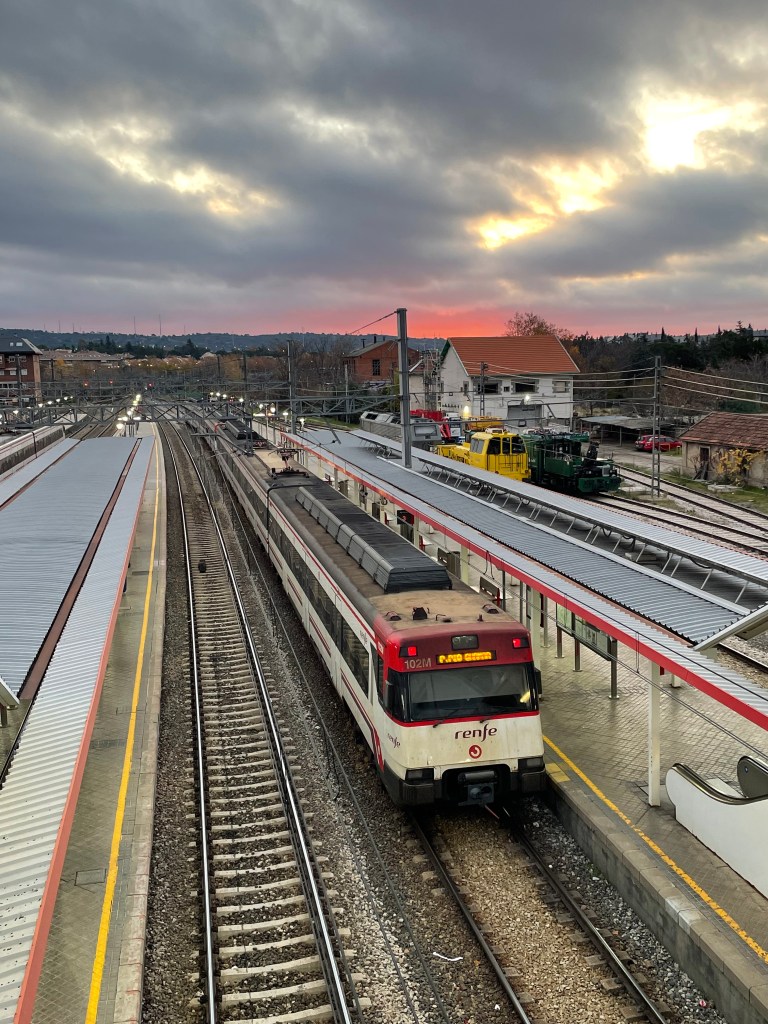
Madrid railway stations like to keep you in suspense about which trains might turn up, and which platforms they might use. It’s not unusual to not discover the platform until one minute before the train rumbles into the station – not great for those with heavy bags or disabilities, but that’s the way they roll – and my train, supposedly due in less than ten minutes, still isn’t showing.
I’ve been here before though, I know their little game, so I don’t panic, and two or three minutes later they release the secret information confirming my train’s existence. Then, seconds before it pulls into the station, they let us into the circle of trust and reveal which platform it’s going to use – although given all the other platforms have trains already sitting on them, this isn’t quite as suspenseful as it might be, and I am already in position waiting with my camera like a proper travel blogger:

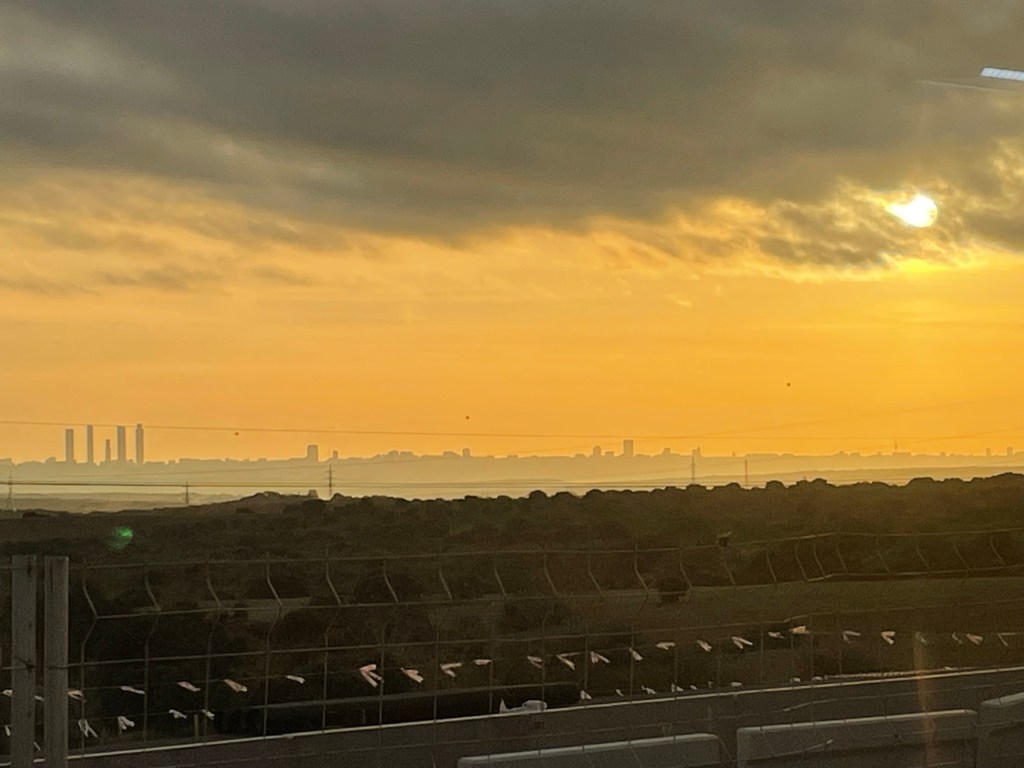
The sunrise is lovely as we plough south and cut through the Monte de El Pardo woodlands that have the Pardo Palace at one end – this used to be Franco’s residence, and is still used by visiting heads of state – and the more-modest Zarzuela Palace at the other – the actual residence of Spain’s royal family (although the current King lives next door in the even-more-modest (but still not very modest, not by our standards anyway) Pabellón del Principe). Between the two is this large park full of deer, wild boar and trains.
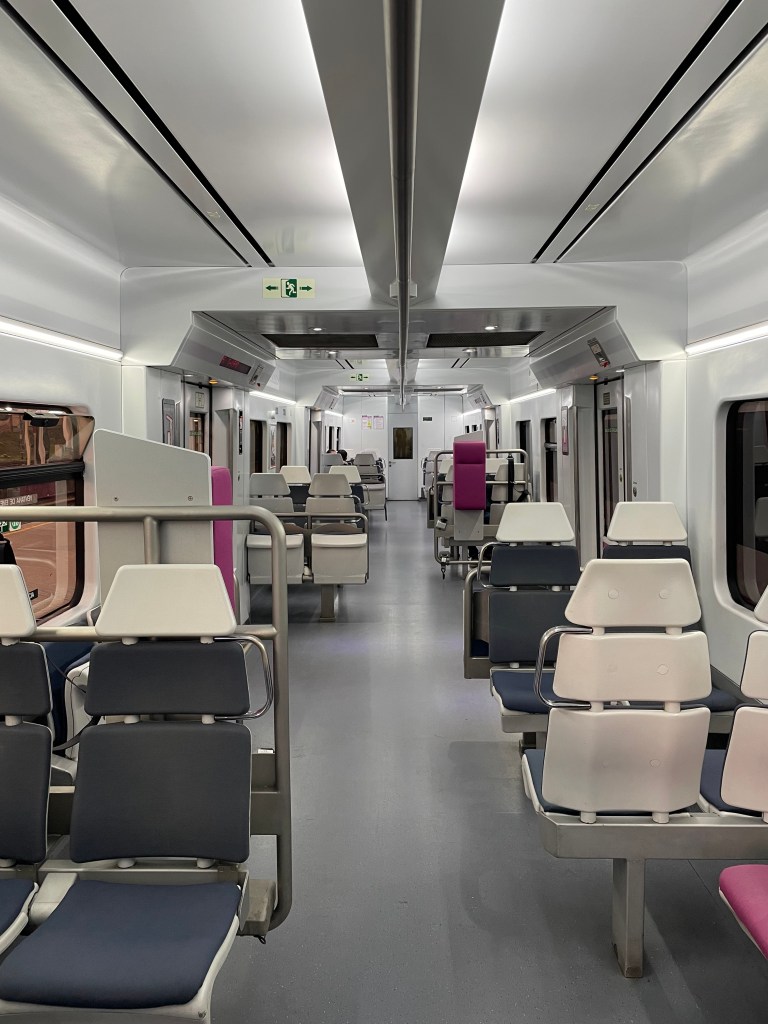
We get to Chamartín and I have one minute to get across to platform 11 to make the tatty old double-decker train heading the short distance up to the airport. The trains just ping back and forth between Chamartín and the airport at the moment, a temporary change to improve reliability while the renovations are going on. It’s good to have them back, I prefer trains to metros any day, although this cramped double-decker is a poor choice for people with luggage.
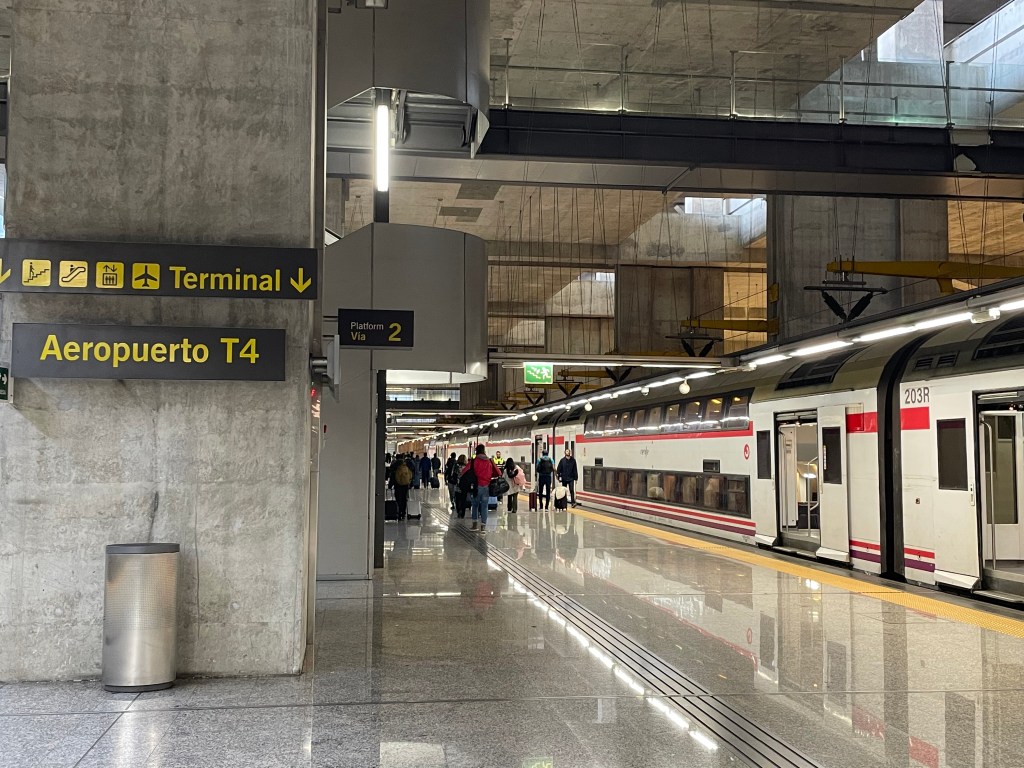
I make it, slightly out of breath from running and dragging my bag up the stairs, but I needn’t have been so fleet-footed as the train waits another couple of minutes before stirring itself into action and dragging us the three stops to T4. A proper blogger would have waited for the next one and created some content about the station, but as it’s in a bit of a mess mid-renovations, I will save that treat for another post.
Madrid Barajas Airport
The airport is packed, and I sigh. It’s not that I hate people individually, but when they cluster together into crowds, I admit I am not a big fan. Arguably I am contributing to the busyness by also being here, but I don’t look at things like that and see my presence as a net positive for the airport, unlike everyone else who are just annoying and cluttering the place up.
This is the reason airline loyalty cards work: air travel and airports are so frustrating and uncomfortable that things like fast-track security, private lounges and priority boarding are genuinely valuable things to have2.
Annoyingly, our Gate is K93, as far away as possible in a very long terminal …
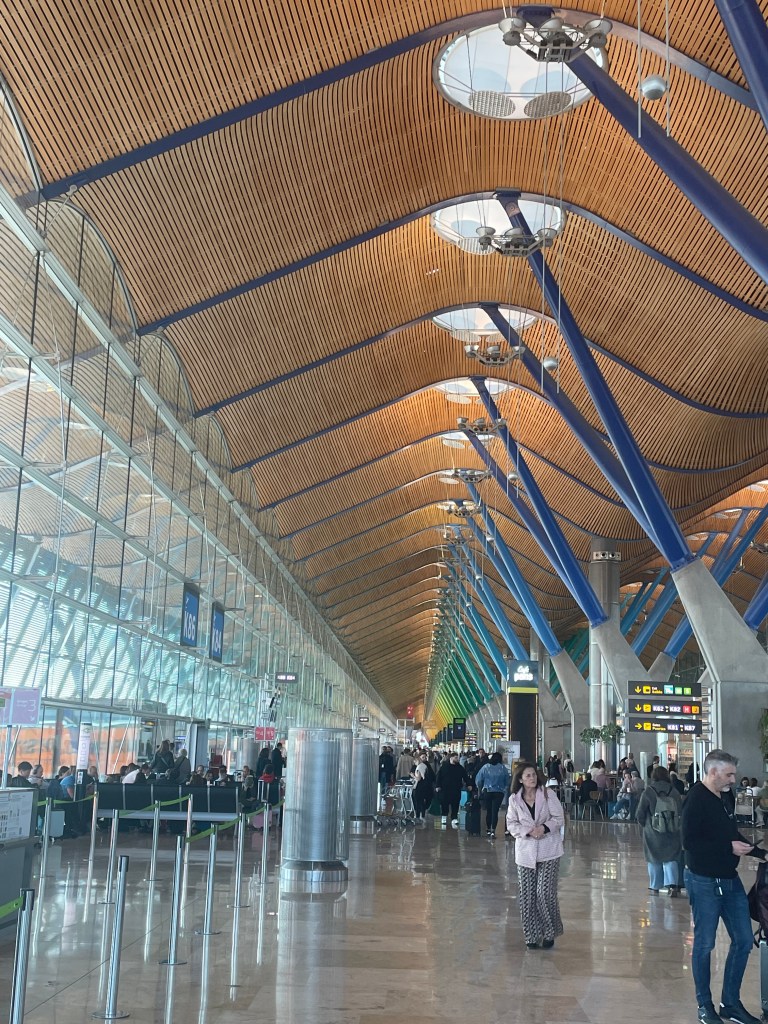
… this is Terminal 4, designed by Richard Rogers Partnership, and winner of the 2006 Stirling Prize for architecture. The photo above is from the far end, by K93, and today is the first day I noticed that the struts are blue by the K gates, yellow by J and another colour by the H gates at the far end – I can’t see that far, this terminal is exactly a kilometre long.
I realize why we’re on K93 when I see our plane is a tiny dart-shaped CRJ1000, and we need to board via the steps. K93 is in the corner, and connects to the tarmac via a rather nice add-on escalator that I don’t think was in the original award-winning design – Richard Rogers might be a smart cookie, but he didn’t think of this one.

The short hop to Lisbon
The flight is on Air Nostrum, a Valencia-based airline subcontracted to operate mostly as Iberia Regional (you can’t buy tickets from them directly). It doesn’t fly the usual Airbus or Boeings like every other Tom, Dick or Harry with an airline; it only operates smaller craft like this CRJ1000 (100 PAX) or the smaller CRJ200 with half that capacity.
The seats are a squash and a squeeze given the 2-2 configuration, and in my aisle seat I am constantly buffeted by passengers getting on after me. I can’t do much about it, if I lean to my right my seat mate is so close I will risk ending up on some police register.

It doesn’t matter, the row directly in front is free and as soon as the seat-belt sign is off, so am I, grabbing the window seat as we clear the Guadarrama mountains and roughly follow the course of the Tagus down toward its mouth at Lisbon.
Rivers are my favourite geographical feature, and not just because you can kayak down them, although that’s great, but because they are transport infrastructure, and because of their impact on history and humanity. The Tagus, being the longest in Iberia, is fascinating, and its basin contains both capitals: Madrid and Lisbon, as well as the ex-capital of Toledo. It is blocked by multiple dams these days, so I won’t be kayaking down it for my next exciting adventure. A pity, a capital-to-capital theme would have been proper travel blog content!
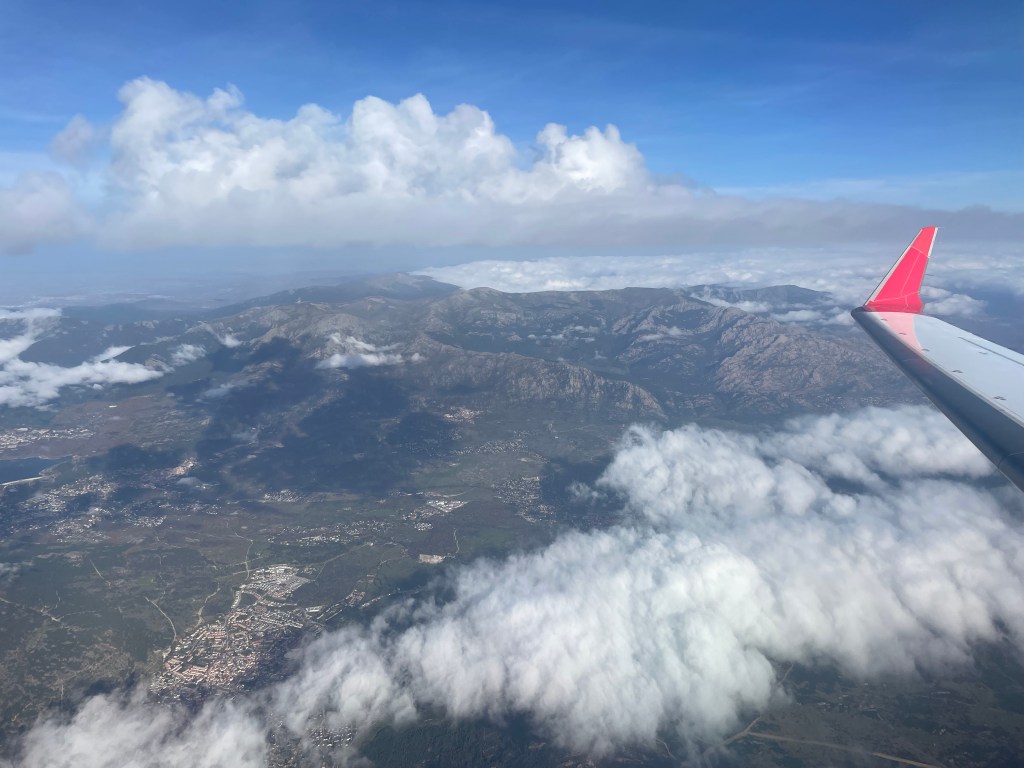

The Guadarrama mountains in the photo on the left ring the north of the Madrid province, forming the edge of the Tagus basin. This watershed means a drop of rain falling to the south of the ridge will, left to its own devices, end up in Lisbon, whereas one falling milimetres further north will end up in Porto via the mighty Duero / Douro – Iberia’s largest river (by volume).
Maybe I can do a source-to-sea mission down the Tagus – it rises in the Albarracín area, arguably Spain’s most-beautiful village, and an area known for brilliant cheeses … but then the Duero is one of the best wine regions … cheese or wine? … decisions, decisions ….
We land at Lisbon’s Humberto Delgado airport, named after a Portuguese air force general, politician and founder of their national airline TAP – not my favourite airline in the world. This airport is due to close in 2034 when they complete the new one south of the river (Luís de Camões Airport), and I won’t miss it. It’s not a bad airport exactly, but it is, like many airports, a bit of a jumble as an original building is extended and extended over time, meaning it doesn’t flow, and has quirky oddities like the route to get to baggage reclaim which feels more like entering a broom cupboard than the main way out.
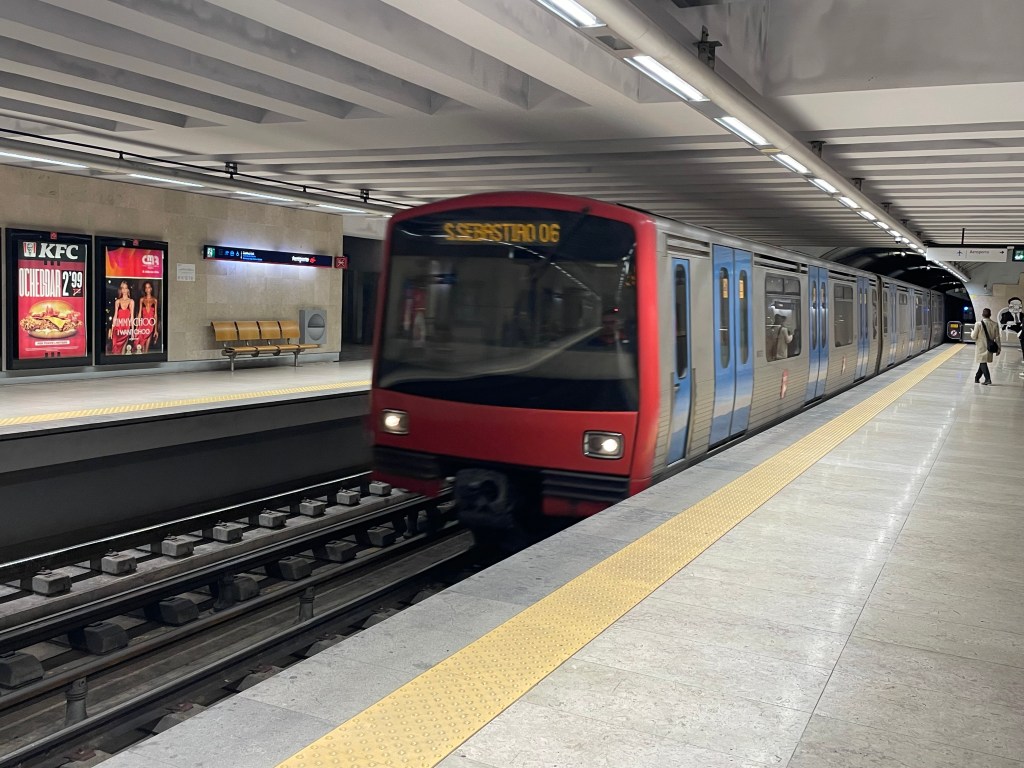
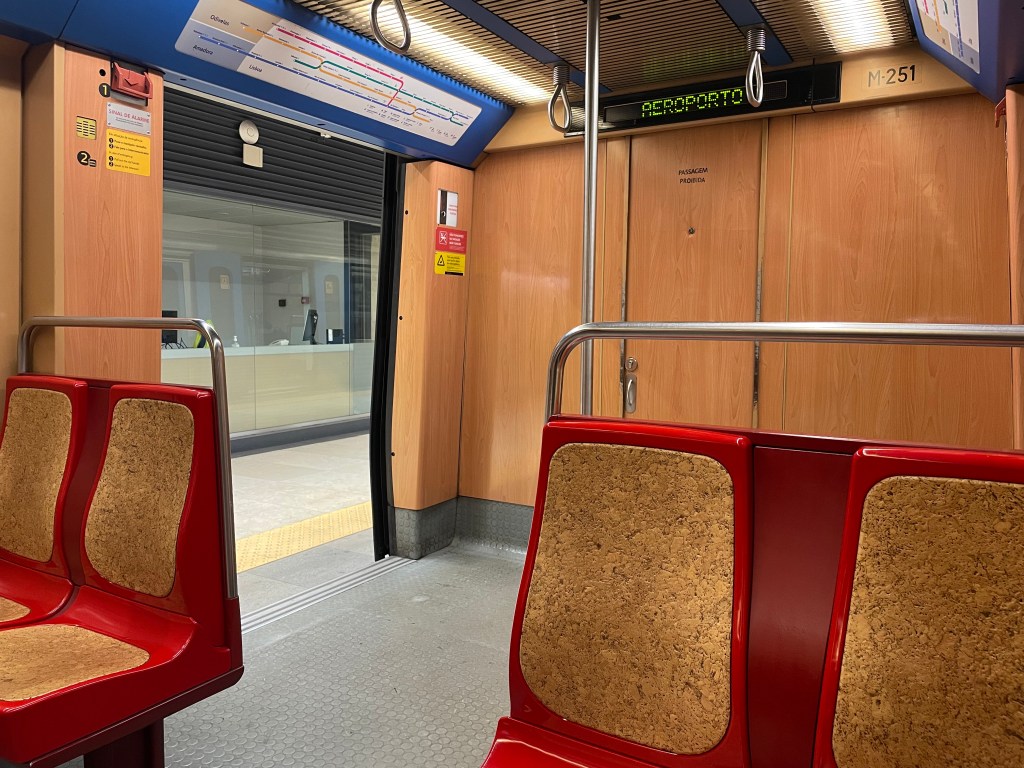
Despite this, I find my way out and am soon on the Metro – relieved to be able to tap on with a credit card rather than have to buy a pass and charge it with credits. The Metro is noisy and charmingly old, and has a nicely-designed criss-crossy schematic map that I like a lot (you can see it above the door on the photo on the right). It’s not a very extensive metro system, and could certainly do with a few more lines to better serve this lovely city, but this is a seismic area, so perhaps the options are limited. Anyway, I will save re-designing the mass-transport system for the moment, and instead focus on getting to my hotel for lunch.
Back up the Tagus
Two short, busy, exhausting days in Lisbon, with no blog content to show for it! I like to offer recommendations where I can, so will offer this from a previous visit: I had a wonderful pizza at a place I can no longer find, and think must have gone out of business, so unfortunately I cannot recommend that, but I can point you toward the lovely craft beers they served from the Minho region of northern Portugal called Letra. The busy waitress found me annoying as I asked for details about the beer, and when I shared this observation with my companions, one said “a lot of people find you annoying” which wasn’t the best moment in my life.
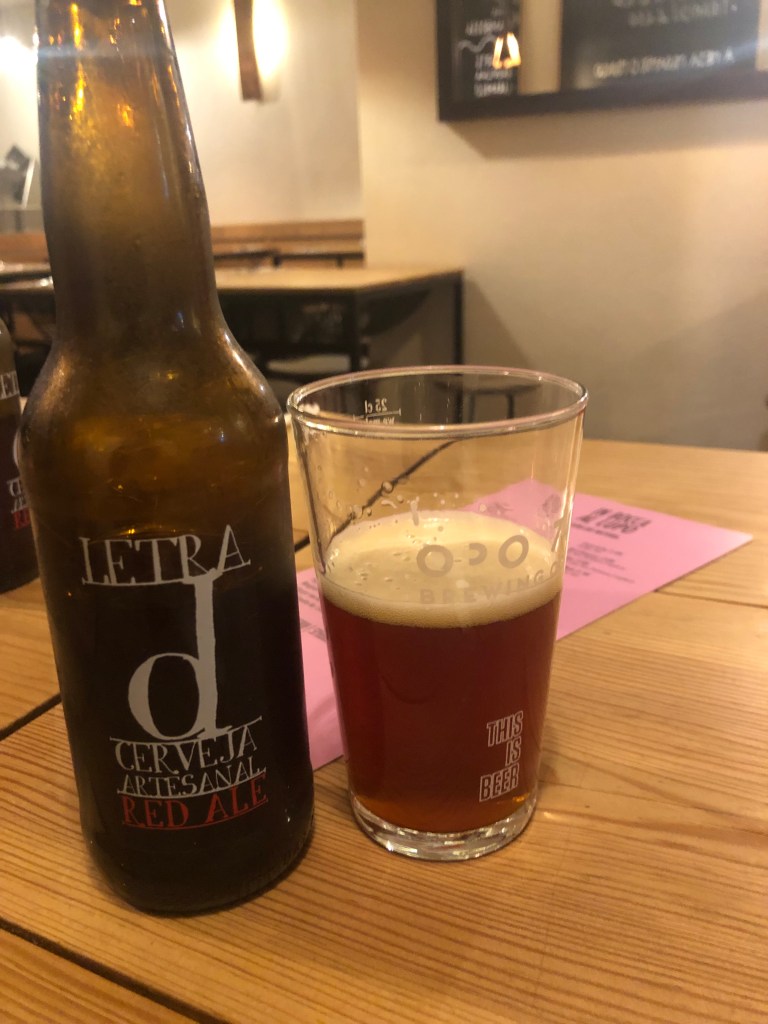
Anyway, enough about my problems, let’s get back on the Metro and up to the airport.
I march through the terminal, trying to remember the way, mentally confusing it with Brussels and so forgetting which way the gates are. I make it through security and ponder why some security guards think their job description includes the line “must not have sense of humour”. I pick up some wine in Duty Free and some pastéis de nata in another shop, then decide to check out the posh VIP lounge because I need a bit of peace and quiet. It is exactly the opposite, it’s over-crowded and noisy, and looks like it was last cleaned back in the 1970s. The few scraps of food available look like leftover school dinners and I think buns to this, and march back out again, hoping they’ll ask me why I am leaving so soon, but they don’t and so I don’t get to complain. I re-enter the much nicer world of non-VIPs in the main terminal.
I skipped lunch and barely ate any breakfast so am starved, and therefore make the absurd decision of ordering a beer and a burger, drawn as I was to the brie and mushroom topping. I’d have been much happier with just the brie and mushrooms, but there is something in my reptilian brain that is triggered by the sight of certain stodgy foods I associate with my childhood … there’s a greasy burger and chips on offer that will make me feel fat and sick, or there’s some sensible wholemeal toast with grilled mushrooms and brie served with a pot of green tea, after which I will feel great … burger it is!
I walk to the gate feeling fat and sick.
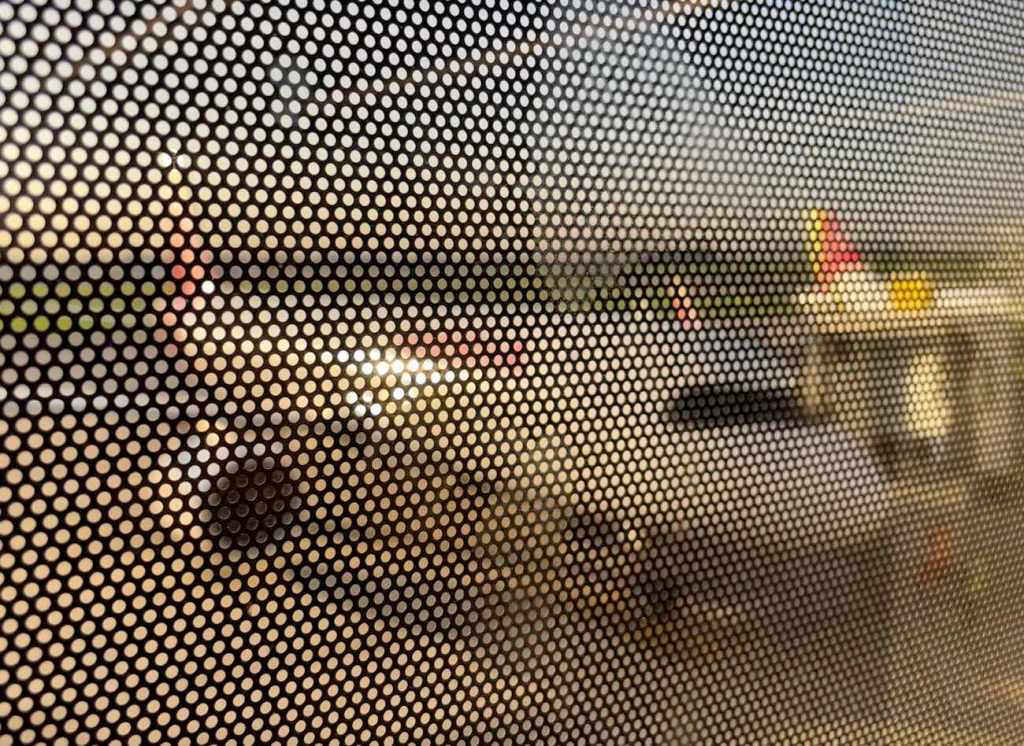
The plane pulls in as I arrive, but the grill on the window prevents a decent photo, although I quite like the effect:
I find the queue and ask a man if this is the line for Group 1, but he’s on the phone and rudely says, “I’m on the phone!” and then walks away, finding me annoying. I decide I don’t like him, and he is the annoying one, and wrong to behave that way, and then I try to work out why he was wrong, eventually concluding that he was probably right and it was rude of me to interrupt his phone call … so it’s probably me that’s annoying and wrong … so now I dislike him even more.
I get on the plane and sit down. There’s a man who looks vaguely like The Edge from U2, although this is mainly because of his beanie hat and beard, but I spy a man at the far end who looks very slightly like Adam Clayton, and I wonder if this plane is going to be full of people who look a bit like members of U2.
The man who looks a bit like Adam Clayton gets closer and doesn’t really look anything like him at all. At best, he has a slight resemblance to an old Boris Becker, but even that’s a bit of a push.
I am later surprised when no other passengers look anything like Bono or Larry Mullen Jr, and it takes a moment to realize that there is no reason why anyone would.
The short flight is busy but uneventful, we are presumably flying back up the Tagus but I don’t see any of it because I’m in an aisle seat. We land comfortably on time and I rush to the train, dodging slow people as I power my way through.
There’s a man on the platform asking a couple something, I am already on the train and can’t hear what they are saying, but as they don’t know the answer, they get on and ask me in Spanish, “do you know if this train goes to Atocha”. I know this one, so answer in Spanish that it doesn’t, that the train only goes to Chamartín because of the renovation works, and so he’ll need to change.
They put this into a translation app and it barks it out to the man in English.
He doesn’t like this answer, so gets on board the train and asks me in English the same question and I explain in English that the train only goes to Chamartín because of the renovation works, and so he’ll need to change.
He doesn’t like this answer any more than the first time I said it, so he points to the C3 route map on the wall of the carriage, clearly showing Atocha, and then traces his finger along the line looking for the airport … there’s no airport on the C3 route map because we’re not on the C3 route, but he doesn’t like this answer, so he asks a woman who’s just got on and she says yes, the train goes to Atocha, and he likes this answer and so sits down near her.
I, conscious not to be seen mansplaining anything, but also feeling the right thing to do is to speak up – not that I am ever really sure what the right thing to do is – and so I say, “I think it only goes to Chamartín because of the renovation work being done on the station.”
The man is now finding me annoying, but is buoyed with confidence because he’s heard an answer he prefers, points to the C3 route poster to bolster his argument, and I, pointing to the equally irrelevant C5 route map on the opposite wall, say, “Yes, but this isn’t C3, and nor is it C5.”
“Which route is it then?”
“C10,” I say, and then add, “but the C10 line is cut because of the renovation work being done on the station. It now stops at Chamartín and from there you change on to one of the dozen or so trains that connect to Atocha.”
He doesn’t like this answer, and he and the woman find the route map for C10 further up the carriage and are pleased to see that it clearly says the train goes to Atocha.
They return and explain to me that C10 does go to Atocha, and I decide to shut my mouth in case I’m wrong. We’ll find out when we get to Chamartín anyway.
The man settles down, happy in the knowledge that he’ll soon be effortlessly connecting to his Seville train in Atocha, and the woman watches something on her phone. The train leaves. I am uncomfortable because, in a few minutes, I am going to be proven right. I don’t like being wrong, and definitely prefer being right, but I don’t want to crow about it or make anyone else feel bad, I was only trying to help.
The train pulls into Chamartín and a rattly announcement on the tannoy explains that this is the end of the line.
The man is confused and asks the woman about this. He’s not sure what to do now because he was pretty sure this train was going to Atocha, yet it has unexpectedly terminated at Chamartín.
The woman looks at me and explains she thought the train went to Atocha.
I shrug and say yes, she’s right, normally it does, but now it terminates at Chamartín because of the renovation work being done on the station.
She heads off for her train to Salamanca and I help the man get to one of the six or seven trains about to leave for Atocha. He finds me annoying, and elects not to hide it. I think he blames me for the train terminating here and not continuing to Atocha, as per the map and the woman, but what he thinks of me is not really within my circle of control, and so I gently point him in the right direction and head off to find my own train. I am now very tired, and still feeling fat and sick from the greasy food I still can’t believe I ate (I thought I’d grown out of this!). I get on the train, now bored of taking photos for travel blogs, and think about going to bed.
Footnotes
- Their translation of cercanias is “Suburban Railway” but I don’t like this very much, because it’s urban as much as it’s suburban, and it also stretches beyond the burbs. The word cerca means near, and cercanias translates as surroundings, so Cercanias in this context means something like Local Trains. ↩︎
- I have no idea how aviation bloggers (like Noel Philips) do it – air travel really is the absolute worst form of travel and a terrible way to spend time. In my case, the expectation is I will always travel the cheapest possible way, which (unless I’m travelling within Spain) is invariably air travel, so it will take a bit of courage, a lot of time, and a fair chunk of money to get off the planes and on to the trains. ↩︎
 MrJohn