This post and podcast is about a brief trip to Vilnius (with a bit of extra content from 2016 thrown in for free). The podcast version is with Rebecca Smith.
For those reading this via the podcast feed, here’s the link to the blogpost City of Strangers.
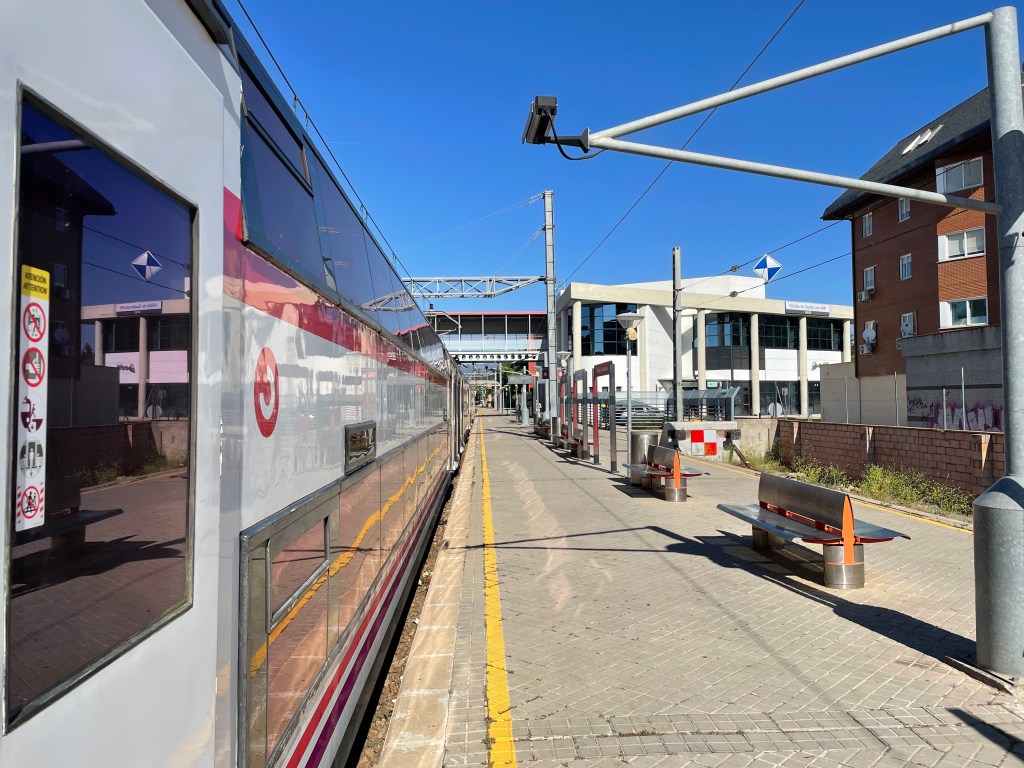
I sit upstairs on the train.
I don’t usually sit upstairs in summer because it gets too hot; the shaded lower deck is the smarter option. Today though, I’m anxious about the whole trip and not really in the mood for any of it, so naturally I decide to break my routine and head upstairs.
I’m immediately sorry I did.
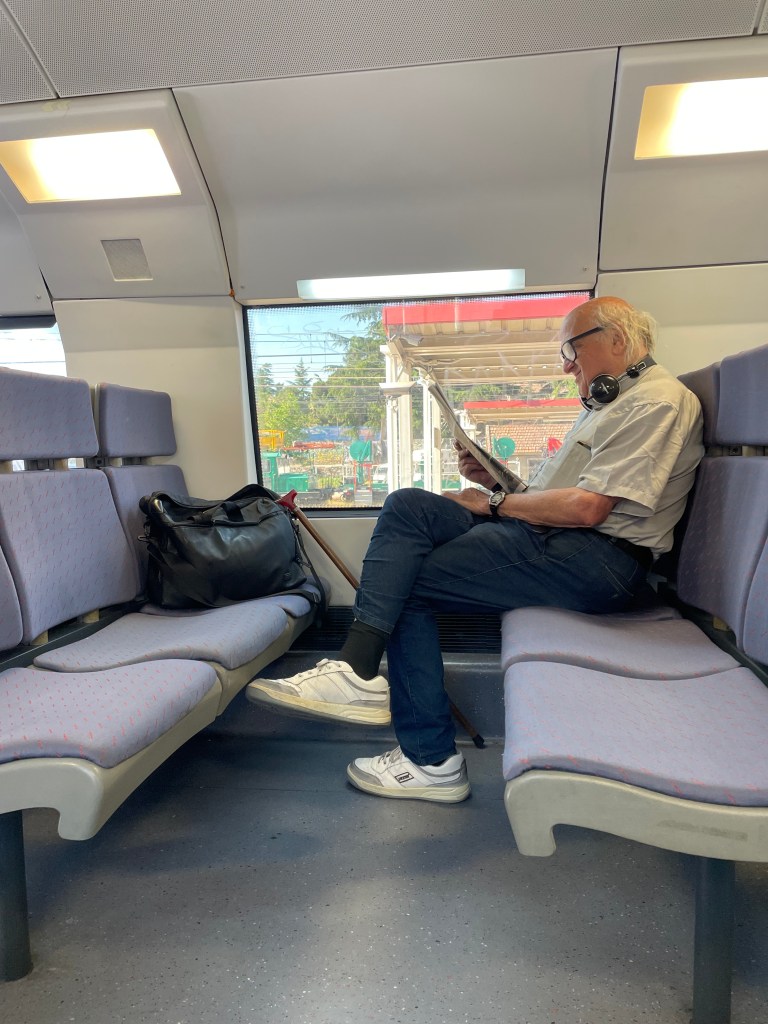
The man opposite is reading the news on an actual newspaper, which feels faintly reassuring in an olde-world sort of way, but then he’s providing an audible commentary on the political news of the day, repeating “hijos de puta” time and again.
Literally it means “sons of a whore”, although “sons of bitches” is probably closer in spirit, so perhaps his analysis is accurate, metaphorically, but it’s still annoying.
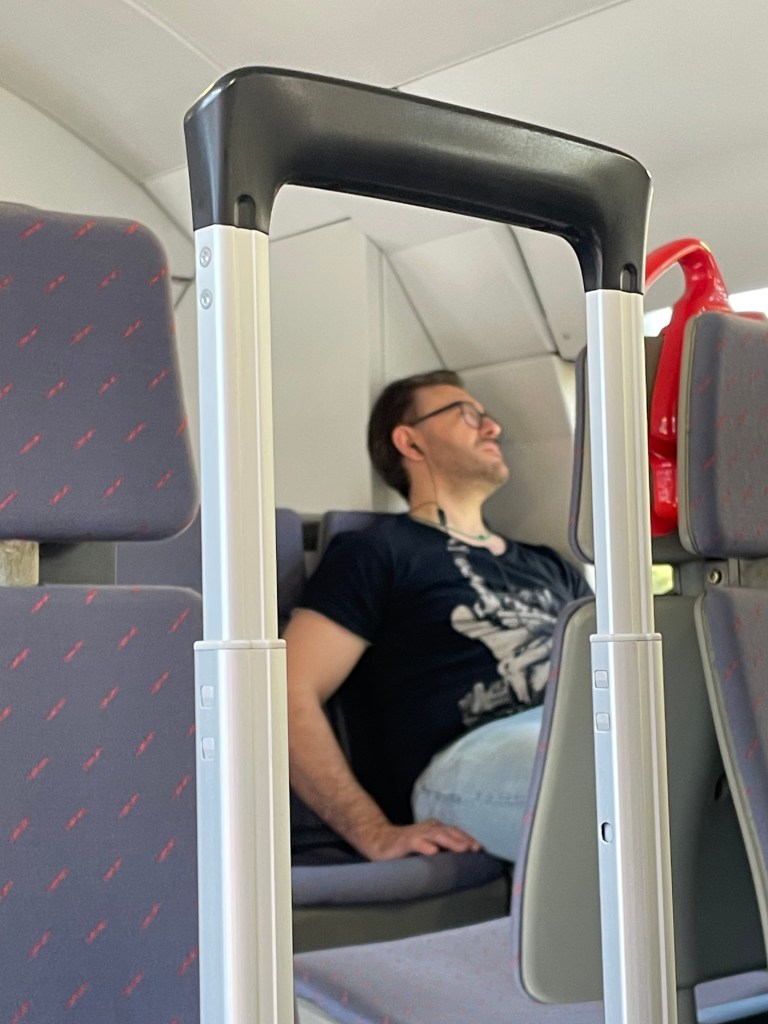
The man in the seat in front of him – diagonally opposite me – is having a loud telephone conversation and saying “puta madre” a lot, which literally means “whore mother” but better translates as “brilliant”.
“Puta” is an ugly word, but it’s flexible.
Two people, both annoying … this doesn’t bode well for the journey and I am reminded why I don’t like strangers.
I mean, why do people have loud telephone conversations in public?
Public transport used to mean mutual avoidance; now it means involuntary participation.
As an introvert, I find the idea of strangers overhearing my private conversations excruciating. I am listening to a podcast with Ryan Holiday and Olga Khazan as we chug toward central Madrid. She is talking about her new book Me, But Better in which she challenges the notion of personality being fixed, arguing that we are what we do. Apparently she trained herself to become more extroverted. I’m not convinced I want that. The ability to fill a railway carriage with one half of a phone conversation doesn’t strike me as personal growth.
Hijos-de-puta-guy decides to start watching a video about how to change the privacy settings on his phone. This is ironic because he’s doing this very un-privately, and also because he has a pair of headphones clinging to his stupid neck which he could use if he wanted to.
Another point chalked up for us introverts.
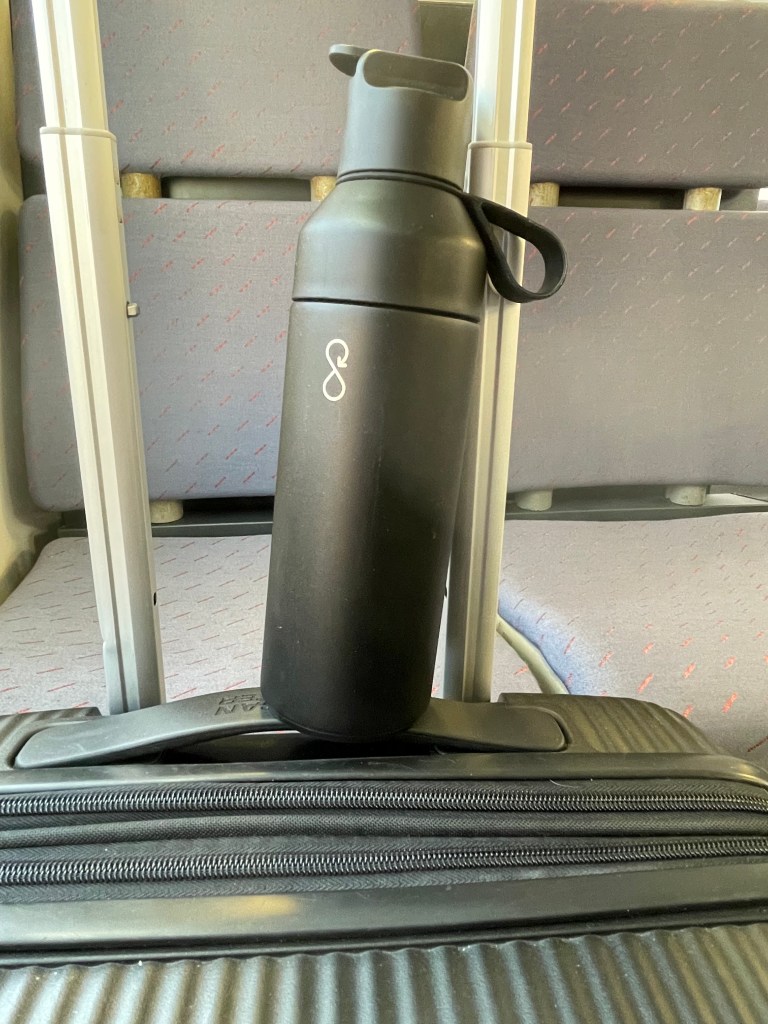
I sip water from my Ocean Bottle. I briefly feel morally superior to both these hijos de puta, because every time I refill my bottle, some plastic gets taken from the ocean somehow – although I don’t really understand how.
We are often advised that we should stop caring so much what other people think, which is useful advice up to a point. Fair enough if it stops you wearing your favourite hat or trying something creative like writing a travel blog. But somewhere along the line some people interpreted this as meaning “play TikTok videos out loud on public transport”. That cannot be what the philosophers intended.
I get to Nuevos Ministerios train station and cut across to the metro, and am soon at the airport. I am travelling with hand luggage only, so can use the Terminal 3 entrance.
Madrid Airport doesn’t really have a Terminal 3 so much as a few extra gates bolted awkwardly onto Terminal 2. You can’t really check in there and there’s no proper arrivals hall, but crucially it still has security, meaning hand-luggage travellers can sneak in through the side door and avoid some of the chaos.
Our gate is at the far end of the T3 spur, the very last one in the lengthy run of gates from A1, yonder in Terminal 1, to E89 here on the pointy end of the Terminal 3 north dock.
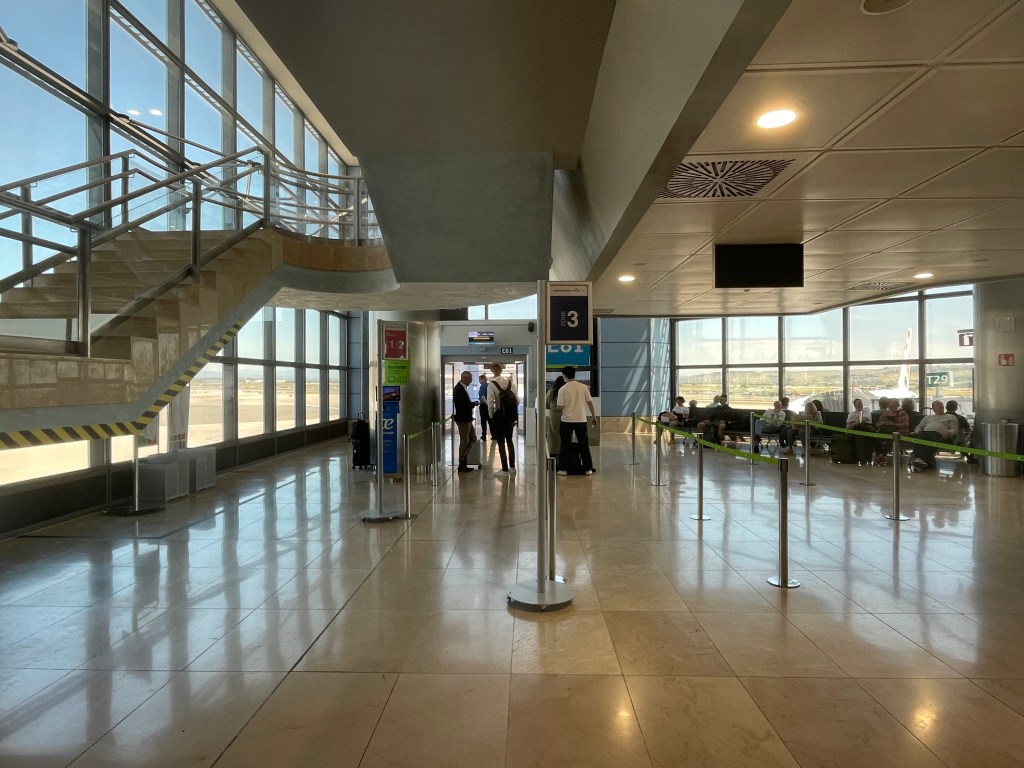
I stand at the front of the line for Zone 4, even though I’m in Zone 5, but I was a bit confused by the signs. Others line up behind me, then slightly to the side, as if I’m not really there. People line up for Zone 5 a bit to the other side, so I edge that way. I am surprised the people behind me seem to think they’re allowed to go in front, even though I’m definitely there and definitely in front of them, and haven’t formally ceded my spot.
Zone 4 is called and the people behind me surge past as if I’ve become temporarily invisible. Technically they’re right because I’m actually Zone 5, but they don’t know that, so it feels slightly rude. I guess they’re fully signed up to the idea that you shouldn’t worry about what other people think, not even people in front of you in the queue.
I sit on an aisle seat, but the plane’s not busy so there’s no-one in the middle biffing at my elbows. I am reading Adrian Edmondson’s autobiography Beserker, which is very good. I like Adrian Edmondson as a person and as a performer, and – and this is controversial, so hold on – I think he increasingly outshone a staid Rik Mayall, his comedy partner, who was starting to look like a one-trick-pony by the 1990s. Edmondson’s greater versatility and broader vision eventually had more staying power than Rik’s ground-breaking show-stealing, but ultimately one-dimensional, brilliance in The Young Ones and Blackadder.
The Young Ones was my generation’s big moment – labelled “alternative comedy”, the equivalent of Monty Python or The Goons to previous generations. It was a seismic step change in comedy, no more joke telling by racist and sexist smug middle-aged working-class white men, this was middle-class sweary slapstick with a social conscience.
It rocked my world back then, but looks dated now – alternative comedy fizzled out, replaced by more coherent wordy comedy like Blackadder, then the sketch shows and satire of the 90s … but back to Edmondson … the relationship with his Father is interesting. He talks a lot about the absence of love and how this affected him, about how they were virtual strangers. This didn’t hold him back, he didn’t confusedly try to do the right thing to gain approval like I did; his self-confidence wasn’t diminished by his brutal school years and lack of parental attention, instead he did his thing with anger and abandon (“berserking“), determined to prove himself.
The person behind me is using my chair to practise their percussion rudiments, and as much as I enjoy a good bit of drumming, it’s starting to annoy me. I think about turning around and delivering a hard stare, but instead I think evil thoughts to myself and get back to my book.
It’s freezing cold on the plane. I go to the loo and it’s surprisingly warm at the back, and the cabin crew confirm it’s warm in Business Class too, so it’s just us stuck in the middle, in hypothermia class, who are left to freeze.
At least Buddy Rich behind me seems to have calmed down – perhaps hypothermia has finally silenced him.
Fingers crossed.
We arrive on time, and I make my way across Schipol to the B gates, entirely forgetting I’m supposed to be a blogger so there’s no video, audio or photos.
The next flight is on Air Baltic, which I didn’t expect, I thought I was on KLM the whole way. It’s an Airbus A220, which I only mention because it has an unexpected 3-2 configuration throughout, which I’ve never seen before. I’m not remotely an aviation enthusiast, but a 3-2 seating layout feels fundamentally wrong somehow, like a typo made physical.
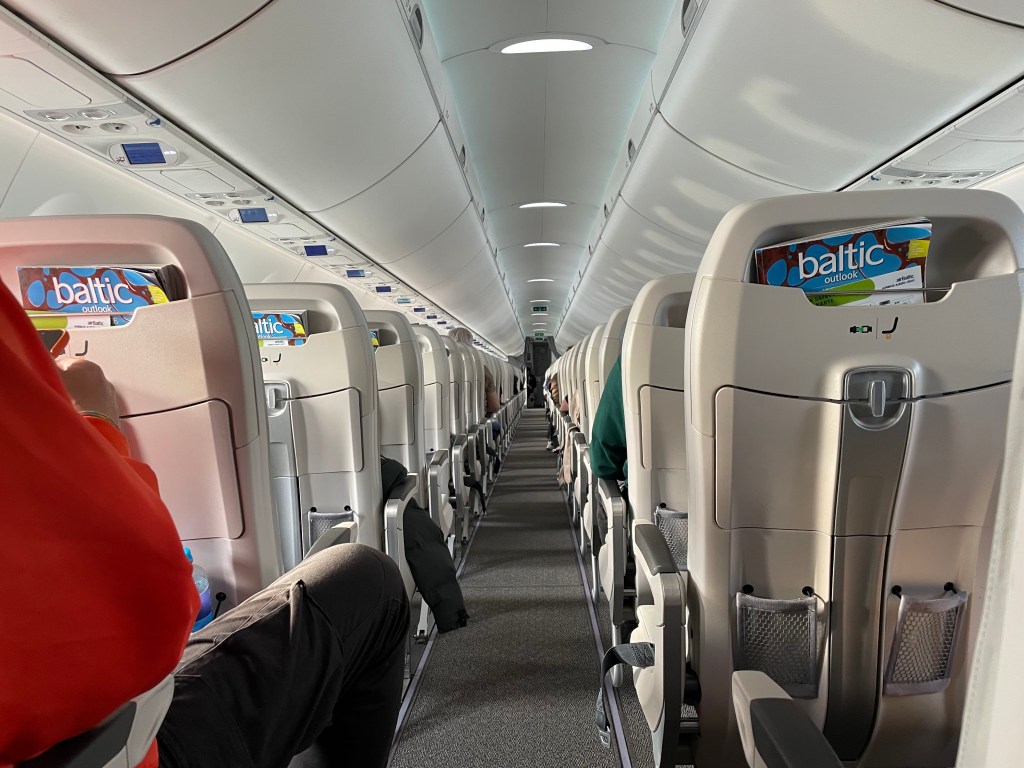
I’m not complaining, an uneventful flight is the best kind, no one wants to live through interesting aviation times. We all want to land safely with the undercarriage intact, ideally on time, and preferably without the police needing to board to drag unruly passengers off – and this flight is, thankfully, completely uneventful.
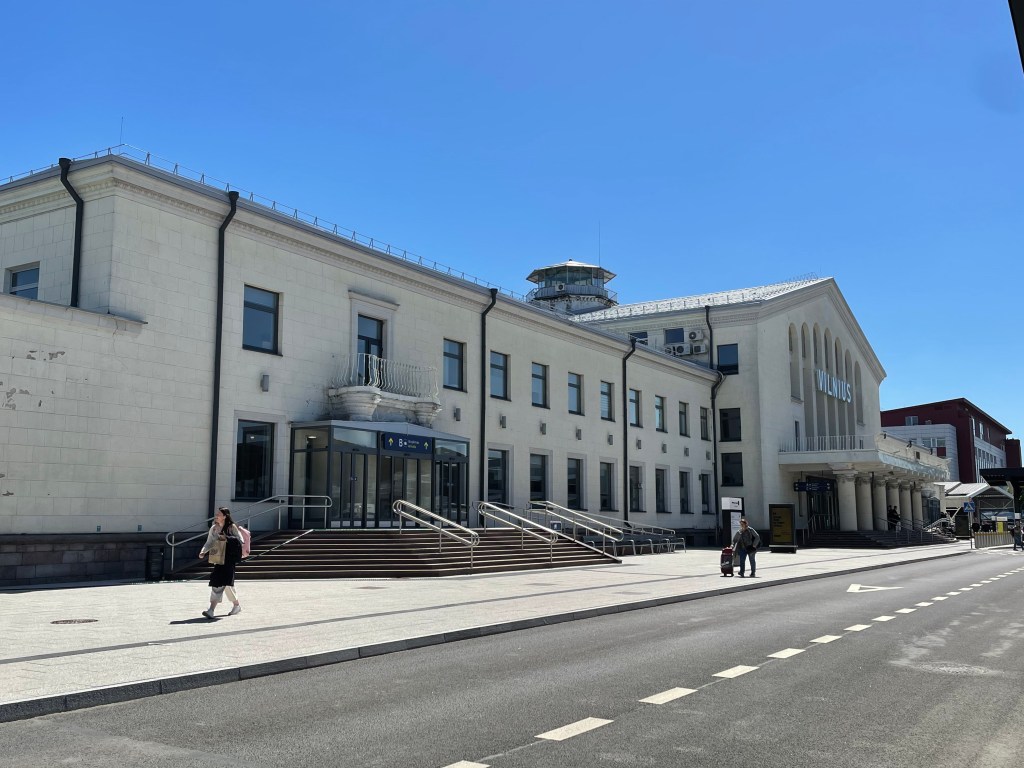
As I’m at the very back, I patiently wait to shuffle off the plane. The airport is small, but charming, and seems to have been built before airport design became a big thing because it feels more like a normal building and not like every designed airport. Designed airports feel like massive sheds made of steel and glass, less a transport hub and more a bunch of architects showing off at enormous expense.
Vilnius Airport isn’t that, it’s a regular building with columns and normal-sized rooms. I like it, and wonder why other airports don’t go down the route of being made out of nice buildings.
Vilnius
I came to Vilnius in 2016, and back in those crazy pre-pandemic days I had more time and did the proper walk around the old town, bought gifts made of Baltic amber and went for a lovely run in the gorgeous Vingis Park.
The city is built where the Grand Duke of Lithuania (Gediminas) was leading a hunting party that had to camp overnight. That night the Duke dreamed of an iron wolf atop the hill where the castle now stands, and this dream was interpreted as a message from the gods to build the capital of his duchy on this spot. The castle was built, and Gediminas invited people to settle there, including Jews and Germans, an early example of multiculturalism.
On this visit, I don’t have time for history and exploration, it’s just a quick couple of days with lots of work.
Well, work plus ribs and red wine.
I love ribs, but am trying to eat less meat, and nudge myself in the direction of (flexible) pescatarianism, at least in principle. Mostly I do quite well, but the hotel restaurant was called The Rib Room and everyone wanted ribs, and ribs need red wine … and so on my final evening, when everyone else had gone home and I was on my own, I swear off both alcohol and meat and brave the rain-sodden world beyond the hotel doors.
Kamanių Šilelis (The Pinewood of Bumble Bees)
I like to explore the local music scene when I travel, and although people may get a little sniffy about the idea of bands coming from less-obvious places like Lithuania, there are musical gems to unearth everywhere you go.
The idea that decent bands only come from Anglo-sphere countries like the USA or the UK is outdated, but has historical substance. Even now there are relatively few bands on the international stage that are not from those same few countries – of the top 50 best-selling artists according to Wikipedia – only five are not from the UK, USA, Australia, Canada or Ireland (they are Rihanna, ABBA, Julio Iglesias, Roberto Carlos and Nicki Minaj) – and so you can see why people might lack musical curiosity when travelling beyond that cluster of countries.
I reckon this is because what has become international pop music is based on American styles of jazz, country, blues and gospel, developed and popularized by British bands in the 60s and 70s. It took other countries a long time to get involved – some resisted this cultural take-over of lowbrow pop with formal measures, banning imports and radio play of foreign sounds with their lewd dance moves and suggestive lyrics; others were more subtle, instead choosing to actively preserve their own country’s folk traditions and not be overwhelmed by the tidal wave of creative populism.
My interest is exploring what people in different countries feel inspired to play. Naturally, if you’re from Lithuania, you cannot fail but have something of your country’s musical traditions running through your veins, and as long as it’s an influence not a restriction, a springboard not a cage, then I’m all ears.
So, my search for new music when I travel is a culturally-agnostic exploration for anything I like. In this case, I used this article from Louder Than War as my main reference, and was drawn to Kamanių Šilelis (The Pinewood of Bumble Bees).
As I head out the hotel and down the street, it’s drizzling. I am glad I bought my raincoat – it had felt like a ridiculous encumbrance in the heat of Madrid, but now it looks like the smart move. That’s one problem with travel, you have to dress for the climate at both ends of the trip and be sufficiently layer-ready for a plane that might be freezing cold or stiflingly hot.
I walk over the river and turn right, cross the road and go into iMuzika. There’s a young girl with a guitar on her back buying CDs, and I think how brilliant she is. Thirty years ago I might have deployed one of my trademark flirting techniques, like standing nearby looking terrified. I don’t do this because I am a middle-aged man and am well aware that however young I might feel on the inside, I look like someone’s ill-kempt Grandpa on the outside.
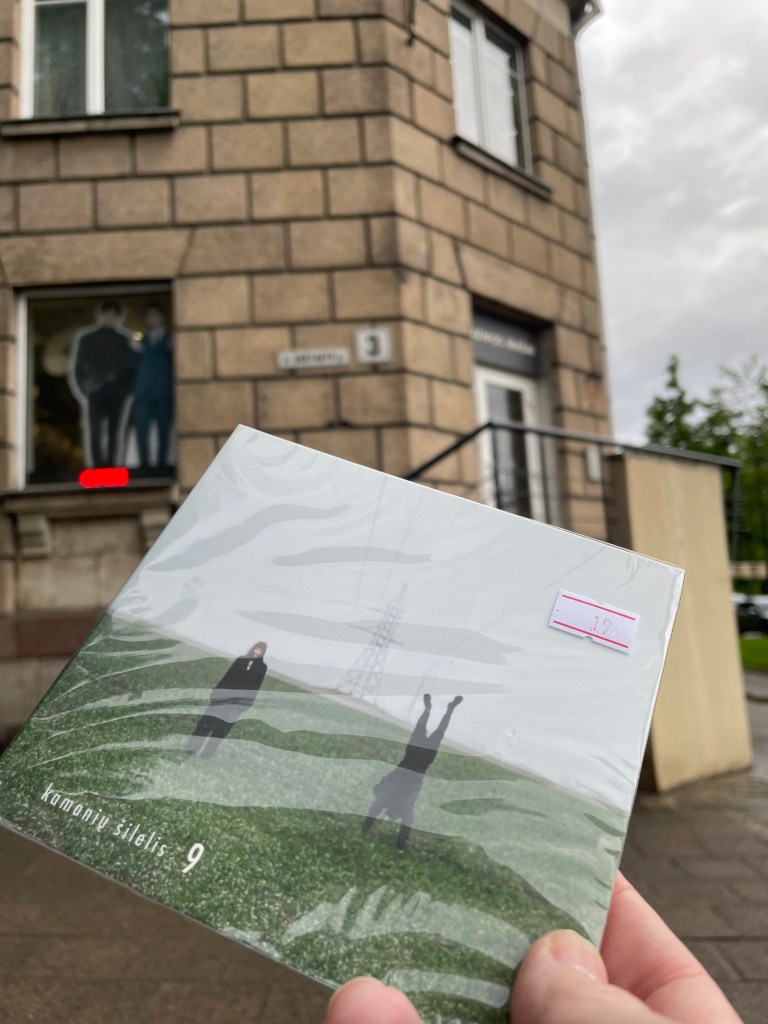
I can’t find anything by Kamanių Šilelis and so decide to ask, which involves showing the words to the man in the shop because I don’t think me trying to pronounce them will do much good.
Unable to process the decision properly, I buy 91 at random to conceal the fact I can’t make decisions.
I head up a street or two and pass a craft beer pub. I ask if they serve food, and the man says, “no, only sex” by which I assume he means “no, only snacks” – either way, it’s not what I’m looking for and I continue.
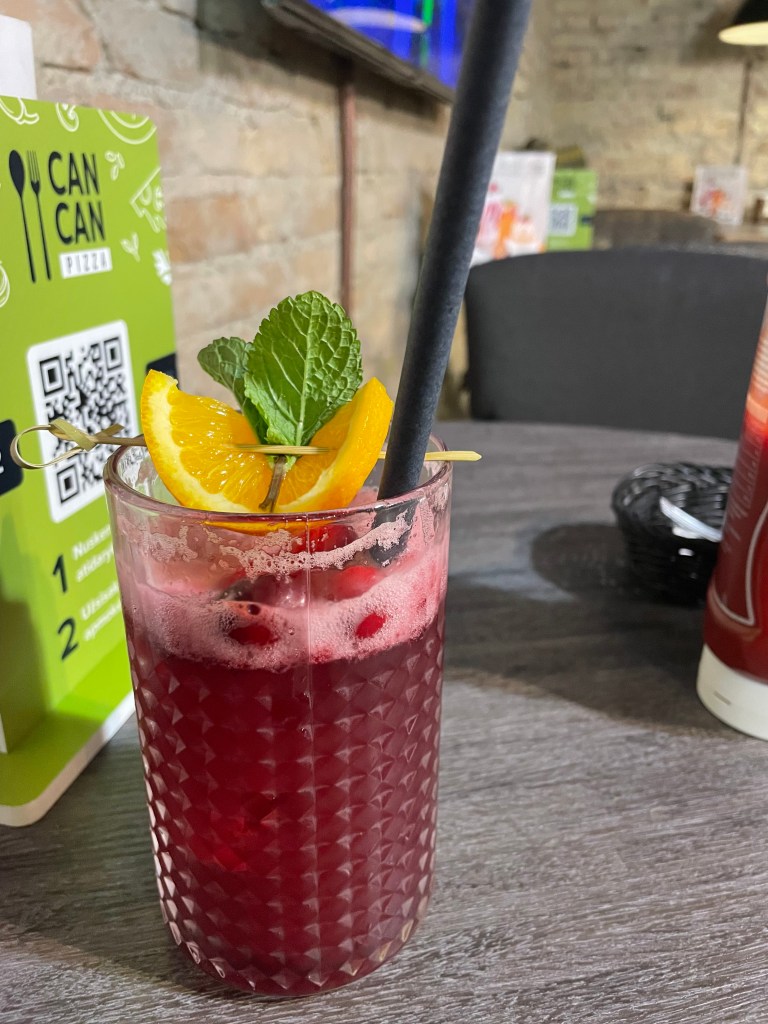
I settle for a thin mushroom pizza with a blackcurrant lemonade and read my book, before heading back through the rain to my hotel.
The next morning I have a bit of time before I need to head to the airport and so I go for a walk by the Neris River and up past the castle to the cathedral with its tower standing separate from the main church building. The river Neris rises in Belarus, and flows into the Neman, a pretty big river that also rises in Belarus before going on to form the border with Russia’s Kaliningrad oblast. It’s easy to forget where you are, Vilnius feels like a typical northern EU city, yet here we are, nestling between Belarus and a bit of Russia.
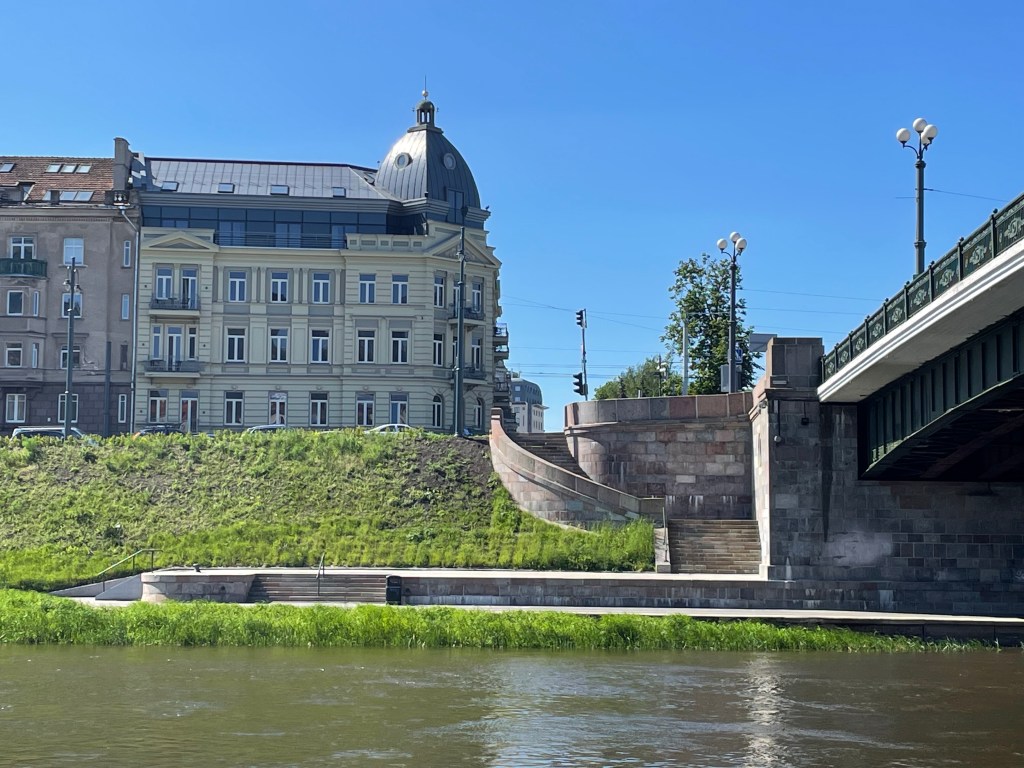
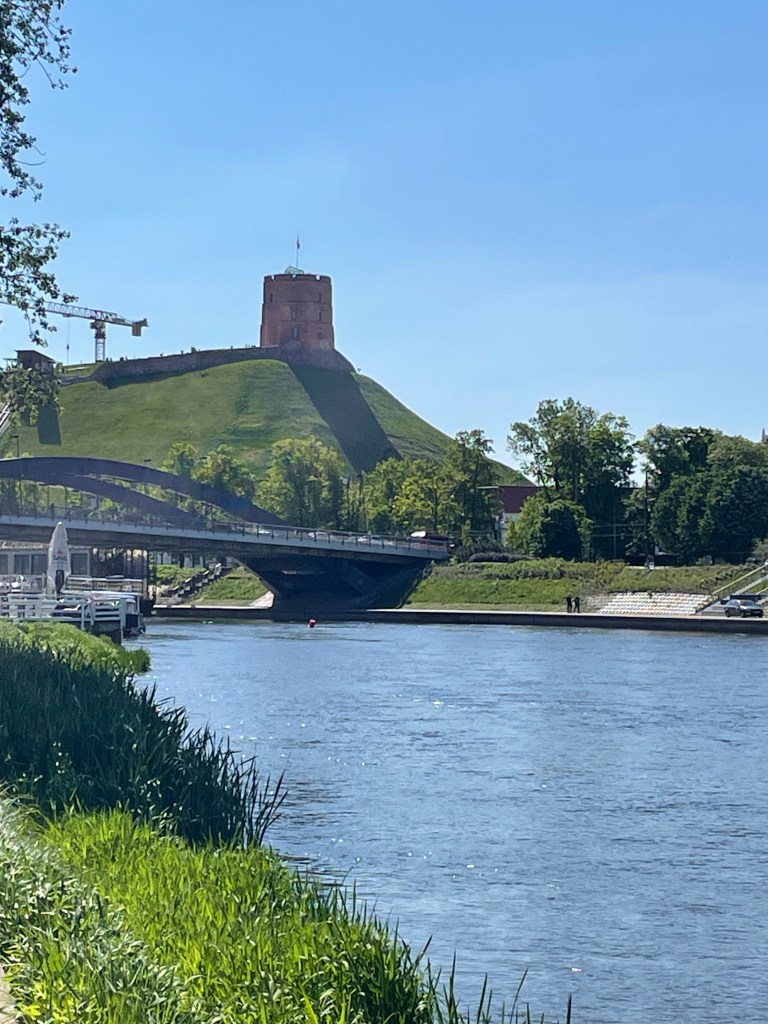
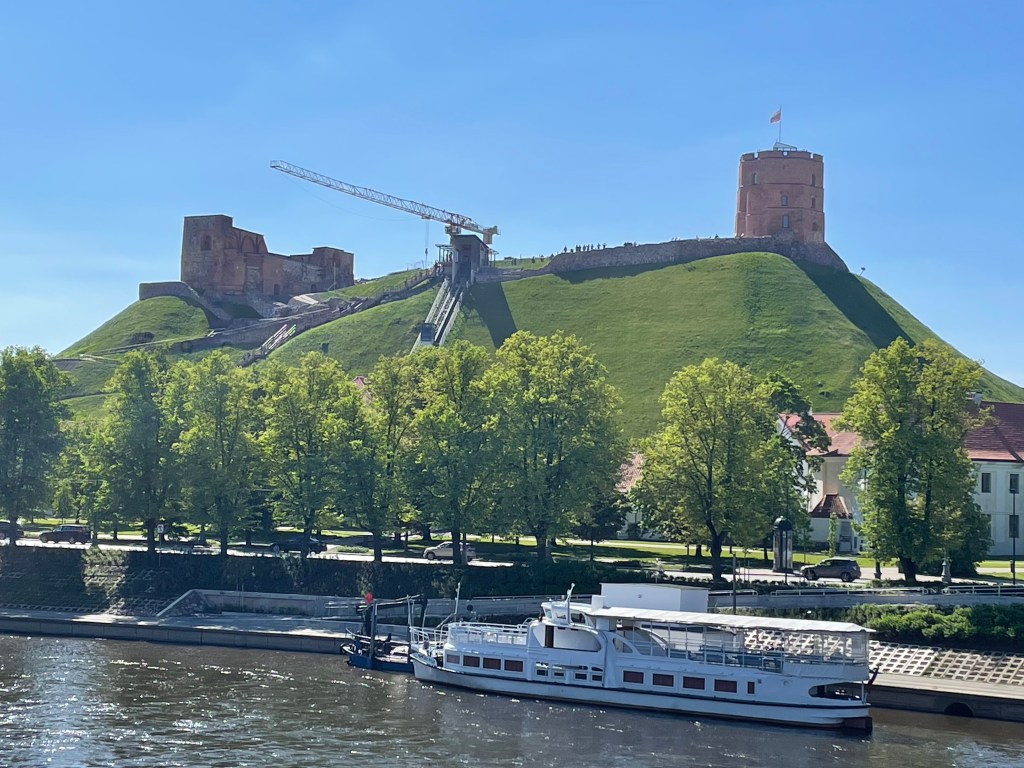
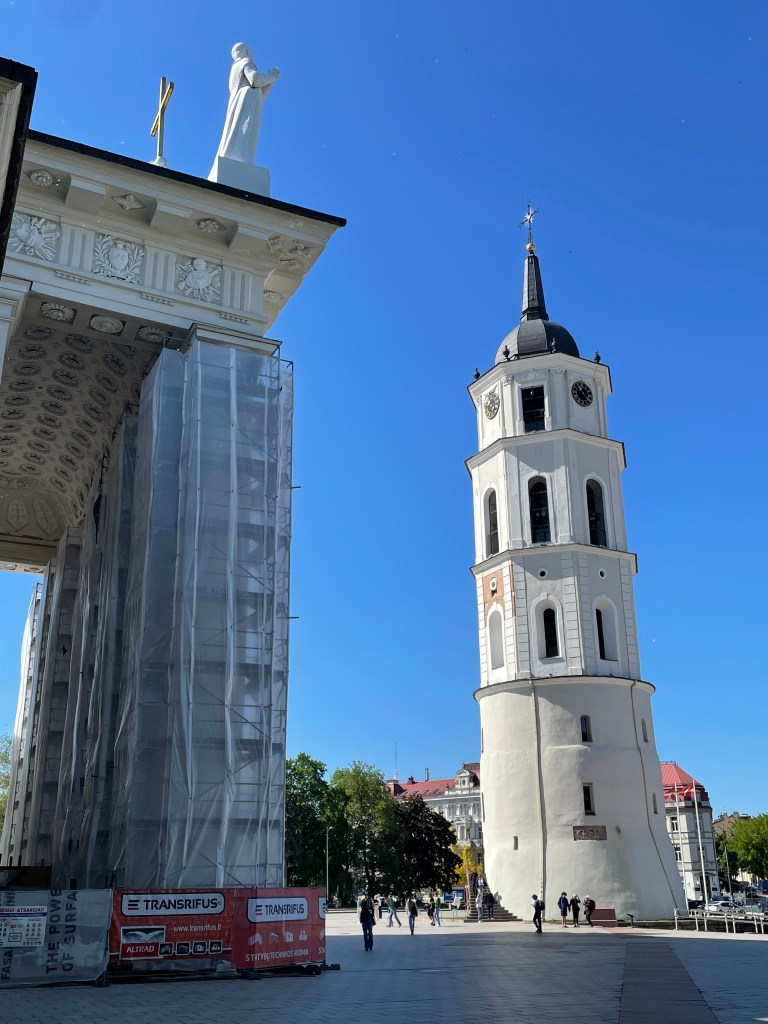
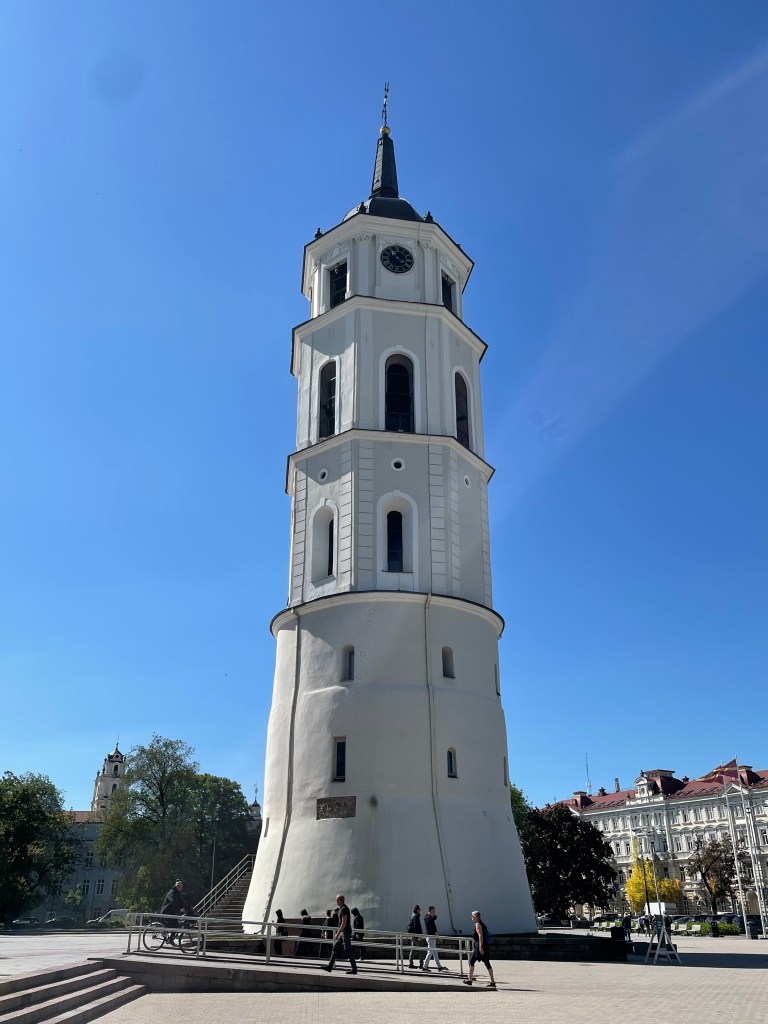
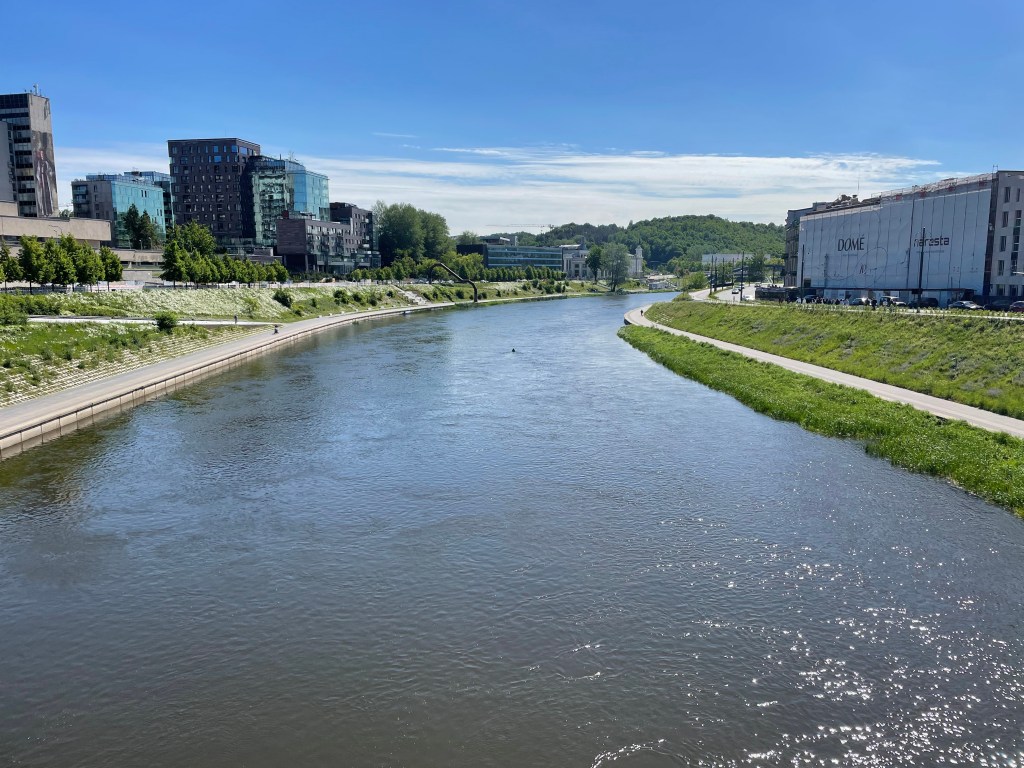
I don’t have time to explore the old town or do anything other than head back to the hotel, check out, and get up to the airport.
The airport is made of two halves: the old quaint Arrivals bit I already mentioned, and the fancy new Departures hall.
I go in, and there’s music, and it’s brown – in a good way – like a welcoming bar, a very human space, not a big glass-and-steel barn like most airports.
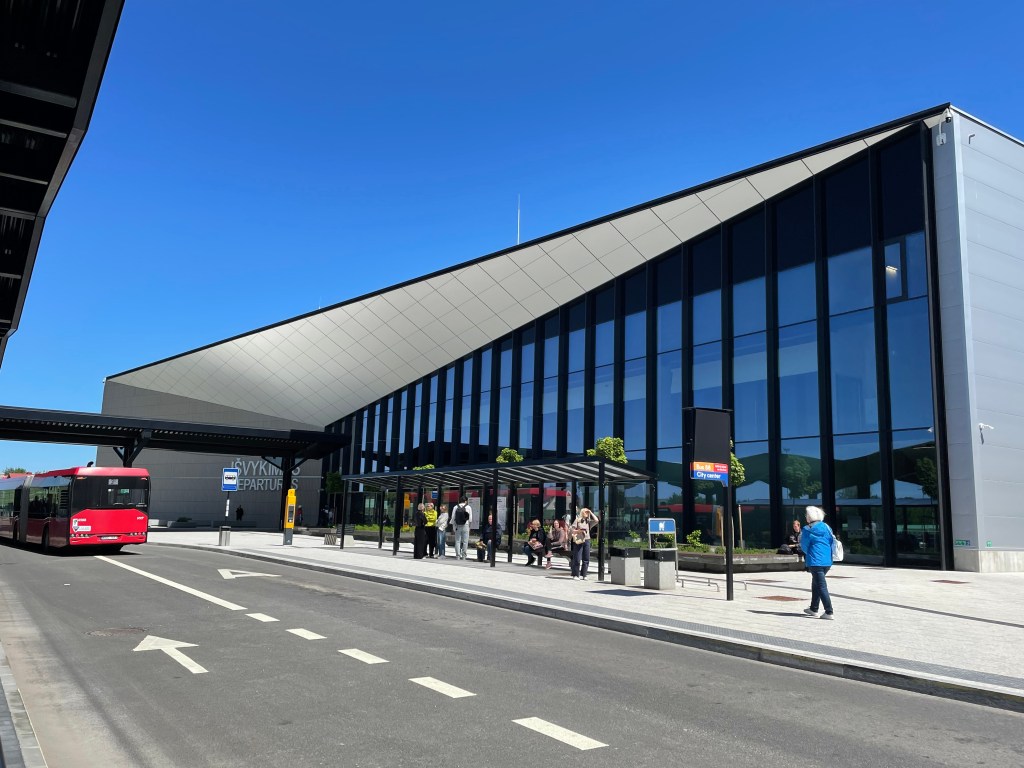
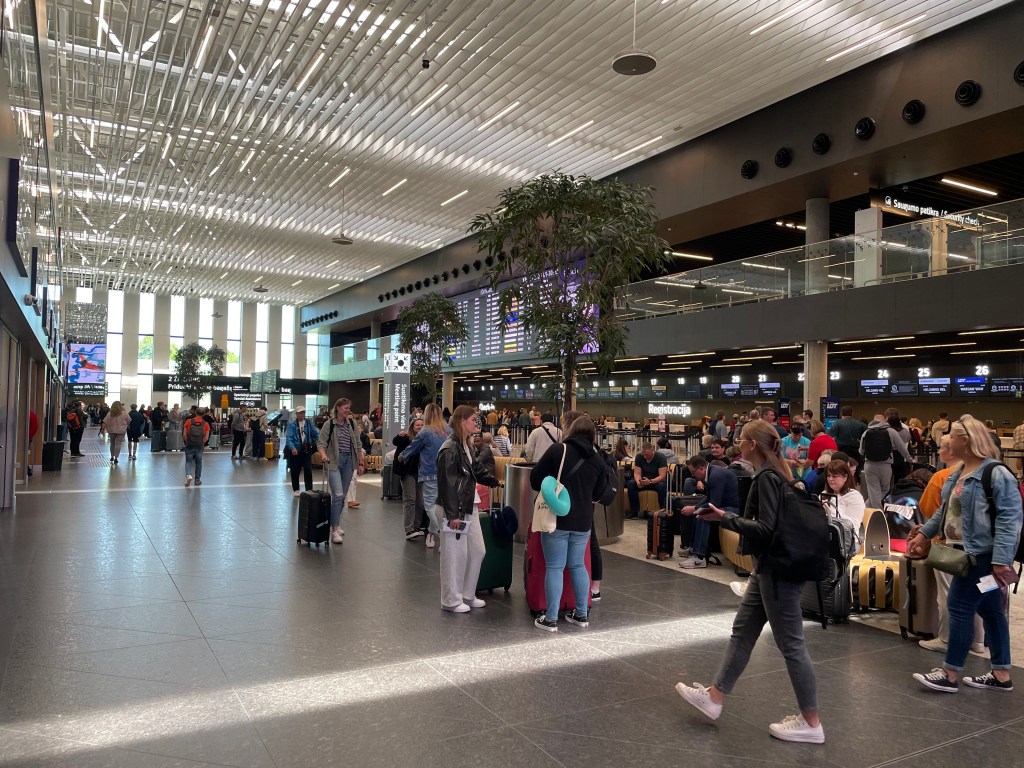
I go through security (thankful I don’t have to empty my case of computers, Kindles and liquids) and find the gate where my Air Baltic flight is not yet ready.
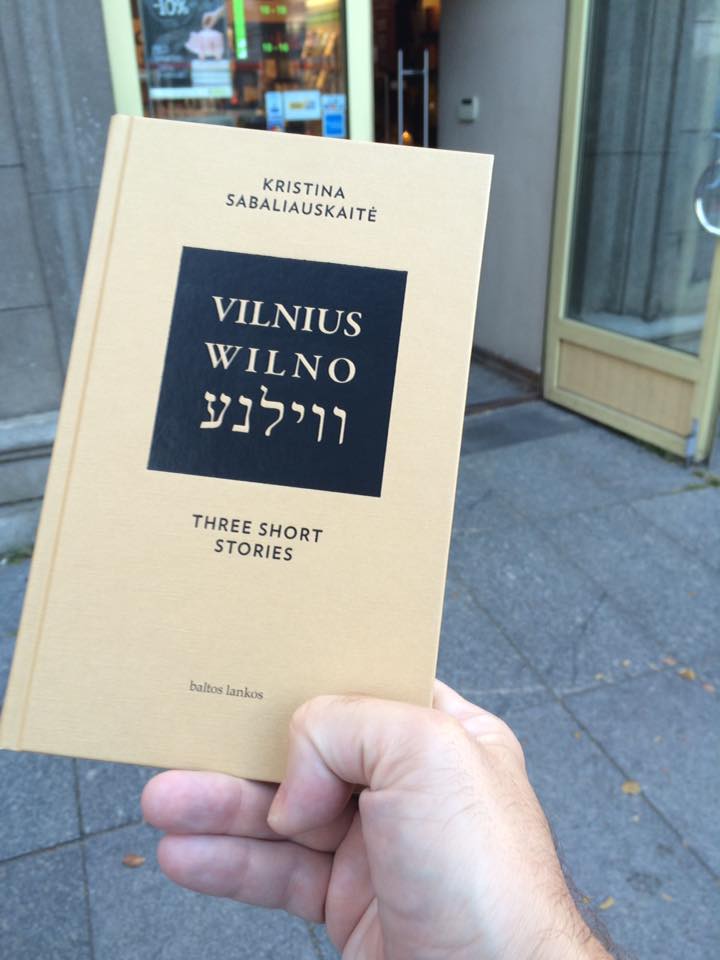
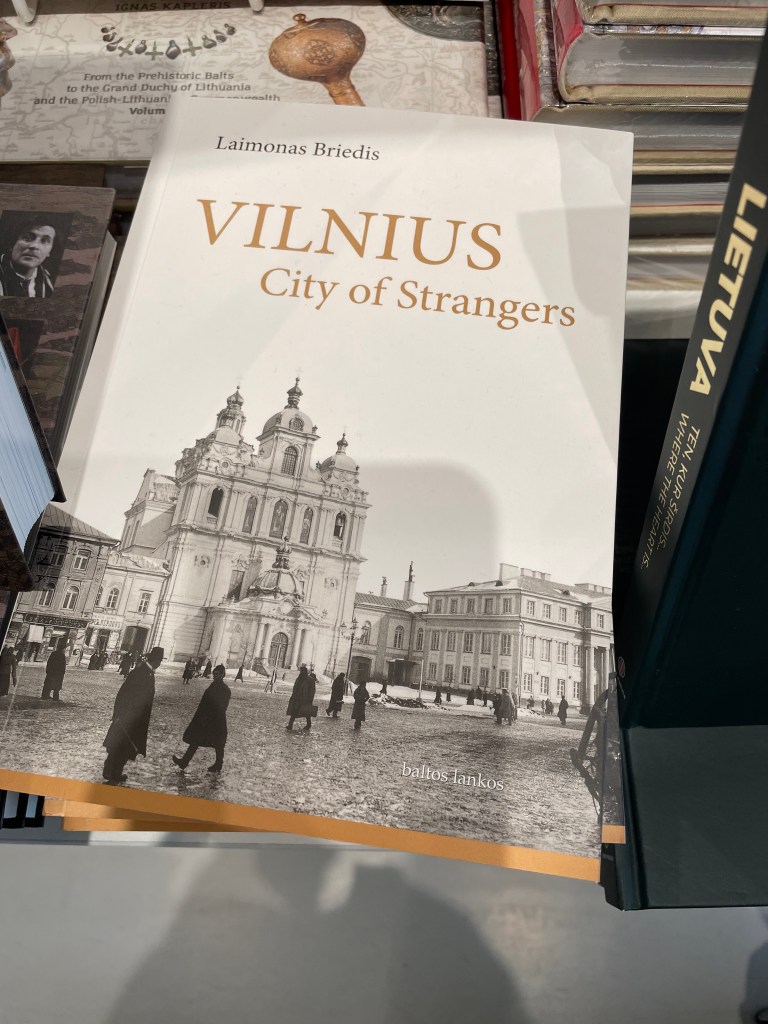
I browse the bookshop, and notice a big pile of Vilnius. Wilno. Vilna by Kristina Sabaliauskaitė. I bought this lovely little book of short stories when I was here in 2016, and it’s a great way to understand how this city is made of distinct communities and traditions: Lithuanian, Polish and Jewish – plus Russian influence. The three stories are from each of those perspectives, and why the city is sometimes called “the city of strangers” (not in a bad way, more in the sense that these communities are quite distinct).
I regret not buying the book of the same name, but with my luggage creaking at the seams, I decide to leave it, knowing the pile of unread books in my study is already unwieldy and daunting, it doesn’t need adding to.
The return flights to Amsterdam and on to Madrid are like most flights in that nothing enjoyable happens, although both are at least empty enough to be almost comfortable, at least insofar as a flight in Economy Class ever can be. Not a single interesting thing happens worth blogging about, not even if I exaggerate – unless we count the chatterbox woman with a voice like a diamond drill in the row in front. She is very attractive, and needs to be; her (also very attractive) boyfriend is very patient, and he needs to be.
Maybe the problem isn’t strangers, maybe it’s that modern life no longer lets us ignore each other.
Alas, that is the end of this post, but there is more! When I visited in 2016, I had gone for a run, and blogged about it at the time, and so I include it here for your reading pleasure:
Runs in different places
To paraphrase Mark Twain, a run is something I want to have done, but not something I want to do.
I am only able to run because I never decide to go running. Instead I put on my running gear, walk to the place where the run is set to start, and then start running. At no point do I ask myself “Shall I go for a run?” because I know the answer will be “Absolutely not, there’s the news in Lithuanian on, and I don’t want to miss it”
Once I start running, my body fights back, making it clear that running is not on its priority list. If I push past that, I get into a rhythm and soon I’m enjoying myself and able to feel smug in the way only people doing cardio exercise can.
I also love running as a way of seeing a different side of a city. It is a simple low-tech way of getting around, so much more straightforward and under my control than public transport or even riding a bike, although both can be fun too, depending on the traffic and the hills.
And so, as I finished the first day’s work in Vilnius, I decided to put my running gear on and stand by the river. Some people were going for drinks after, but as I am not into the consumption of vast quantities of alcohol, and had already traced the running route I wanted to do, I decided to skip drinks and stick to my plan to wear running gear next to the river.
As is inevitable, once I’m there, in my running togs, I start running.
The river was not so nice. It was trapped in a concrete channel as it looped through the city, strictly kept in its lane, unable to make new meanders that might disrupt the city structure. This was a few metres below the city proper, meaning all but the most abundant floods could be held within its banks.
I took the steps down to the river level and started jogging west, toward a large park I’d seen on the map. There weren’t many people around as I followed the gentle curve of the river, and it was nice and peaceful to be plodding along, hearing the traffic noise in the background, but feeling far away from it.
After about three kilometres the path rose away from the river toward street level, and I gently jogged upwards, pacing myself, unsure how much of a hill this was. It wasn’t much, and soon I was running next to a busy road but I could see the park ahead, and in a minute or two I was in it and away from the traffic again. It was wonderful! So peaceful and beautiful in the evening sun. This part was heavily wooded, although it seemed to open out up ahead, so I ducked down a path to the right that went back downhill toward the river and deeper into the woods.
I was guessing the route, but had guessed correctly, and after about ten minutes of glorious peace, I emerged by the bridge I had been aiming for. I crossed the river and turned right into a small green space, hoping to trace my way back on the opposite bank of the river. This wasn’t so easy, there was no way down and seemingly no path. I ran on, feeling increasingly unsure of what I was doing, but confident I knew more or less where I was. There were dogs, large black labradors I think, and no owner, and I suddenly worried that they might attack me, and if they did, I wouldn’t have many options other than to shout “sit” at them and hope they were domesticated enough to pause for thought when a human barked an order at them.
I ran around the back of a school, and deep into some more woods, this time they were wilder, with thorny brambles everywhere. This was the kind of place people might come for obscure sexual trysts or drug taking, although there was no evidence of either. It was feeling more and more like a dead end, and so as soon I could I made it onto a street, and ran in the general direction I imagined the river to be. This is not so obvious because rivers don’t run in straight lines, not even ones held in concrete channels, but I found it … although the river was on three sides of me at that point, so finding it was probably less of an achievement than it sounds.
Thankful to be back by the river, and now running along its bank at the lower level, it was easy to get back to the hotel. This side was less well-maintained, and so I had to be more careful in spots, but, with the sun shining and the castle in the distance, I felt elated at having almost made it back, and having done enough exercise to justify a beer and a pizza.

- It is good, a little rough around the edges in places, but an enjoyable electro-indie sound with interesting instrumentation, and a little Lithuanian folk rippling through. A good choice. ↩︎

